
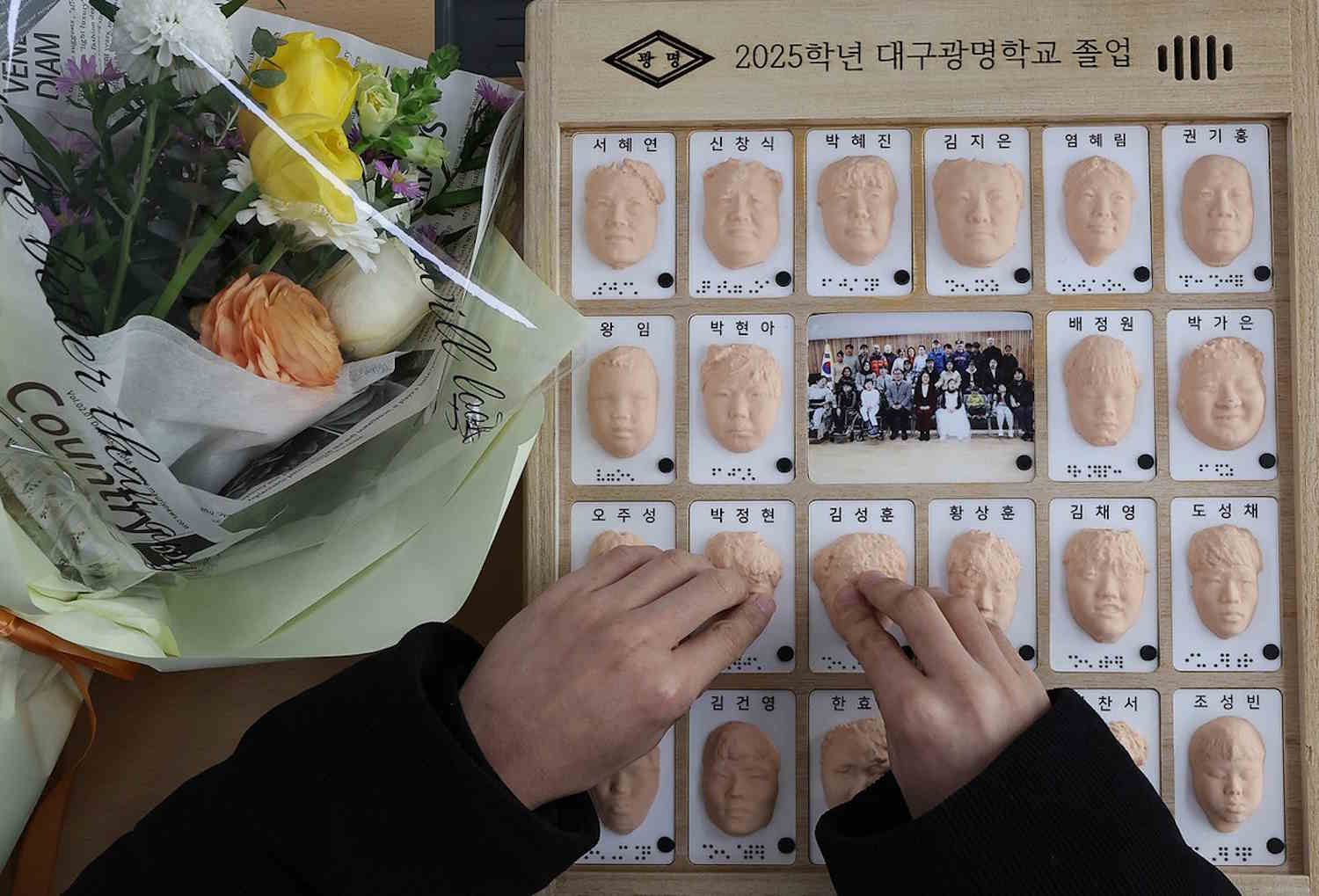
Technology, when driven by empathy, can truly change the way people live the most important experiences. This is what happened in South Koreawhere a school for blind and visually impaired students transformed a symbolic object such as the end-of-year yearbook into a tangible, emotional and inclusive memoryaccessible even to those who cannot see.
The initiative was born within the Daegu Kwangmyung Schoolan institute specializing in the education of blind and visually impaired students located in the city of Daegu. Here, teachers and technicians have decided to overcome the limits of traditional albums, which for these students have always been reduced to simple Braille pagesdevoid of any visual or physical reference to people’s faces.
Thanks to the use of Very high resolution 3D scanner and of three-dimensional printersthe school created end-of-year albums containing relief portraits of classmates. Each face is reproduced in the form of a tactile bas-relief, allowing students to explore with their fingers the distinctive features, expressions and even smiles of the people with whom they have shared years of school.
An idea born from the collaboration with an American university
However, the idea was born on the other side of the world. In 2018, a team of Mercer University faculty and engineering students collaborated using 3D printers to create “3D Touch Yearbooks” for students at Georgia Academy for the Blind in MaconGeorgia. Since then, over 35 yearbooks have been produced for visually impaired students, creating memories that can be cherished for a lifetime. The project was then implemented on the Mercer On Mission trip to South Korea, where team members created 3D yearbooks and 3D family photos for visually impaired students at the Drim School he went to taught and passed on the 3D printing process, so you can continue the project even after the trip ends.
The goal was to share this research with schools and centers around the world, to create yearbooks and keepsakes for visually impaired young people.
How 3D end-of-year albums work
The process is as sophisticated as it is delicate. Students are subjected to a three-dimensional scan of the facecapable of capturing even the smallest variations in features. The digital data is then processed and transformed into printable three-dimensional modelsoptimized to be read by touch.
The end result is an album that doesn’t just tell a story, it makes it happen physically perceivable. Alongside the portraits in relief, there is obviously the text in Braille, which accompanies the experience and provides names, dates and dedications, integrating words and tactile sensations into a single object. For many students, it is the first opportunity ever to “feel” the face of a frienda classmate or a loved one met during school.
A profound emotional impact
The most powerful aspect of this project is not only technological, but emotional. End of year albums are not simply school products: they represent a shared memoryan object that accompanies students well beyond graduation. In the past, blind students could only retain abstract memories, relying on words. Today, however, they can associate a name with a shape, a friendship with a face, a smile with a recognizable surface under their fingers.
It is a change that strengthens the sense of belonging and identity, making the school experience truly equal compared to that of sighted students. Not surprisingly, the initiative was welcomed as a virtuous example of inclusive education and emotional storytelling applied to school.
A model that looks to the future of accessible education
The Daegu Kwangmyung School project is part of a broader context of technological experimentation in the field of special education in South Korea. In the past, similar initiatives have involved universities, research centers and educational institutions, but they have rarely managed to combine so effectively technical innovation and human value.
The international resonance obtained by the initiative demonstrates that accessibility is not a limit, but a push for innovation. Transforming digital data into tactile memories means completely rethinking the way in which technology can be put at the service of people, especially those who most easily risk being excluded. These 3D albums tell a simple but often forgotten truth: innovation is at its best when it leaves no one behind.
