

You open Instagram, look for some videos about football, put five likes and keep scrolling. Nothing particularly strange, except that in less than a minute and a half the algorithm can start serving you toxic contentbetween models of dominant masculinity and gender stereotypes. And, within a few minutes, the openly misogynistic videos also arrive.
This is what happened during an experiment conducted by ActionAidwhich in the new report Suggested for you. Manosphere, femosphere and primary prevention of gender violence in Italy analyzed how social media recommendation systems can encourage the spread of anti-feminist content, even among people who have never explicitly searched for it.
The research highlights an often underestimated phenomenon: the misogyny online no longer hides only in extremist forums, but mixes with motivational videos, relationship advice, fitness, personal growth and daily entertainment. And it can even become a profitable business.
What ActionAid discovered
To understand how the mechanism works, ActionAid created four experimental Instagram profilestwo male and two female, all with a declared age of 21 years. Two accounts carried out searches and interactions, while the other two were used as control profiles, without searches or likes.
Between 10 and 21 September 2026 they were analyzed as a whole 1,400 Reelsstarting from apparently neutral topics such as football, video games, finance, gym and personal care.
The active male profile results are:
The path identified by the researchers is gradual: it starts from contents that exalt discipline, economic success and male strength to arrive at narratives in which women are described as obstacles, enemies or trophies to be conquered.
It doesn’t mean that every research on football inevitably leads to misogyny (the study is a pilot investigation, conducted on a limited number of experimental accounts), but it shows how quickly a recommendation system can amplify certain messages in response to user interactions.
What is the manosphere
With the deadline manosphereor manosphereindicates a galaxy of online communities united by anti-feminist narratives, in which men are often presented as victims of female emancipation. It includes environments linked to incels (acronym for INvoluntary CELibate, or “involuntary celibate”, groups of men who meet online and who stand out for their misogynistic and anti-feminist ideas), to the culture of the alpha man and to movements that claim male rights by contrasting them with those of women.
But the most interesting data from the research concerns precisely the way in which these messages are spread: of the 100 Instagram profiles analyzed, only 49% explicitly deal with manospheric themes. The remaining 51% includes lifestyle, dating, fitness, personal growth, media and general information pages, which can act as a bridge to much broader audiences.
And you don’t even need to raise your voice. Only 6% of profiles use openly aggressive language: informative tones prevail (31%), coaching (22%) and irony (15%). In 37 profiles out of 100, feminism is delegitimized, while 34 build a narrative of man as victim, often through themes such as false accusations of violence, the courts or separated fathers. The result is a misogyny that is not always immediately recognisable, because it can come in the form of a joke, advice or an alleged defense of true equality.
And if you are a woman?
Instagram suggests a completely different reality to you. In fact, the experiment also highlighted profound differences in the contents offered to male and female profiles. When they both tried datingi.e. content about romantic relationships, the men’s feed received 82% of videos classified as toxic and 30% openly misogynistic. In the female profile the percentages were 16% and 0% respectively.
But this doesn’t mean that women are only offered harmless content. In fact, the research also describes the femospherea digital ecosystem that promotes rigid models of femininity, linked to beauty, home care and traditional roles.
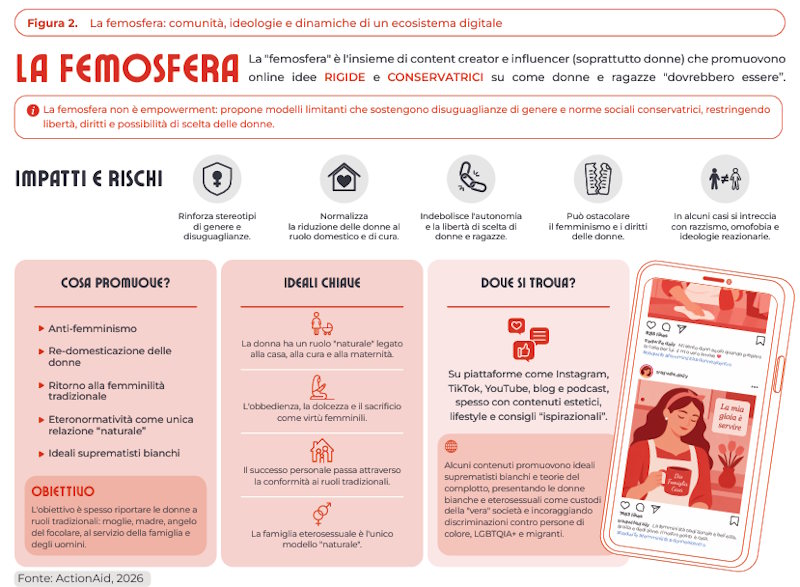
Even in the control profiles, who had not carried out searches, over a third of the contents suggested to women concerned cooking, home and care, compared to 9% of those proposed to men. There were 97 videos dedicated to cleaning and the house in women’s feeds and just two in men’s.
In essence, according to ActionAid’s analysis, recommendation systems can help reproduce two different models: on the one hand the dominant and competitive man, on the other the woman who must be attractive, nurturing and focused on the domestic dimension.
Misogyny is also a business
Making the phenomenon even more complex is its economic dimension. Nearly half of the posts examined in the in-depth analysis are designed to provoke reactions and increase visibility. AND approximately one in seven posts links to paid productsfrom seduction courses to books, to subscriptions and consultancy.
Provocation generates comments, comments fuel attention and that visibility can turn into a commercial opportunity.
Furthermore, there is no shortage of female creators: almost a third of the individual creators mapped in the manosphere are female, including anti-feminist influencers and figures who promote traditional relational models. The phenomenon also takes different forms depending on the platforms. On Instagram, informative language prevails, on TikTok content on relationships dominates, while on Facebook the aggressive register is much more frequent.
Three days after the conclusion of the searches, ActionAid reopened the profiles without carrying out any new interactions. In the male feed, 90% of the contents were still classified as toxic and the share of overtly misogynistic videos had risen from 46% to 57%. Even in the female profile, the contents that promoted patriarchal models of femininity had increased, going from 26% to 40%.
Research shows that misogynistic content enters the screen even of those who are not looking for it, he points out Katia Scannavini, co-secretary general of ActionAidrecalling the responsibility of platforms and institutions in preventing digital violence.
What to stop the spread of online hate?
According to ActionAid, removing individual violent content is not enough. It is also necessary to intervene on the cultural and technological dynamics that favor the spread of stereotypes and discrimination. For this reason, the organization asks the Government and Parliament for a national plan for the primary prevention of gender violence, with specific measures for digital environments, stable resources and verifiable objectives.
Among the proposals are: allocate at least 40% of anti-violence funds to primary preventionestablish a permanent technical table and rigorously apply the Digital Services Act, the European regulation which introduces obligations for digital platforms, including regarding systemic risks.
An important occasion will also be the transposition of the European Directive 2024/1385 on violence against women, expected by 14 June 2027.
In Naples the Patriarchate Museum
The report Suggested for you it is finally at the center of the third edition of MUPA, Patriarchate Museumhosted in Naples from 12 to 25 November at La Santissima Community Hub, with the patronage of the Municipality.
HERE all the information.
The project transforms stereotypes, behaviors and discriminatory narratives into symbolic artefacts of a past to be overcome. The 2026 edition includes 26 works, two of which are unpublished, and a calendar of meetings, workshops and free shows.
HERE you can find the full report.
