
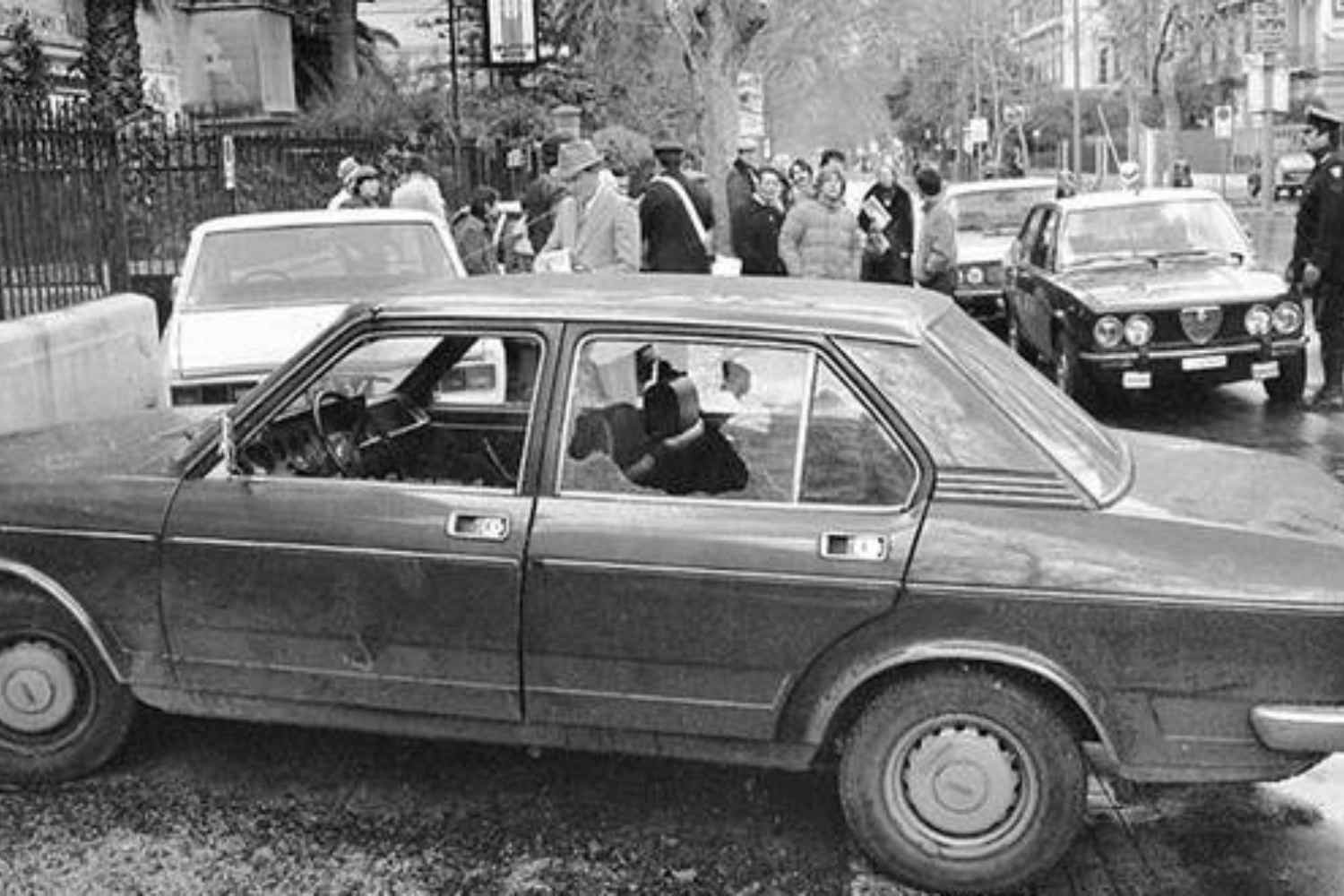
The crime of January 6, 1980
On the morning of Sunday 6 January 1980, in via della Libertà in Palermo, Piersanti Mattarella was murdered while on his way to mass together with his wife Irma, his daughter Maria and his mother-in-law. Driving his Fiat 132, the president of the Sicilian Region was hit by numerous 38 caliber pistol shots fired through the window by a gunman who approached on foot. After the first shots, the killer walked away to receive a second weapon from an accomplice in a white Fiat 127, then returned to fire more shots. His wife Irma was injured in the hand while trying to protect her husband.
The Fiat 127 used for the escape was found in the early afternoon about 700 meters from the crime scene, with counterfeit license plates. Investigations revealed that the car had been stolen the previous evening a few hundred meters from Mattarella’s home, as had the license plates used to alter the original number plate. All the places involved in the preparation of the crime were located in an extremely limited area, a sign of careful planning and in-depth knowledge of the area.
An inconvenient politician for too many
Piersanti Mattarella represented an innovative political figure in the Sicilian Christian Democratic panorama. A student of Aldo Moro, he had given life to a revolutionary political experiment in February 1978: a regional government with the external support of the Italian Communist Party, the so-called Autonomist Solidarity. This experience, started just a month before Moro’s kidnapping, was destined to create strong tensions both within the DC and in relations with Cosa Nostra.
In the interview given the day before the murder to the Giornale di Sicilia, Mattarella had highlighted the difficulties of the Sicilian political and economic situation. The decade of the 1980s opened with the energy crisis following the Khomeini revolution in Iran, the Soviet invasion of Afghanistan and the decision to install NATO missiles in Comiso. In this complex context, Mattarella argued the need for a stable and effective regional government to address the island’s problems, from economic marginality to growing unemployment.
The turning point against mafia and clientelism
The real breaking point with Cosa Nostra came when Mattarella decided to radically change his political line. After initially having maintained relationships with environments close to the mafia through his father Bernardo’s family connections, the President of the Region distanced himself from these ties and undertook a battle for legality and the renewal of the Sicilian public administration.
Mattarella strongly opposed the return of Vito Ciancimino to the governing bodies of the Palermo DC and began to combat the system of rigged tenders that fueled mafia interests. At the end of 1979 he had asked the national secretary of the DC Benigno Zaccagnini for the commissionership of the Provincial Committee of Palermo, believing that Ciancimino, political representative of the Corleonesi, was regaining too much influence in alliance with the Andreotti current.
The first reactions: mafia, terrorism or both?
Immediately after the crime, claims came from alleged neo-fascist groups, fueling the hypothesis of a terrorist attack. However, the manner of execution left observers perplexed. Leonardo Sciascia, already the next day, alluded to possible links with the Sicilian mafia, while Cardinal Salvatore Pappalardo in his funeral homily strongly argued that there must also be other occult forces, external to Sicily.
Francesco Cossiga put forward the hypothesis that the mafia had wanted to punish Mattarella for his unwillingness to grant compensation after the electoral support guaranteed to the DC. Others, such as the French agent Pierre de Villemarest, suggested a complex alliance between the mafia, the P2 lodge and right-wing subversion, with possible international connections.
Falcone’s investigations: the black-mafia trail
The investigations proceeded with great difficulty. The first significant contribution came from Cristiano Fioravanti, brother of the leader of the Nuclei Armati Rivoluzionari Valerio Fioravanti. After his arrest in April 1981, Cristiano began to collaborate with the judiciary, indicating his brother Valerio and Gilberto Cavallini as possible perpetrators of the Mattarella murder, in connection with far-right circles in Palermo.
According to the investigative reconstruction, the black terrorists would have received logistical support from local exponents of Third Position, in particular Francesco Mangiameli, later killed by the Fioravanti brothers in September 1980. The investigations ascertained that family members of Gabriele De Francisci, a FUAN militant, owned apartments a few meters from the site of the ambush, offering a possible base of operations to the killers.
Giovanni Falcone elaborated a complex theory that saw cooperation between Cosa Nostra, in the person of Pippo Calò as ambassador of the Corleonesi in Rome, the circles of neo-fascist terrorism, the P2 lodge and the Banda della Magliana. His 1690-page indictment, filed in March 1991, represented the last investigative act before his death in the Capaci massacre.
The contradictions of mafia turncoats
In parallel with Cristiano Fioravanti’s statements, several mafia justice collaborators provided contradictory versions about the instigators and perpetrators. Tommaso Buscetta claimed in 1984 that the murder had been decided by the Cosa Nostra Commission without the knowledge of Stefano Bontate and Salvatore Inzerillo, bosses who later found themselves at odds with the Corleonesi.
Francesco Marino Mannoia instead claimed that Bontate was not aware of the operation and appeared particularly upset by what had happened. Only after Falcone’s death in 1992 did Buscetta reveal new details: Mattarella, initially close to Cosa Nostra, had changed his attitude, becoming rigorous and intransigent, especially after the murder of DC secretary Michele Reina in March 1979.
Marino Mannoia in 1993 added an explosive element: in the summer of 1979 a meeting was held in a Sicilian hunting reserve between Giulio Andreotti, Stefano Bontate, Salvo Lima and other political and mafia representatives, during which everyone complained about Mattarella’s behaviour. A few months later the murder was decided with the consent of all the members of the Provincial Commission of Palermo.
The trials: convictions for the mafia, acquittals for the terrorists
The first degree trial for the Mattarella-Reina-La Torre political crimes opened in April 1992. In 1995 the sentence sentenced the leaders of Cosa Nostra – Salvatore Riina, Michele Greco, Bernardo Provenzano, Giuseppe Calò and others – to life imprisonment as instigators of the murder. However, the black terrorists Valerio Fioravanti and Gilberto Cavallini were acquitted of the charge of being the material perpetrators.
Mattarella’s wife had recognized Fioravanti as the murderer, as had Michele Reina’s wife for the 1979 ambush. Cristiano Fioravanti had also accused his brother, although he interrupted his collaboration in 1990 so as not to continue accusing Valerio, a decision motivated by the desire to preserve family relations with his sister Cristina.
However, the court deemed the testimonies against Fioravanti not sufficiently reliable, giving greater weight to the declarations of the mafia turncoats who indicated other possible perpetrators. The sentence confirmed that Mattarella was killed by Cosa Nostra for his work in renewing the regional administration and for his fight against the procurement system controlled by the mafia.
The mystery of the material executors
The perpetrators of the murder have never been identified with certainty. Different justice collaborators have mentioned different names: Francesco Davì, Antonino Madonia, Giuseppe Leggio, Calogero Ganci, Francesco Paolo Anselmo. Francesco Di Carlo claimed that Bernardo Brusca had confided to him that the murderer was Antonino Madonia, and that the black trail would have been started due to the physical resemblance between Madonia and Fioravanti.
In 2018 the investigations were reopened to verify whether the gun used by Cavallini in the murder of judge Mario Amato in June 1980 was the same one used against Mattarella, but the comparison was not possible due to the destruction or consumption of the exhibits. In 2025, the Palermo Prosecutor’s Office entered Antonino Madonia and Giuseppe Lucchese in the register of suspects, already sentenced to life imprisonment for other excellent crimes, on the basis of new evaluations of declarations by collaborators of justice.
The Andreotti trial: failure to report
In the trial of Giulio Andreotti, which ended in 2004 with a final sentence that established the former prime minister’s stable relationship with the mafia until the spring of 1980, the Mattarella murder represented a crucial point. According to judicial reconstruction, Andreotti had participated in at least two meetings with mafia leaders concerning the political actions of Piersanti Mattarella.
The sentence established that Andreotti was aware of Cosa Nostra’s intolerance for Mattarella’s conduct, but did not warn either the interested party or the judiciary of the danger he ran. After the murder, according to the testimony considered reliable by Marino Mannoia, Andreotti would have gone to Sicily to ask Stefano Bontate to account for the decision to kill the president of the Region, marking the break between the Christian Democrat politician and the Cupola.
A crime still without complete truth
46 years after the murder, the death of Piersanti Mattarella remains shrouded in gray areas. It is certain that it was Cosa Nostra that decided and ordered the execution, as ascertained by the final sentences. It is certain that Mattarella was killed because his renewal action threatened mafia interests in public procurement and territorial control. It is certain that leading political figures were aware of the tensions between the President of the Region and the criminal organisation.
However, the material perpetrators and the possible involvement of subversive environments external to the mafia remain shrouded in mystery. The black-mafia trail followed by Giovanni Falcone did not lead to convictions, but nor was it definitively excluded. The contradictions between the testimonies, the destruction of artefacts, the silences of the repentants and the late revelations have prevented us from completely reconstructing the truth about a crime that has marked the history of Sicily and the Italian Republic.
You might also be interested in:
