
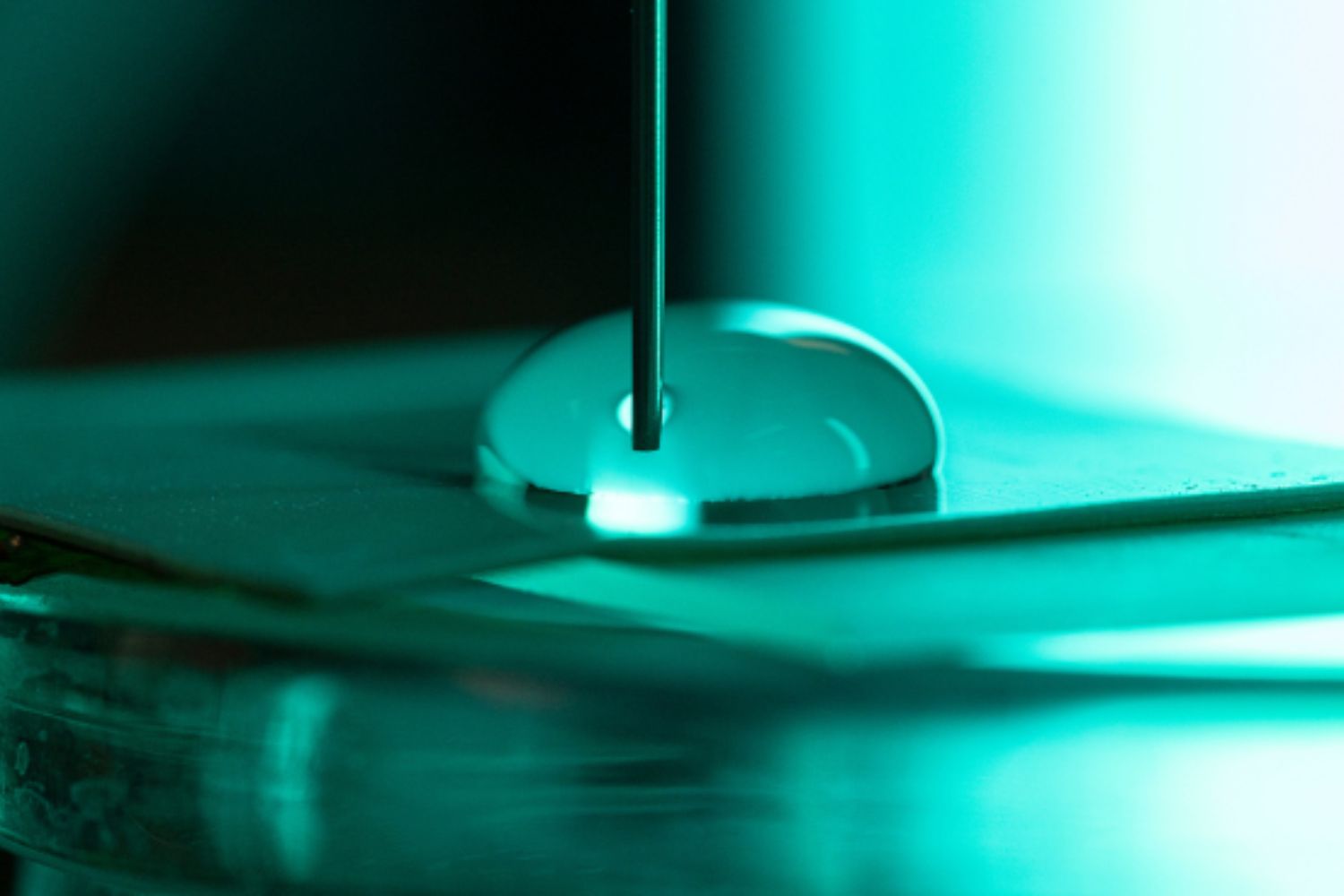
Water can generate an electric charge up to 10 times higher than that observed to date.
The news comes from a group of researchers fromUniversity of Melbourne and RMIT University, Which observed that when a drop of water remains blocked on a small obstacle or an irregular surface, the accumulated force makes it “jump or slide” beyond the obstacle, creating an irreversible charge never reported before.
This “jump”, defined “stick-lip“,, It opens the way to the design of materials with controlled electrification, with potential applications that also provide for the production and accumulation of energy.
The charge of the water
The team, led by Dr. Joe Berry and Professor Amanda Ellis of the Faculty of Engineering and Information Technology, together with the Dr. Peter Sherrel of RMIT University, published the study on Physical Review Letterswith the title “Irreversible Charging Caused by Energy Dissipation from Depinning of Droplets on Polymer Surfaces”.
Dr. Sherrell, whose work at the School of Science of the RMIT focuses on the capture and use of environmental energy, has shown that, although most of the people known the rainwater that slips on a window or a freezer in a random way, few know that this process generates a small amount of electric charge.
In this study, we have shown that the charge can be generated when the liquid comes into contact with the surface, going from dry to wet, and is 10 times more intense than the charge generated in the reverse passage. It is important to underline that this charge does not disappear. Our research has not identified precisely where the charge accumulates, but clearly shows that it is generated at the interface and is probably held in the drop while moving on the surface.
Dr. Sherrell explained.
The research method
The team studied this effect using water and polytetrafluoroethylene, the material used in the teflon.
It is a plastic commonly used in pipes and materials for the management of fluids, but which does not lead electricity, which means that the generated charge cannot be easily dissipated.
To conduct the experiment, the researchers measured the electric charge and the contact areas created by the diffusion and contraction of the drops of water on a flat teflon plate, simulating the movement of the drops on the surface.
They used a special camera to capture individual drops of the drops as they adhered and slipped on the surface, simultaneously measuring the change in the electrical charge.
The amount of charge may seem insignificant, but this discovery could lead to innovations that allow to enhance or inhibit the charge generated in the interactions between liquids and surfaces in numerous real applications.
Shuaijia Chen, the first author of the study and researcher at the University of Melbourne said.
Applications for the energy transition
According to the team, the impact of this research will depend on the development of commercial technologies in collaboration with potential industrial partners.
The researchers intend to study the phenomenon of “stick-lip” with other types of liquids and surfaces and plan to examine how the movement can influence the design of fluid management systems,
