

There is a planet outside the solar systemthat astronomers called K2-18Bwhich seems to be able to host lifeat least the microbial one. This is the incredible news that circulating these days. But is it really the case? Let’s clarify!
The facts (what’s true)
Using the data of the James Webb Space Telescope (JWST), a research group led byCambridge University (United Kingdom), found the chemical footprints of Dimetyl Solfuro (DMS) and/or of the Dimetyl disolfuro (DMDS) in the atmosphere of theEsopianeta K2-18bwhat an orbit around his star.
Previous observations of K2-18ban exoplanet with a mass 8.6 times higher and a diameter 2.6 times higher than that of the earth and which finds in the constellation of the lion 124 light years from us, have identified methane and carbon dioxide in its atmosphere.
This was the first discovery of carbon -based molecules in the atmosphere of an exoplanet in the habitable area and the results were consistent with the forecasts of a ‘Hycean Planet’that is, a habitable world covered with oceans under an atmosphere rich in hydrogen.
However, another sign, weaker, suggested the possibility that it was happening on K2-18B. something else.
We did not know with certainty if the signal given the last time was due to the DMS – says Nikku Madhusudhan, the first author of the work – but even just a hint of this was interesting enough to push us to take another look with the JWST using a different tool
On earth, the DMS and the DMDS are products only from lifemainly from microbial life forms such as the Fitoplankton Marino: the observations have a probability of 0.3% that have occurred by chance, so they are actually very likely.
The data, according to scientists, represent at the moment The most powerful test that life can exist on a planet outside our sun system.
To determine the chemical composition of the atmospheres of distant planets-and so it was also made for K2-18b-astronomers analyze the light of the mother star during the transit of the planetor during his passage in front of the star seen from the earth.
During the transit of K2-18B, the JWST is able to detect a drop in stellar brightness With a small fraction of the star light that crosses the atmosphere of the planet before reaching the earth.
The absorption of part of the star light due to this atmosphere leaves footprints in the star spectrum that astronomers can reconstruct to determine the gases constituting the atmosphere of the exoplanet.
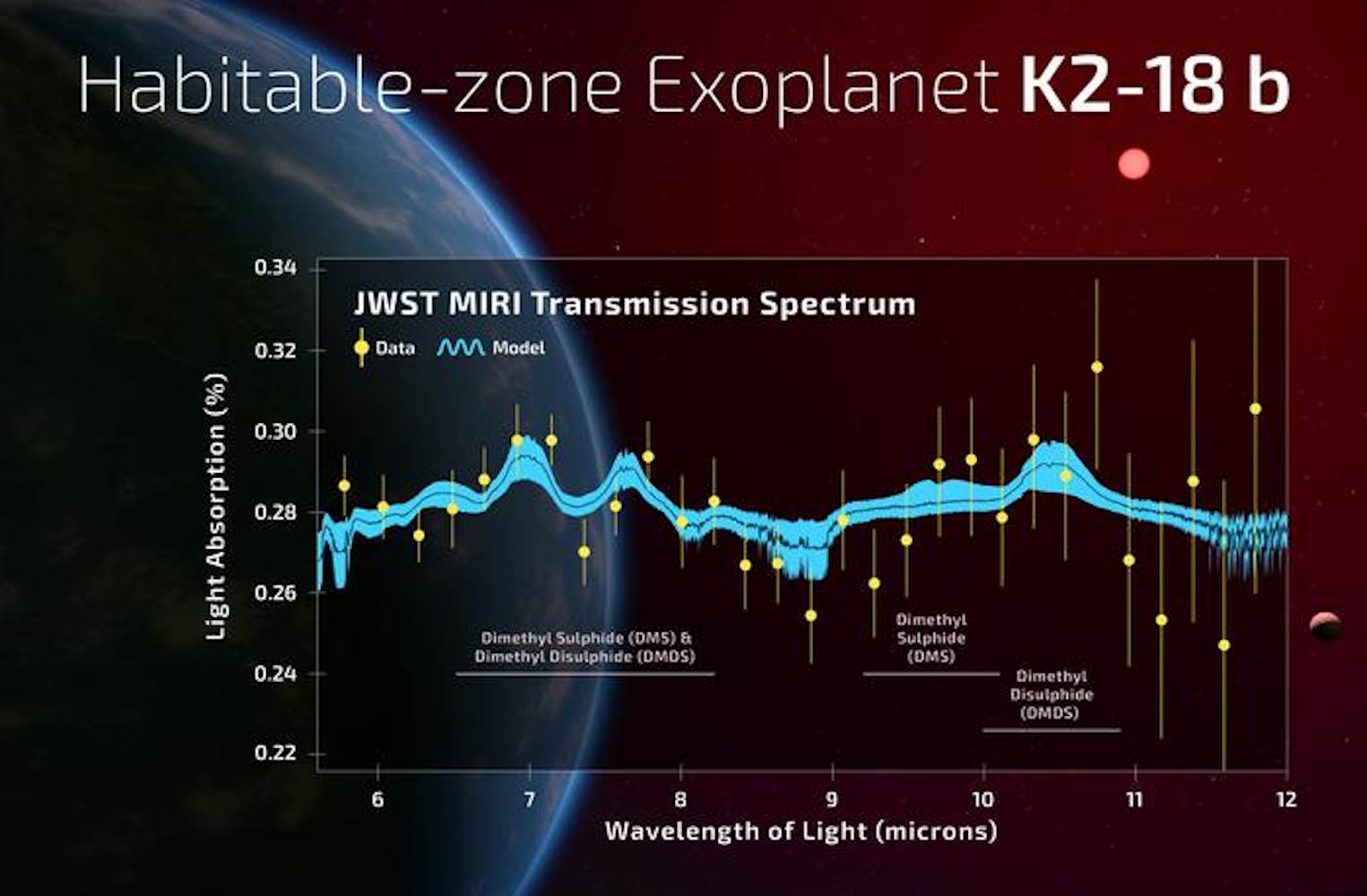
It was an incredible discovery see the results emerge and remain consistent During large independent analyzes and robustness tests
announces with enthusiasm Måns Holmbergco -author of work
What is missing (and what data are still needed to be sure)
The same authors, however, are cautious, because, for example, the observations could be due to chemical processes taking place on the planet previously unknown and.
On the other hand, the concentrations of DMS and DMDS in the K2-18B atmosphere are very different Compared to the terrestrial ones, where they are generally lower than a part per billion in volume, against an estimate of concentrations on the exoplanet of thousands of higher timesover ten parts per million.
Furthermore, to reach the classification accepted for scientific discovery, the observations should exceed the threshold of five sigmawhich means that the probability that they have happened by chance should be lower than 0.00006%.
The researchers say that a follow-up observation period between 16 and 24 hours with the JWST could help them achieve the very important significance of five sigma. The researchers also hope to conduct further theoretical and experimental studies for Determine if DMS and DMDS can be produced in a non -organic way at the currently deduced level.
The work was published on The Astrophysical Journal Letters.
Sources: Eurekalert / The Astrophysical Journal Letters
