
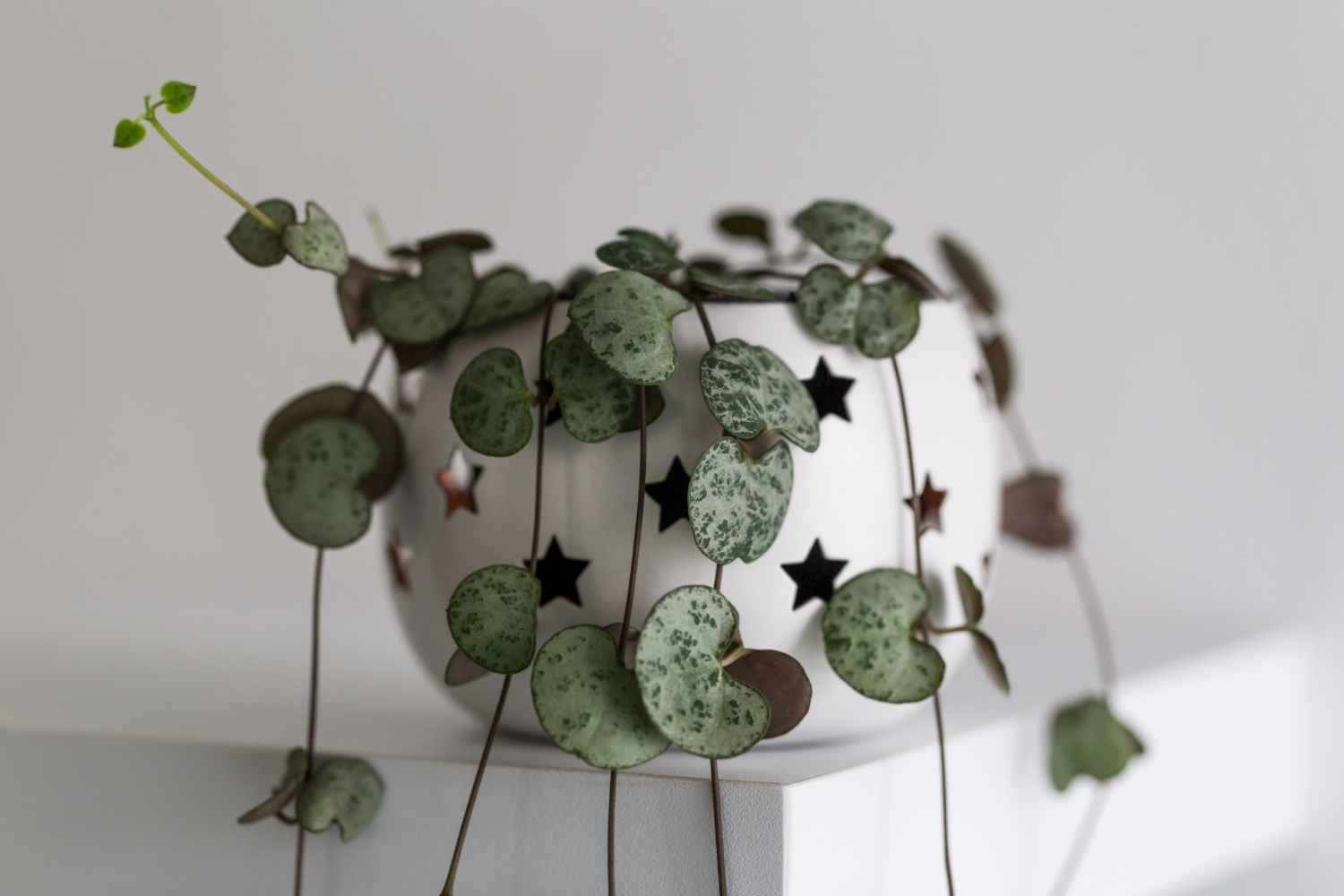
Nature often gives us small wonders that can transform our domestic spaces into green paradise corners. Among these, the Ceropegia Woodiialso known as the “necklace of hearts” or “chain of hearts”, and is one of the most romantic succulents that can be grown in the apartment.
The origins of the Woodi Ceropegia
Originally from the warm lands of southern Africa, Ceropegia Woodii was discovered in 1881 by the botanist John Medley Wood, who later introduced it to European botanical gardens. Since then, this plant has conquered the heart of green enthusiasts for its extraordinary beauty and the simplicity of cultivation.
Ceropegy belongs to the Asclepiadaceae family and can be found in the wild not only in Africa, but also in Madagascar, in the Canary Islands, in some areas of Asia and even in Australia. Her adaptation has made it one of the most popular house plants in the world.
What makes the Woodii Ceropegia really special is its cascante bearing with long thin drums that can even reach 90 centimeters in length. Along these elegant green threads, perfect heart -shaped leaves develop, of an intense dark green color embellished with delicate silver variegatures on the upper page. The back of the leaves instead reveals fascinating Bordeaux shades, creating a wonderful two -tone effect when the plant moves gently in the air.
This particular conformation makes Ceropegia Woodii ideal for being grown in suspended vases, where its branches can go down freely creating waterfalls of small green hearts. It is a perfect plant to decorate high shelves, bookcases or to be positioned in macramè hanging on the ceiling, where it can completely express its pending nature.
The flower of the Woodi Ceropegia
Not only do the leaves make this plant special. During the summer months, Ceropegy Woodii produces small tubular flowers of purple color with a peculiar shape, which add a further element of interest. These flowers, albeit discreet, have an exotic and unusual charm that captures the attention of the most attentive observers.
One of the most fascinating features of Ceropegia is its ability to produce small tubery growths along the stems, similar to beads or grains of a rosary (hence the name “Rosary of Hearts”). These aerial tubers are not only decorative, but they also represent a natural propagation method: when they fall on the ground, they can root and give life to new seedlings, demonstrating the extraordinary survival capacity of this species.
How to take care of the Woodii Ceropegia
One of the reasons for the success of Ceropegy Woodii is its ease of cultivation. It is a perfect plant for those who are a beginner with domestic gardening or for those who do not have much time to devote to the care of plants.
Ceropegy prefers bright positions with intense indirect light, but is surprisingly adaptable and can grow even in less illuminated areas of the house. In this case, the leaves will tend to become clearer and the lower part will accentuate the purple shades, however creating an interesting decorative effect.
As for water, the watchword is moderation. Being a succulent, the Woodii Ceropegia stores water in its fleshy leaves and tubers, so it is better to wait for the ground to dry completely between one influence and the other. An excess of water is in fact one of the few mistakes that can compromise the health of this resilient plant.
The ideal terrain is a well -draining mix, obtainable by mixing with the common soil for houseplants with cactus soil or adding sand to encourage water drainage. This will prevent water stagnation that could cause radical rot, one of the few problems that this plant can encounter.
Where is it better to keep the Ceropegia?
The fertilization must be carried out during the growth season (spring-summer) using a liquid fertilizer for green plants, always following the doses indicated on the label. In winter, when the plant slows down its development, it is advisable to reduce or suspend fertilizations.
How to multiply Ceropegy
A fascinating aspect of Woodii Ceropegia is the simplicity with which it can be propagated. If you want to have more specimens than this beautiful plant or make a green gift to a friend, you have several options.
The simplest method consists in using the air tubers: just detach them gently and stop them in a slightly humid substrate, keeping them in a warm and bright environment until the appearance of the first roots. Alternatively, you can take branch cuttings of about 8-10 centimeters, cut just below a knot, and put them to root in a light and humid soil.
An interesting trick to obtain a thicker plant is to take a long branch and, identified an ascrence, to stop it without detaching it from the mother plant. In this way, an additional rooting point is created which makes the general appearance more luxuriant and full.
Possible problems
Ceropey Woodii is a robust plant, but it can still show some problems:
