
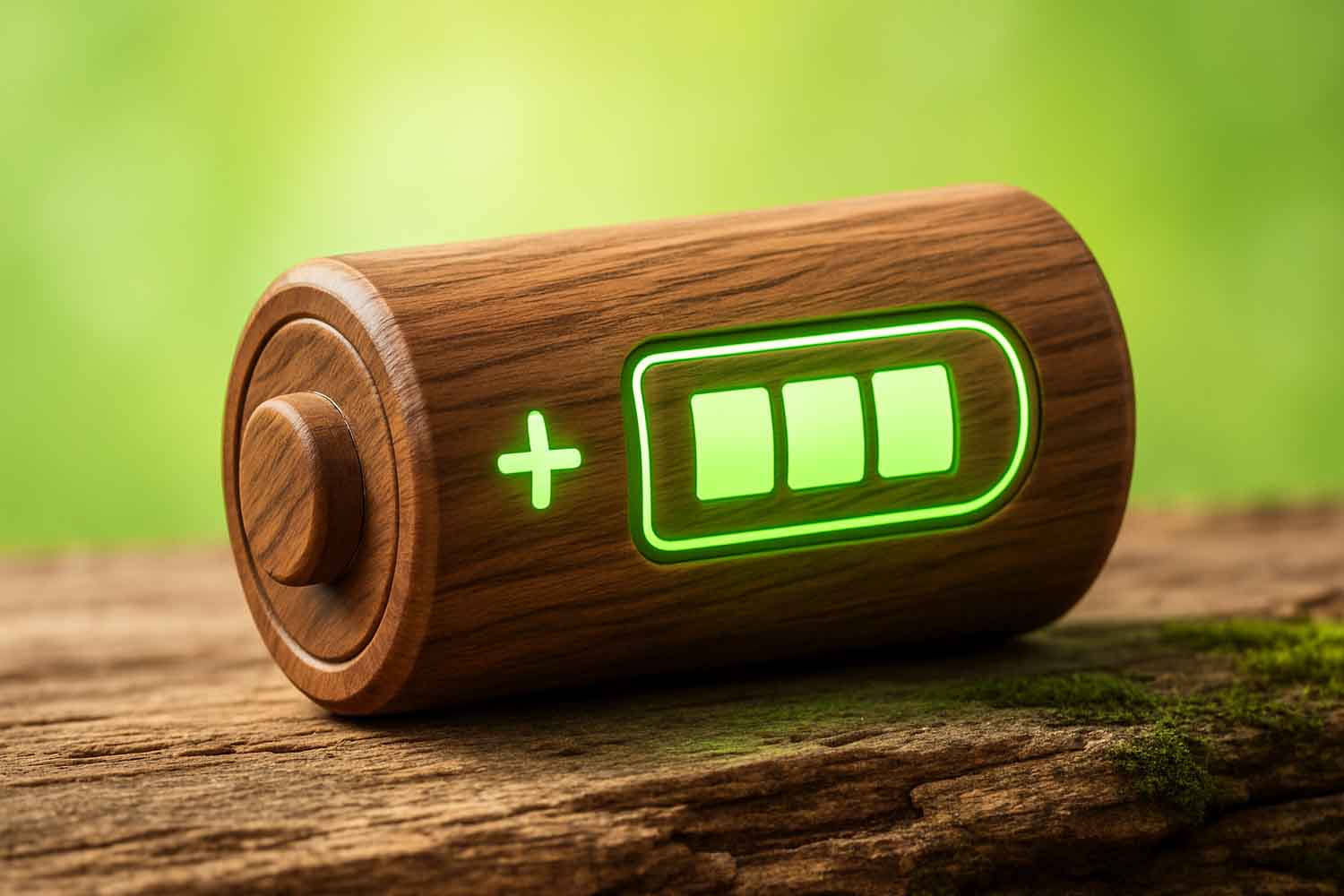
In an era in which the search for ecological alternatives became essential, a group of scientists reached a surprising goal. Using materials obtained from wooden waste, the researchers designed both a battery and a totally eco -sustainable supercondensor. This project promises to significantly reduce the environmental impact of traditional energy storage devices, while offering high performance.
The team of scholars, belonging to Linköping University and the Chalmers University of Technology In Sweden, he developed an innovative method to transform wooden waste into a precious resource for the accumulation of energy. In particular, they developed a hybrid electrode Which can work both as a battery and as a supercondensator, all using a raw material widely available and often unused: waste wood.
Scientists extracted the ligninaa natural polymer present in the cell walls of plants, to obtain a substance capable of storing energy. Through a chemical process of oxidation, they managed to create a nanoporous structure particularly suitable for increasing the contact surface, a fundamental feature to improve the loading and downloading capacity of energy devices.
How the new Lignina -based energy accumulation system works
The new technology combines lignina with a conductive polymer called Pedot: PSS. This combination allows to obtain a material capable of store electrons And to free them quickly when necessary, just as it happens in supercondensors. However, unlike the latter, the Lignina -based device also guarantees an energy accumulation capacity similar to that of a battery, thus offering an extremely interesting double functionality.
Laboratory tests have shown that the system can be recharged up to 8,000 times Without losing efficiency, keeping its storage properties intact. In addition, the entire production process is more respectful of the environment than current technologies, since it avoids the use of heavy metals and highly polluting chemicals.
This innovation could find application not only in consumer electronics, but also in accumulation systems for renewable energy, representing an important step towards a greener future.
