
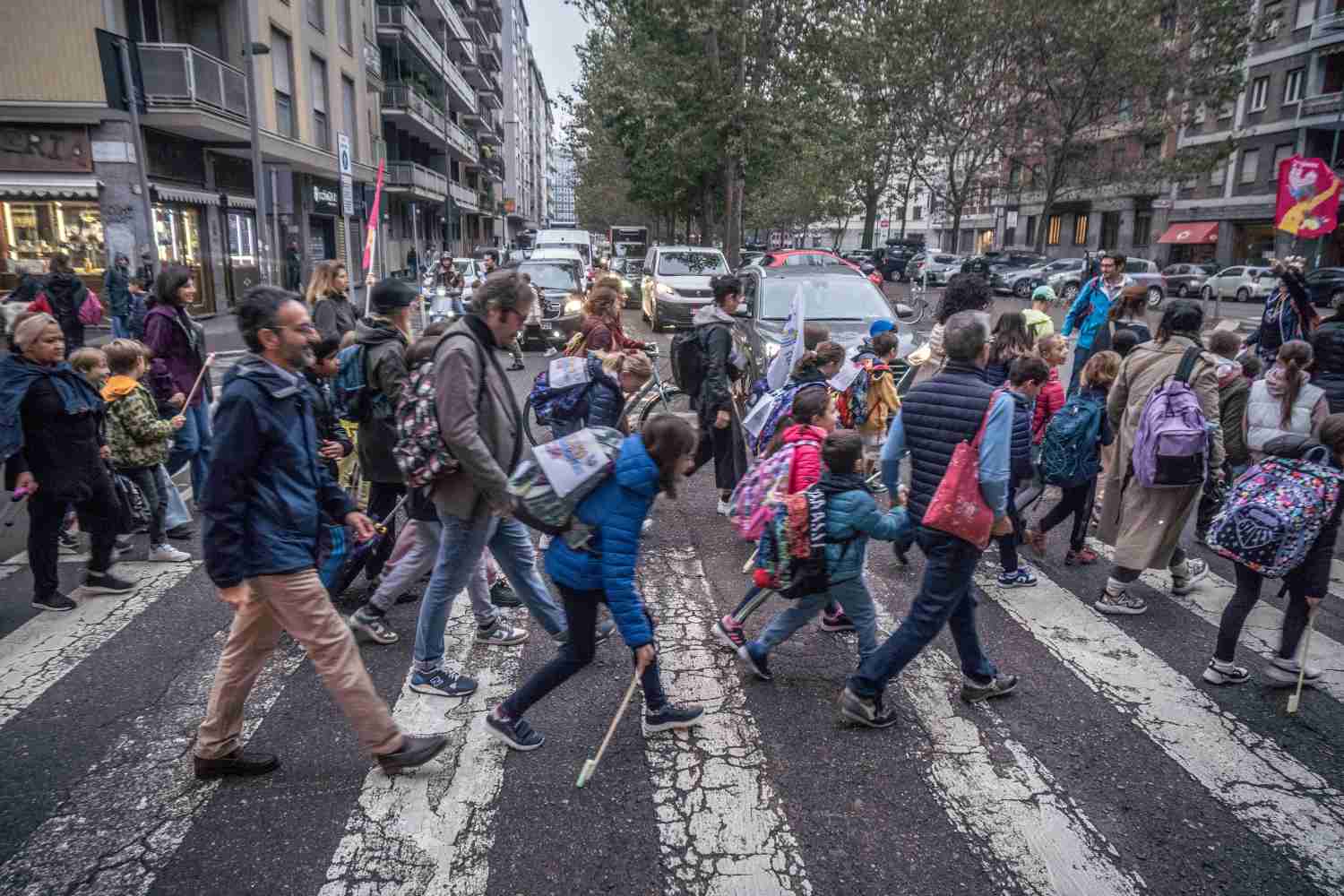
Safe school roads, less cars, more bike and clean air: shouldn’t this be the minimum for every little girl and baby that goes to school every day? Yet, according to the new report of “Streets for Kids,
Cities for All Ranking Europe’s Cities on Child-Friendly Urba Mobility “of Clean Cities, Italy Arranca, while in Europe there are those who run quickly towards a future for small citizens.
Paris dictates the pass
Child -scale urban mobility is not only a question of road safety, but an investment in the future of our cities. This is clearly demonstrated by the new ranking, which has put the policies of 36 European cities To evaluate how much they really are shown by girls and boys. The results, presented in conjunction with the European mobilization “Streets for Kids”, launch a clear message: some cities are taking great strides to guarantee the little ones the opportunity to move independently, safely and in a healthy environment, while others, including the main Italians, struggle to keep up.
To excel in this unprecedented ranking is Pariswhich with a forward -looking policy and targeted investments is also in front of cities such as Amsterdam (2nd place) and Antwerp (3rd). The French capital conquered the first place thanks to a virtuous combination of factors: one Network of rapidly expanding protected cycle paths, drastically reduced urban speed limits and the creation of numerous limited traffic areas or even absent near the educational institutions. A holistic approach that recognizes the importance of safe infrastructure and a pacified urban environment to encourage the active mobility of children, on foot or by bicycle.
Italy at two speeds
The picture that emerges for Italy is more complex. No Italian city appears in the top 10, an alarm bell that highlights a significant gap with respect to the most virtuous realities in Europe. The best national performances are recorded with Bologna (16th), Milan (23rd) e Turin (24th), follow more spaced by Florence (29th) e Rome (32nd).
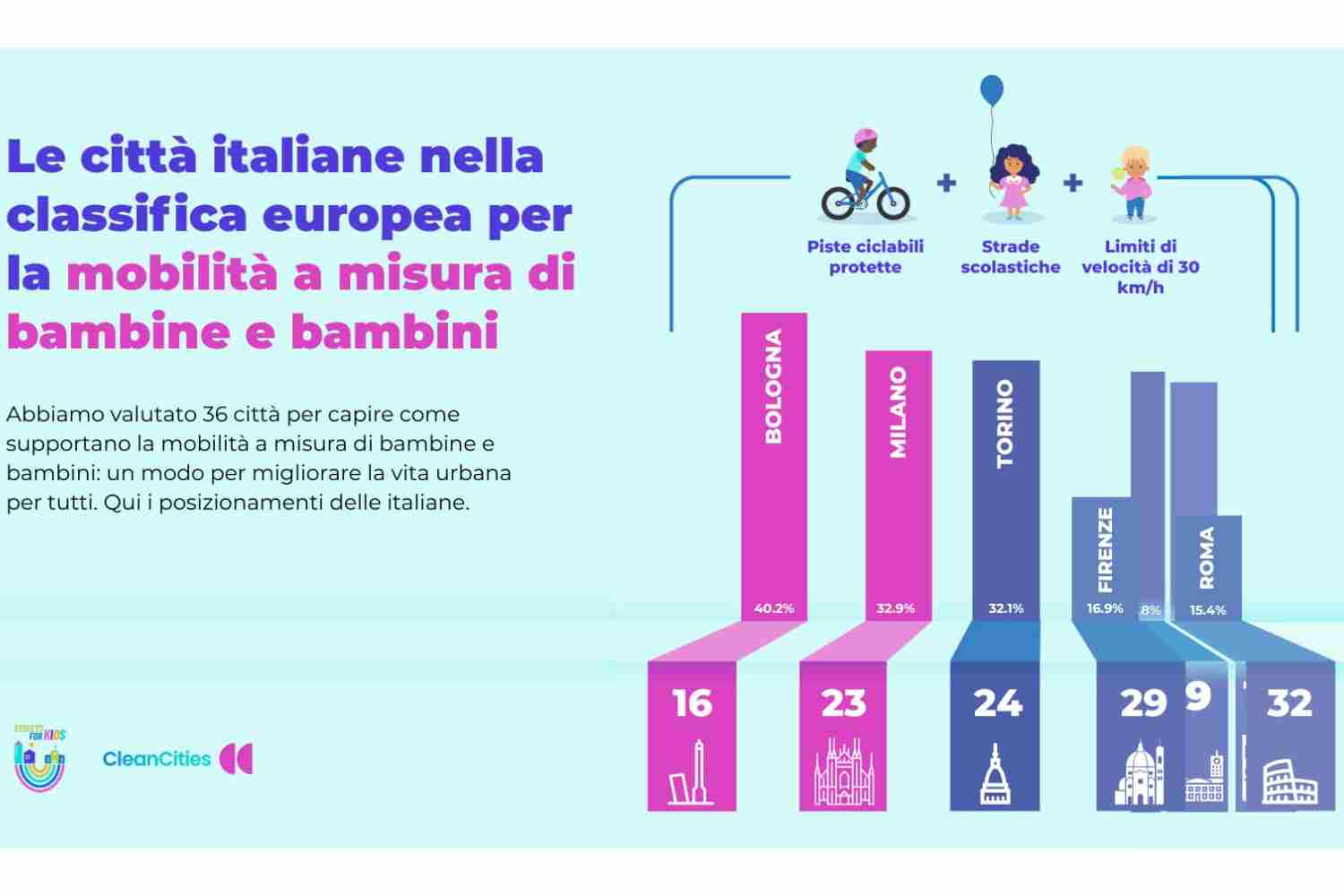
By analyzing the individual indicators, lights and shadows emerge. Italy is positively distinguished as regards the “school roads”, that is, those streets adjacent to primary institutions where traffic is regulated to ensure greater safety during entry and exit times. Milan even positions itself in second place at European level for this specific indicator, followed by Turin (4th) and Bologna (11th). Rome (16th) also shows progress in this area. However, it is important to underline that the ranking considers both temporary closures and permanent pedestrianizations. If you only look at the latter, Milan, Rome, Turin and Bologna are still among the top ten. Tail light for this indicator is Florence, among the ten cities analyzed to have not yet implemented any school road.
The painful notes arrive on the front of the moderation of speed and cycle infrastructure. As for the urban speed limit at 30 km/h, a measure recommended by WHO, OECD and European Council for the Safety of Transport to reduce accidents and pollution, Bologna is confirmed as the best among the Italians (18th), having been the first big city in the country to adopt this policy on most of its road network. Florence (24th), Milan (30th), Turin (31st) and Rome (33rd) follow, testifying to a long -long journey.
Even more critical is the situation relating to cycle infrastructure in the separate seat, considered fundamental for the safety of younger cyclists. Rome is among the last three cities at European level, while Milan, Florence, Bologna and Turin are located in the middle-low part of the ranking, highlighting the need for significant investments to fill this infrastructure gap.
Parents on the front line by more liveable cities
Despite the delays on a general level, the Clean Cities Campaign report underlines how The civic pressure from below is producing concrete resultsespecially in the field of school roads. Cities like Milan, Rome and Turin, where groups of active parents have mobilized to ask for permanent pedestrianizations, are seeing the first fruits of this commitment. European experience teaches that parents involvement is a powerful engine for urban transformation, as shown by the cases of London, Paris and Lyon, where activism has been enhanced by the administrations to implement ambitious policies.
The mobilization “Streets for Kids”, which sees until the end of May thousands of girls and boys to go to the streets in 18 European countries to ask school streets and low -speed areas, represents a strong signal of growing awareness on the importance of rethinking urban spaces starting from the needs of the little ones. In Italy, the over one hundred organized initiatives testify to a ferment from below that the administrations cannot ignore.
The challenge of Italian cities
The ranking of Clean Cities Campaign is not only a photograph of the current state, but an invitation to action. Making cities safer, safer and more liveable for girls and boys means improving the quality of life for all citizens. As he points out Tim Gillexpert in child mobility, “A city that is good for children is good for everyone“.
The example of Paris, with his Chiara political vision and his strategic investments, shows that a radical change is possible. Also in Italy, the positive experiences of Bologna with “City 30” and the commitment of Milan and Rome on school streets indicate a promising direction. However, a change of pace is necessary at national level, with more consistent investments and long -term planning that center the needs of the most vulnerable. The mobilization of parents and civil society represents a precious resource for Push administrations to more courageous and far -sighted policiesto transform our cities into real “places to grow”.
