

A new test conducted in the United States has detected alarming levels of arsenic and cadmium in the rice sold in supermarkets. Among the most contaminated there is also the Arborio rice cultivated in Italy
A recent report published by Healthy Babies, Bright Futures and exclusively shared by the CNN has turned on the spotlight on a public health problem that concerns a basic food for millions of families: rice. The investigation noted alarming levels of arsenic and cadmium in over 100 brands rice purchased in US supermarkets, with potential serious health repercussions, especially children.
What the investigation discovered
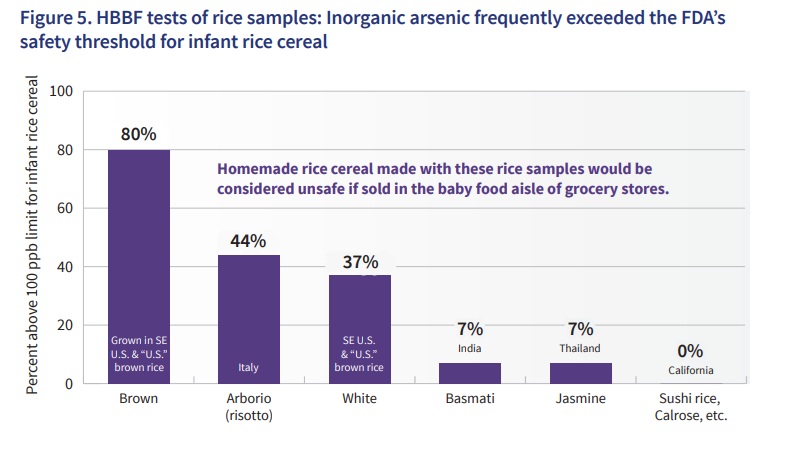
The study examined 145 rice samples from the United States, Italy, India and Thailand, purchased by American consumers. According to the data, one in four sample exceeded the limits set in 2021 by the Food and Drug Administration (FDA) for the inorganic arsenic in the cereals intended for childhood. Still, the FDA legislation does not apply to common rice, the one that ends up daily in adults and children’s dishes.
Jane Houlihan, director of Healthy Babies’s research, Bright Futures, underlines that “Rice consumed by children between 0 and 2 years represents one of the main sources of exposure to inorganic Arsenic, even overcoming cereals for babies“.
Arsenic is a natural element present in the environment, but its inorganic form is highly toxic and carcinogenic. The early exposure, especially during pregnancy and in the early years of life, is connected to neurological development disorders, reduction of Qi, spontaneous abortions and premature birth.
Even the cadmium, detected in the samples analyzed, is a dangerous heavy metal: it crosses the placental barrier and can damage the development brain, as well as causing renal, lung and bone problems.
The test then confirmed that The content of heavy metals also varies according to the type of rice and the cultivation area. Full and wild rice, for example, contain higher levels because they retain the external layers of the Chicco, where metals are concentrated. Among the samples analyzed, the Italian and white rice cultivated in south-east of the United States had levels almost comparable to those of full rice. On the contrary, varieties such as Indian Basmati or Thai Jasmine were less contaminated.
Also the Italian rice under accusation
Among the samples analyzed, too The Arborio rice cultivated in Italy (the Marche region is not specified) has shown high levels of contamination from heavy metals. In laboratory tests, this rice has recorded a total content of 142 parts per billion (ppb) of heavy metals, of which 101 ppb attributable to the Arsenic. A value that approaches the maximum limit of inorganic arsenic set by the US FDA for rice cereals intended for children (100 ppb).
In addition to the Arsenic, the Italian Arborio rice has also reported one particularly high concentration of cadmiumresulting – together with Indian Basmati – among the varieties with the highest average levels of this toxic metal. These are results that ask questions about the safety of a food widely consumed also in Europe, especially if intended for daily or childhood use.
The replica of companies
The US Federation has minimized the risk, claiming that the rice cultivated in the United States has the lowest levels of inorganic arsenic in the world and that the industry respects the safety standards. However, according to Houlihan, these data do not reassure: “Rice alone contributes to 17% of the Arsenic in the American diet. It is a single food, yet it is one of the main exhibition sources“.
A global problem, not only American
Rice is the most consumed solid food in the world, present in every daily meal in many cultures. According to the report, for Hispanic children under 2 years it represents 14% of the total exposure to the Arsenic; For Asian ones, the percentage rises to 30.5%, reaching up to 55% between 18 and 24 months. The lack of awareness in many ethnic communities is a further critical element.
The report launches a clear appeal: It is urgent to update food safety regulations, also extending them to rice not intended for childhood. At the same time, it is essential to sensitize families and offer safe alternatives, especially for children.
Alternative cereals: a safer choice?
The study compared rice with nine ancient cereals such as spelled, quinoa, buckwheat and mile. The results are clear: these cereals contained On average 28 times less arsenic than rice. Although they had slightly higher levels than Cadmio, the overall exposure to heavy metals was three times lower.
How to reduce exposure to Arsenic
Varying nutrition is obviously an excellent advice but when you eat rice, to reduce exposure to the Arsenic, experts recommend Rinse it abundantly and cook it in a lot of water (ratio 1: 6)draining the excess one before serving.
