
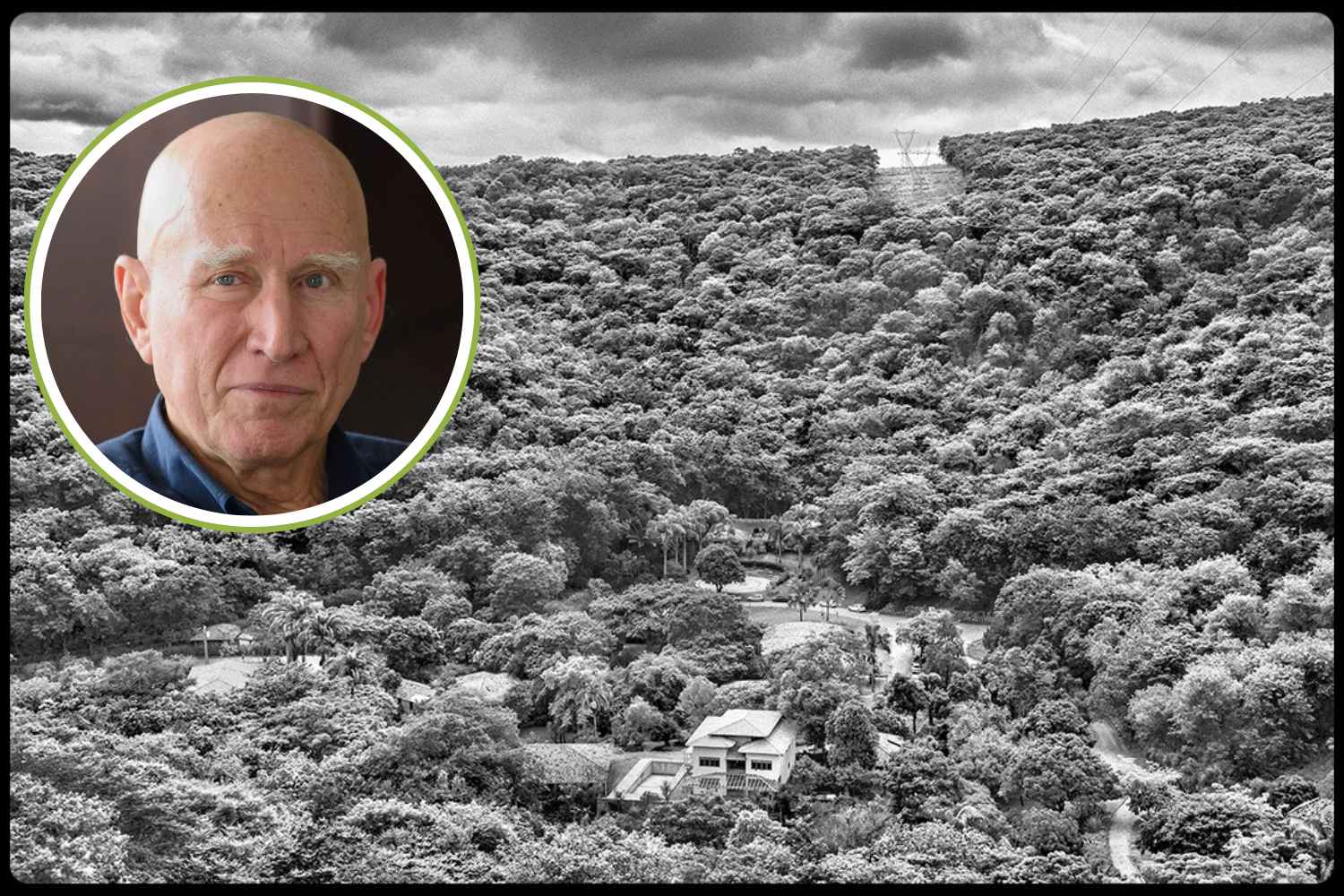
The world has lost one of its greatest photographers ever. The Brazilian photographer Sebastião Salgado He disappeared at 81 in Paris, where he lived with his wife Lélia Wanick Salgado. Known for his powerful black and white shots, he dedicated his life to telling social and environmental injustices, transforming photography into an instrument of denunciation and at the same time hope.
When after years of distance the famous photographer Sebastião Salgado had returned to Minas Gerais, in the south-east of Brazil, instead of the tropical paradise he remembered, he had found demolished trees and disappeared fauna. From there the idea of a great project was born: reconstruct that lost corner of paradise.
He ran the year 1998 and Salgado together with his wife Lélia Deluiz Wanick Salgado launched an ambitious as well as visionary project: replant the forest and return insects, birds and fish to that devastated land.
The Instituto Terra
With the foundation of the Earth Institute, they recruited partners, raised funds and planted more than 2 million trees, completely transforming the environment and offering a concrete response to deforestation and climate change. The project recovered 1,502 hectares of rainforest on the Bulcão farm in Aimorés, Minas Gerais.
Over two million seedlings of 290 different trees have been planted and a center for education and environmental restoration (wax) has been created which aims to raise public awareness towards sustainable development.
View this post on Instagram
From the genocide of the Rwanda to the rebirth of the forest
Sebastião Salgado is a world -renowned artist. His photographs led him to travel all over the world and to move away from his native land. But during a trip to Rwanda, where a genocide was underway, the photographer gets seriously ill. Doctors advise him to stop working before it’s too late. He returns to his Brazil but no longer finds that boundless paradise in which he played as a child.
Of the rainforest, which a few decades previously occupied more than half of that territory, remained only 0.5%. This is where his biggest dream is born: recreate the subtropical rainforest. With drought, desertification, soil devastation and misery, Salgado replied with trees, repopulation of fauna, environmental education and scientific research.
The lesson of the trees
“The trees are the hair of our planet,” explained Salgado with the poetic simplicity that distinguishes the great visionaries. “When there is rain in a place without trees, in a few minutes the water arrives in the streams, taking away the soil, destroying our sources and our rivers, without retaining humidity. When there are trees, the root system holds the water. All the branches, the leaves that fall, create a wet area, and the water takes months and months underground to get to the rivers, keeping our sources alive. We think we need water for every activity of our life. “
A legacy that continues to grow
Today that arid land has become a lush forest that houses hundreds of animal and vegetable species. The project of the Earth Institute represents one of the most extraordinary success stories in the field of environmental restoration, showing that it is possible to reverse the damage caused by man to nature.
The whole story is told in the book “From my land to earth” and in the documentary “The salt of the earth” by Wim Wenders, testimonies of how a man can transform pain for the destruction of the world into creative force for his rebirth.
Salgado has taught us that every end can be a new beginning, that life can arise from the devastation, and that sometimes the vision of a man is enough to change the fate of an entire forest. His most beautiful inheritance are not his iconic photographs, but those 1,502 hectares of green who continue to grow, breathe and give life to the planet.
