
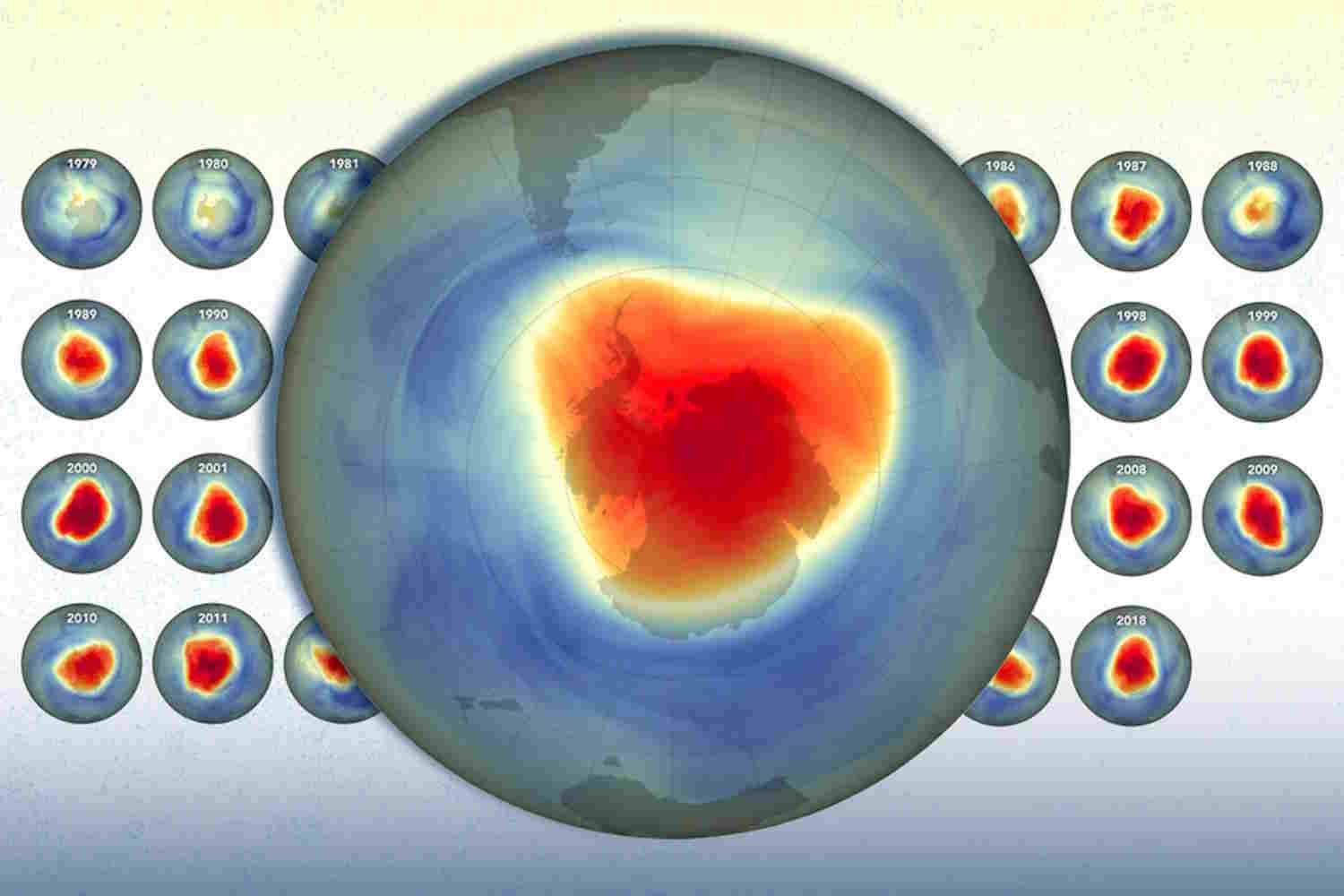
The layer of ozone Above the Antarctica would be healed, thanks to the actions taken worldwide to reduce the substances that damage it.
To say it is a new study led by MIT published in Nature, the first one that demonstrates, with a high degree of statistical certainty, that the merit is mainly of the reduction of destructive substances for ozone, and not other factors such as natural meteorological variability.
There were many qualitative tests that the ozone hole was improving. This is the first study that quantifies with certainty the recovery of the Ozone layer – says Susan Solomon, author of the study and professor of environmental and chemical studies at MIT. We can say with the 95% of certainty that is closing. And it’s fantastic. Show that we can really solve environmental problems.
The origins of the recovery of the ozone
Ozone is a natural gas present in the stratosphere that acts as a “solar screen”, protecting the earth from harmful ultraviolet rays. In 1985, the scientists discovered a “hole” in the ozone layer above the Antarctica that opened during the southern spring, from September to December. This allowed UV rays to reach the earth’s surface, causing skin tumors and other serious health problems.
In 1986, Solomon – then Noaa scientist (National Oceanic and Atmospheric Administration) – led shipments to Antarctica and collected decisive evidence: the cause was the use of chlorophalocarbons (Cfc), present in refrigerators, air conditioners, insulators and spray cans. These compounds, once climbed into the stratosphere, destroy ozone in particular seasonal conditions.
The following year, this discovery led to the drafting of the Montreal protocolan international treaty that aimed to gradually eliminate the CFCs and other substances harmful to ozone, to allow the regeneration of the layer.
In 2016, Solomon published a study with the first signs of recovery: the ozone hole seemed to be reduced every year, especially in September. However, quantitative confirmation was missing. It was not clear how much of that improvement was due to the efforts to reduce CFCs and how much to natural factors such as El Niño, the Niña or the polar vortex.
Detecting an increase in ozone is relatively simple. Understanding what it is due to, much less.
The study
In the new study, the MIT team has adopted a quantitative approach, using a method called “fingerprinting“(Digital footprint), already successfully applied in the studies on climate change. This technique, rewarded with the Nobel in 2021 to Klaus Hasselmann, refers to a method that isolates the influence of specific climatic factors, in addition to natural and meteorological noise. Hasselmann has applied the digital imprint to identify, confirm and quantify theanthropogenic digital imprint of climate change.
Scholars have now applied this method to identify the imprint of human actions in the reduction of harmful substances for ozone.
The atmosphere is full of chaotic variability – explains Solomon. What we want to do is to detect the sign of the recovery of the ozone within that noise.
The researchers performed simulations of the terrestrial atmosphere by creating several virtual “parallel worlds”: some without an increase in greenhouse gases or reduction of CFC (only natural variability), others only with increasing greenhouse gases, others still with only decrease CFC.
They then compared how the ozone changes in Antarctica, month after month and various altitudes, in each simulation. In this way, they areolated the pattern – or “imprint” – of the recovery of the ozone due exclusively to the reduction of CFCs.
With this imprint in hand, they sought it in real satellite data, from 2005 to today. And they found it: with the passage of time, the pattern has become increasingly clear. In 2018 it was now clear, so much so that it allows researchers to affirm with 95% of certainty that the recovery of the ozone depends mainly on the reduction of CFCs.
After 15 years of observations, we have a signal/noise ratio strong enough to exclude that these are simple natural variability. This gives us confidence in our imprint. And it also gives us confidence in the fact that environmental problems can be solved. The study of the ozone shows us how countries can act quickly to reduce emissions, following international treaties.
If the trend continues, and the imprint of the recovery of the ozone is strengthened, Solomon provides that by 2035 we could attend the first year without the hole of the ozone in Antarctica. And in the end, it could close forever. We could see a year without any loss of ozone already in 2035. And many of you will see the ozone hole disappear completely.
The study was financed by the National Science Foundation and NASA.
