
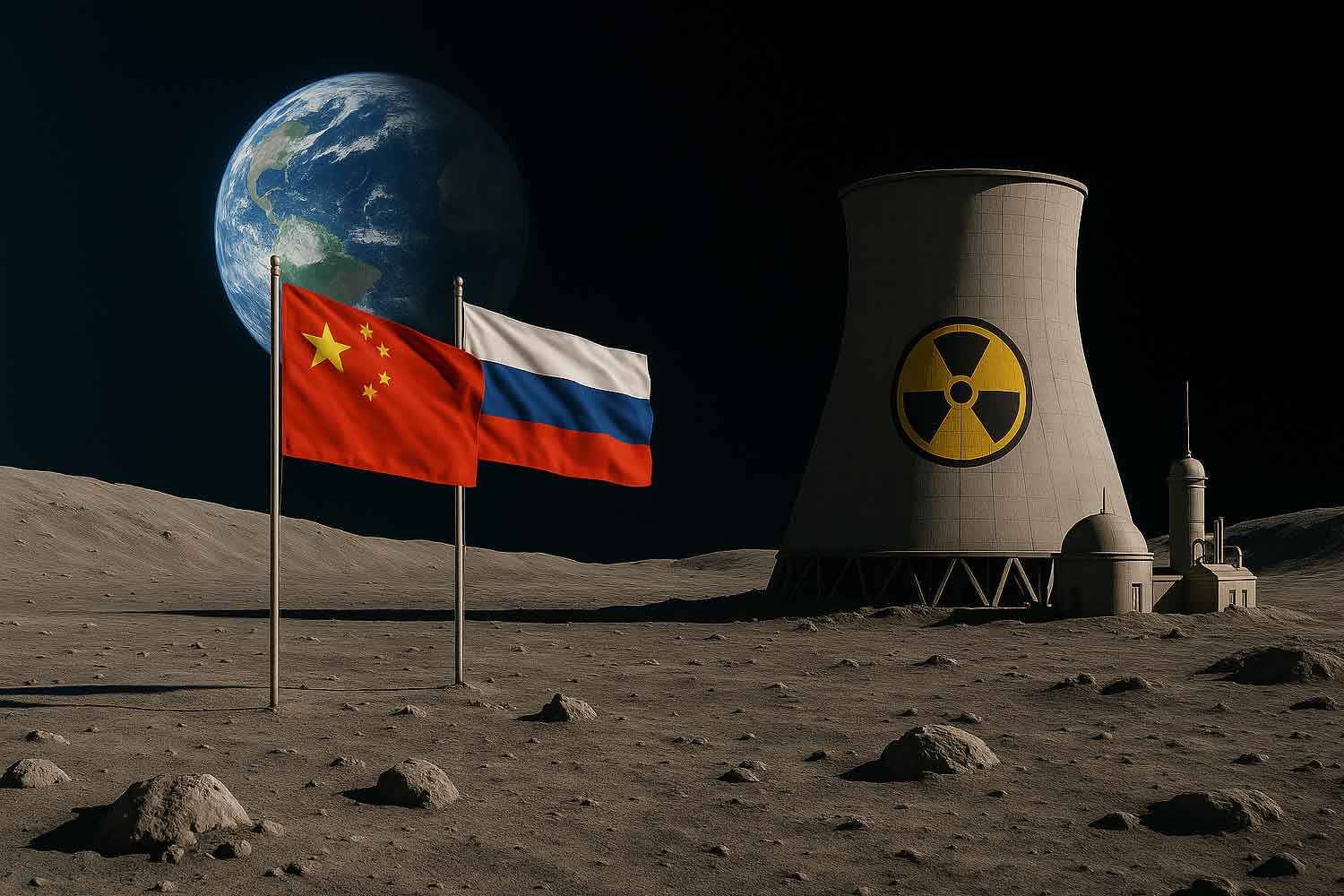
China and Russia have announced an ambitious joint plan that marks a new era in space race: by 2035 they want to install A nuclear reactor on the moonwhich will act as an energy fulcrum for the future International Lunar Research Station (Ilrs), a robotic outpost – and later inhabited – near the South Lunar Pole.
The Memorandum di Intesa, signed at the beginning of May by the Space Agencies Roscosmos and Cnsa (China National Space Administration), represents the most decisive and symbolic step of their growing collaboration in the space sector.
ILRS proposes itself as the main rival of the Artemis program led by the United States, which involves 55 countries and provides for the construction of an orbital station around the Moon (the Gateway) and the return of astronauts on the lunar surface, hypothetically starting from December 2025, even if the date appears not very realistic.
In the meantime, the Sino-Russa alliance quickly earns consensus: from the official launch of the project in 2021, Ilrs has already attracted 17 partner countriesincluding Egypt, Venezuela and South Africaand aims to expand considerably thanks to the Chinese initiative “Project 555”, Which aims to involve 50 countries, 500 scientific institutions and 5,000 researchers.
The choice of the South Lunar Pole is not accidental: it is a area with prolonged sun exposure and the possible presence of water ice In the perennial shadows of the craters. For China and Russia, this also represents a springboard towards even more distant objectives, such as Mars.
The plan includes autonomous construction and mixed energy sources
According to what Roscosmos declared on May 8, the station will be used for the basic scientific research and to test technologies capable of operating without crew for long periods. Russian officials said that the nuclear reactor will be completely built autonomouswithout the need for human presence on the lunar surface.
Yury Borisov, general manager of Roscosmos, confirmed that “the technological passages are almost ready”, suggesting that the infrastructure could soon move on to the operational phase.
The ALRS project includes a first robotic phase with the Chinese mission Chang’e-8 in 2028which will tester the Automated construction with 3D bricks made by lunar soil. Between 2030 and 2035, five heavy rockets they will transport the main modules to the moon. The long -term goal, by 2050, is to create an extended network of bases powered by sources solar, radioisotopics and nuclearwith Rover, lunar jumpers drones And high -speed communications between land and hidden face of the moon.
Because nuclear power is essential to live in the moon
Energy supply is one of the main challenges of lunar stay. The sun is not always availableespecially in the areas in permanent shadow where the presence of ice is suspected. Solar batteries and panelsalone, do not guarantee continuity.
Here comes into play the nuclear reactor. While the United States work on NASA’s Kilopower project, Russia boasts a long experience in spatial nuclear technologies, dating back to the satellite programs of the Cold War era, as Wu Weiren, a designer of the Chinese Lunar program said.
Russia has a natural advantage in nuclear energy applied to space and is ahead of the United States.
To confirm the Chinese interest, Pei Zhaoyu – deputy director of the Cnsa Lunar Exploration Center – included Nuclear energy, solar panels and pipelines infrastructure in the energy grid scheduled for Ilrs.
If successfully made, it would be the First nuclear reactor never installed on another celestial bodyintended to feed not only scientific instrumentation, but also heating systems, communications and robotic vehicles.
Lunar geopolitics becomes more and more intense
The announcement of the nuclear reactor arrives in a strategic moment: a few days earlier, the Trump administration proposed The elimination of the loan to the Gateway orbital station In the NASA budget for 2026, raising doubts about the entire US lunar strategy. Artemis III, originally scheduled for 2025, has already been postponed at least to 2027.
In the meantime, China advances forcefully: in 2024 the mission Chang’e-6 brought samples taken from the hidden side of the Moon to Earthan unprecedented company, celebrated by Chinese state media as “a historical milestone for humanity”.
The Ilrs, initially discussed in 2017, took impetus after the Russian invasion of Ukraine in 2022, which isolated Moscow from its western partners. China proved to be a key ally, providing both political support and advanced technologies. This “Without limits” alliance He concerns several European observers.
The moon has become a new geopolitical battlefield. And, unlike the first space missions, this race is not only scientific.
Lunar soil may contain Rare metals, oxygen-rich regolite and helium-3a potential fuel for merger reactors of the future. Although the Treated on the 1967 extra-atmospheric space prohibited the possession of celestial bodies by states, the race to lunar resources It has now begun, and the legal interpretations are evolving.
The construction of the Ilrs will come alive after 2028. If the plans are respected, a 2035 will be operational Autonomous outpost fueled by nuclear energy. Further modules, international collaborations and, finally, will follow Missions with human crew.
NASA continues to aim for a return of astronauts before China, but between Budget cuts And delaysthe center of gravity of the lunar space could soon move to the East.
