
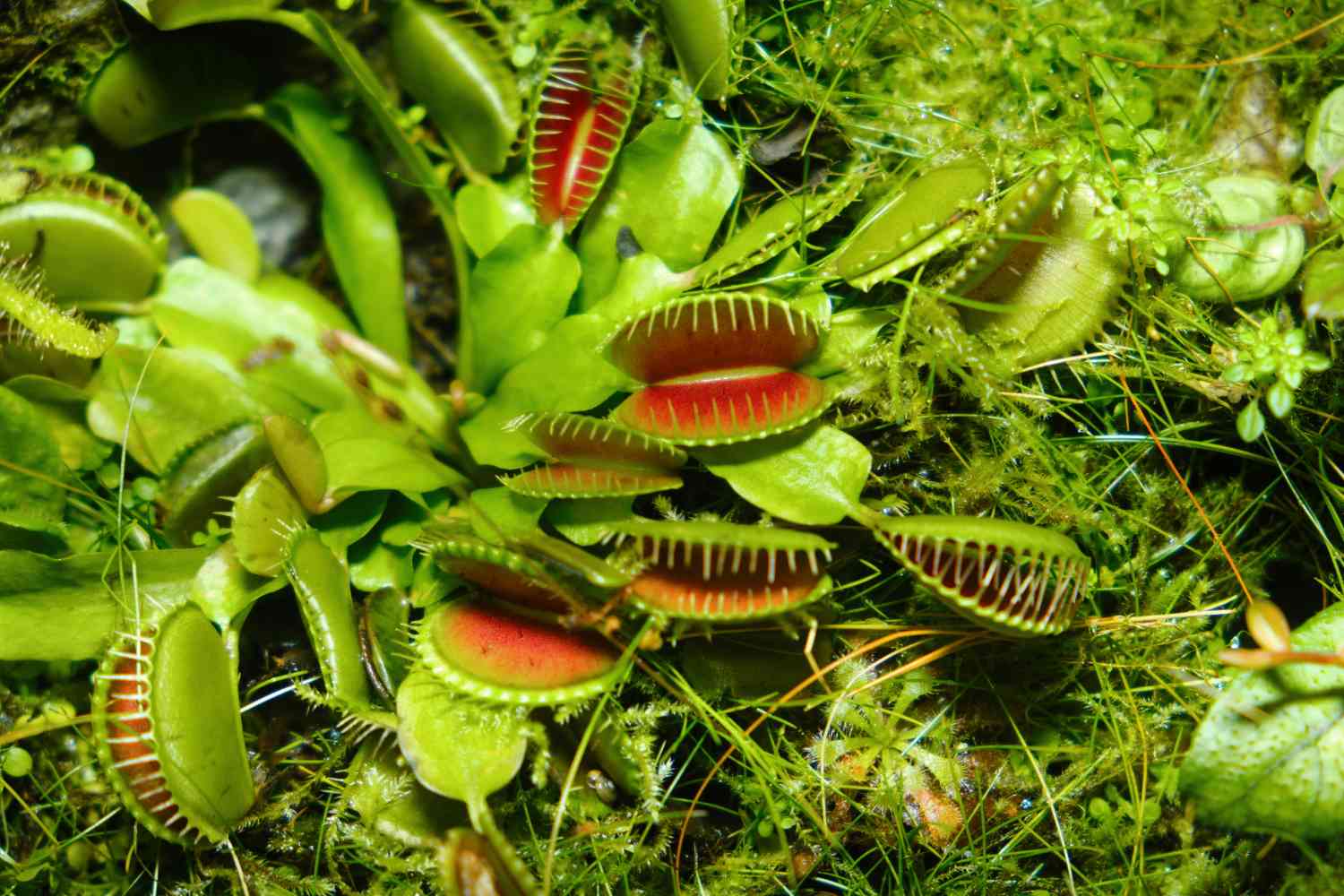
Dionea Muscipula represents the perfect introduction to the fascinating world of carnivorous plants, especially for those with children who will surely remain enchanted by its wide open jaws. This extraordinary plant belongs to a group of about 600 different species distributed in 12 genres, among which also stand out the Drosera and the Nepenthes. Carnivore plants have developed specialized techniques in the course of millennia to capture insects and recover essential minerals such as nitrogen, calcium and potassium, thus compensating the nutritional deficiencies of the acidic soils in which they grow spontaneously.
Dionaea Muscipula stands out for its dentated fleshy leaves that close when stimulated, an almost unique feature in the vegetable kingdom. The leaves have a green outdoor and a reddish interior that produces sugary substances from the clean glands to attract insects. When the prey touch the microscopic internal hair, the trap starts and the plant produces digestive acids to decompose the insect and absorb the nutritional elements. A curious detail concerns the white flowers that grow on stems up to 30 cm high: this height serves to prevent pollinators from finishing in the underlying traps.
Where and how to place the carnivorous plant
The cultivation of Dionea requires particular attention to temperatures and exposure. During spring and summer, the ideal temperatures oscillate between 20 ° C and 35 ° C, while in winter the plant prefers fresher environments with temperatures between 5 ° C and 15 ° C. Although it can be grown in the garden, the Dionea in pots in the apartment represents the most common and practical choice.
For a Dionea optimal exposure, choose a sunny position that promotes the intensification of the red color of the leaves.
During the hottest summer months, it is advisable to move the plant to half shadow to avoid thermal stress. Dionea winter enters vegetative rest from November to February: in this period move it to a cold greenhouse or in an unheated place, completely suspending irrigation and fertilizations. In March the plant resumes its vegetative activity culminating with flowering.
How to cultivate Dionea
The Dionea transplantation must be carried out every two years at the end of winter, using a soil for flower plants in a slightly larger pot than the previous one. Particularly large containers are not necessary, given that the radical apparatus of Dionea is relatively compact.
As for the fertilization of Dionea, the plant does not need many nutrients. It is important not to provide insects or pieces of meat to the plant: Dionea will independently collect the nutrients necessary by the fertilizer and naturally catch small insects when necessary.
How to irrigate the Dionea
Dionea’s irrigation represents one of the most delicate aspects of cultivation. The particular leaves of Dionaaea Muscipula must never be bathed directly: always use the technique of irrigation from the sauce. Fill the water sauce and allow the plant to absorb the amount needed for about 20-30 minutes, then emptied completely to avoid stagnation that could cause fungal diseases.
The water for Dionea must be rigorously demineralized, rain or distilled: some mineral salts present in the tap water are lethal for the delicate roots of the plant. The distilled water for irons, easily available in supermarkets, is also fine.
During the winter, reduce the irrigation, however, keeping the slightly humid soil, avoiding it completely dry. This correct water management represents the main secret for a successful Dionean cure and to keep this fascinating carnivorous plant for many years.
Origin of the plant and its name
The scientific name of Venus Vecchiappamosche It is Dionea Muscipula, another name of Venus (or Aphrodite in Greek) – epithet who means ‘Dione’s daughter’: the first scholars who observed her found her so graceful as to associate her with the goddess of love and beauty – evidently ignoring its danger. It is a plant of American origin (typical of the North and South Carolina), but also spread in our continent as a houseplace.
It is characterized by small pairs of light leaf with thin filaments on the external margin that close like two arches of teeth, taking to the slightest touch. The plant is also enriched with some buds, which in the summer hatch in small white -shaped white flowers. As a plant carnivoreDionea feeds on small insects (mosquitoes and flies) that are trapped in its leaves and digested to obtain nitrogen, potassium, phosphorus, and other microelements. It is therefore a plant capable of resisting also in hostile places to vegetation, on soils completely without mineral salts fundamental to the survival of normal plants.
What eats Dionea?
To meet their nutritional needs, only 2-3 insects per month are enough at Venus Venus. In fact, even if the long filaments that accompany the leaves may seem to be teeth, Dionea does not ‘chew’ nor swallows its prey, but takes many days to assimilate the nutrients thanks to special enzymes that manages to secrete and that slowly destroy the unfortunate prey. For insects it is a slow and painful death.
According to an American study, however, Dionea would be able to distinguish the insects ‘to eat’ from the pollinating ones, necessary for the reproduction of the plant itself (it is an ape of the Gratiosa Aughlorella species, a choleotor of the species Trichodes Apivorus and a choleottero of the species Typocerus Sinuatus): despite their presence in the vicinity of the plant, Insects are not attracted to the mortal trap. This is because insects are attracted to flowers and not by dangerous leaves, and flowers are located higher than the traps. In addition, scientists have hypothesized that the Dionee emit specific chemical signals that attract pollinating insects towards the flowers and only towards those, preventing them from laying on the leaves – but this hypothesis is still the subject of in -depth analysis.
(READ: carnivorous plants become “vegetarian” because of pollution)
No to the fertilizer
To feed the plant, do not use fertilizers or chemical fertilizers but let it nourish insects. In nature, Dionea is able to attract live insects in its traps but, if this is not possible in an apartment, they can also be administered to the plant of the dead insects (available in specialized shops) which will be placed carefully at the center of the trap.
Active, but without stress
Even if the curiosity to see Dionea in action is so great, it is good to resist the temptation to artificially stimulate the activation of the trap – perhaps touching it with your fingers or with an object. It would be a useless source of stress for the plant and a waste of energy that could lead to its weakening.
We also recommend you:
