
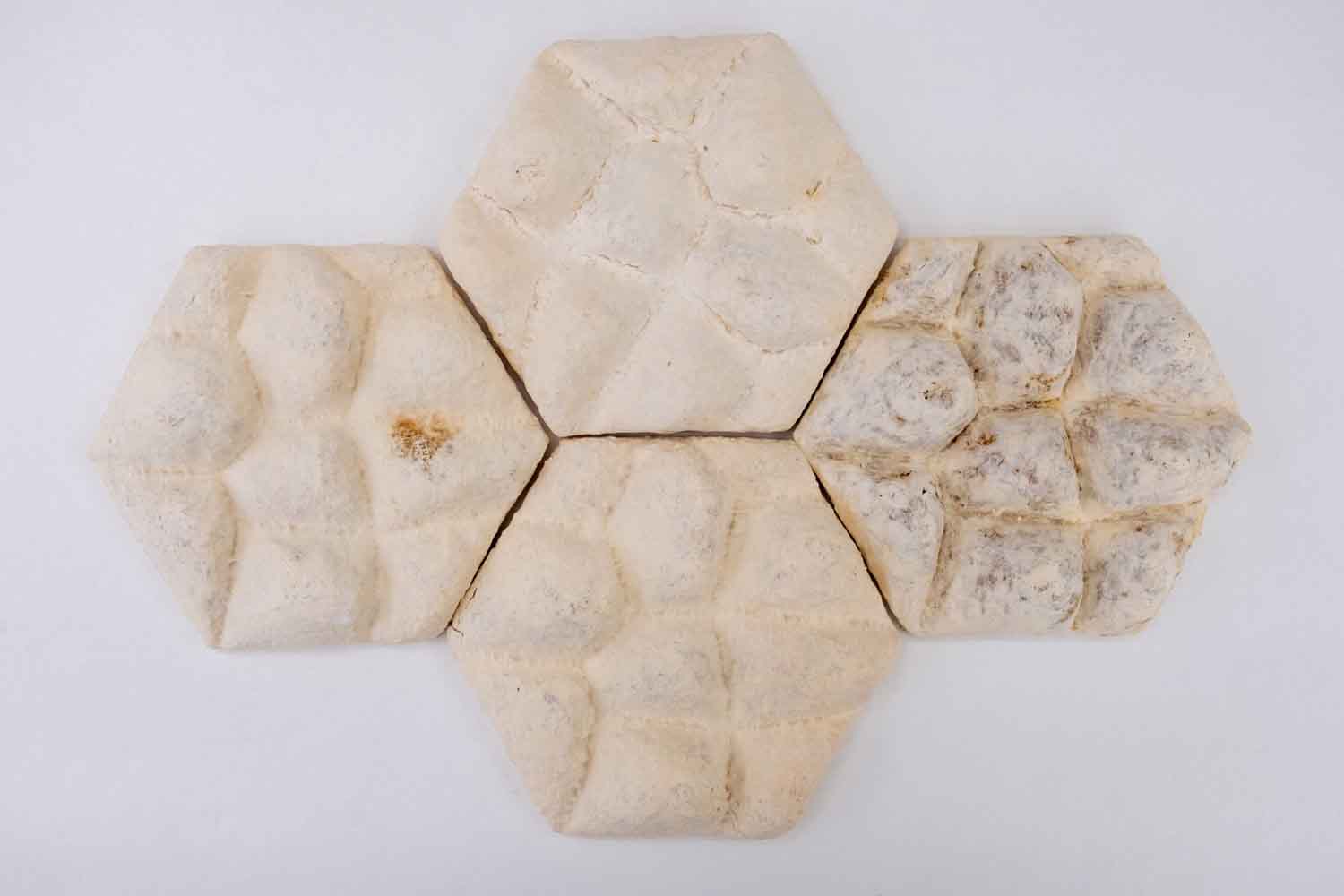
A group of researchers from the Nanyang Technological University of Singapore (Ntu), in collaboration with the ecological design company bioseahas developed an innovative technology for the thermal insulation of buildings: tiles made with mycelium – the network of mushroom roots – modeled to imitate the Rugged texture of the elephant skin. This material is not only biodegradablebut also allows a passive cooling of buildingsthus helping to reduce energy consumption.
The elephantswhile living in hot and humid climates, they do not have sweat glands. To regulate the body temperature, they rely on the wrinkles and cracks of their skin, which retain the water and favor its evaporation, thus cooling the animal. The researchers of NTU and Biosea were inspired by this natural mechanism to design their tiles.
During laboratory tests, tiles with wrinkled surface showed a cooling of 25% more effective compared to the flat ones. Furthermore, in simulated rainthe cooling capacity has improved 70%making them particularly suitable for tropical climates.
The mycelium used comes from the mushroom Pleurotus Ostreatuscommonly known as the oyster mushroom, while the organic support material is made up of bamboo chips obtained from carpentry waste. These ingredients are mixed with oats and water, then inserted in hexagonal molds with a tesuited surface through computational models, and left to grow in dark environments for four weeks, and then be dried in the oven at 48 ° C for three days.
Mycelium against synthetic insulating materials
The construction sector is responsible for about the 40% of the global emissions related to energy. For this reason, the search for Ecological insulating materials It has become a priority. The Myelio tiles offer one Valid alternative to traditional materials like glass wool or expanded polystyrene.
According to the Professor Hortense Le Ferrandresponsible for the study, “the current insulating solutions are mostly synthetic and involve environmental impacts throughout their life cycle. On the contrary, our material, in addition to being biodegradablehas one similar thermal conductivity or even higher to the materials currently used. “
THE’effect of elephant leather texture It has been verified with specific tests. By heating the tiles at 100 ° C for 15 minutes, it was observed that those tesuited absorbed the heat more slowly, with an increase in temperature of 5.01 ° C per minute, compared to 5.85 ° C of the flat tiles. During the cooling phase, the tesuited surface dispersed the heat at a speed of 4.26 ° C per minute, against 3.56 ° C of traditional tiles.
In addition, the water sprayed on the wrinkled surface accentuated thecooling effect by evaporationthanks to the hydrophobic nature of the fungal surface that retains water longer, further improving thermal regulation.
The next challenges: duration, scalability and mechanical resistance
Despite the promising results, researchers recognize some challenges for large -scale application. There production of tiles requires three to four weeksdue to the time necessary for the growth of the mycelium. Also, theexisting infrastructure For the production and distribution of conventional insulating materials it could hinder the adoption of these alternative solutions.
To overcome these obstacles, the team is working with the local start-up Mykílio For Increase the size of the tiles And test its effectiveness in real environmentsin addition to experimenting different strains of mycelium and improvements to increase its mechanical resistance and durability.
Professor Le Ferrand commented on the discovery:
Transforming agricultural waste and mushrooms into a functional and sustainable material represents an important step forward towards an ecological and innovative construction. It is only the beginning of what bioispiration and natural materials can offer in the construction sector.
