

From the 70s Dan Janzen and his wife Winnie Hallwachsbiologists of the University of Pennsylvania, observe the insects and their death between the deciduous and multiplative forests of the Guanacaste Conservation Areain Costa Rica. A drastic reduction of the population due to the increase in temperature, from the now irregular seasonality and poor rainfall.
In the early stages of his career, between the 60s and 80s, Janzen became a reference figure in the design and execution of field experiments in tropical ecology, in particular in Costa Rica, but also in Africa, Asia and Australia.
This led to the identification and documentation of at least 30 thousand species of plants, caterpillars and parasites and the study of numerous species of butterfly caterpillars, the plants that consume and the parasites that are nourished, in what is one of the most exhaustive works ever made in this sector.
Daniel Janzen’s wonderful study
As the The GuardianDaniel Janzen really started a observe Insects only after breaking three ribs. Almost fifty years ago, the young ecologist was in a dense Costa Rica forest to document the fruiting of plants, when he fell into a ravine. The long lens of his camera stood in his chest, breaking his ribs.
He managed to drag himself out on his own, for almost three kilometers, up to the nearest research hut. No close, no roads, no immediate possibility of reaching a hospital. So the bust was tied to a rocking chair with a sheet, and there remained, almost motionless, for a whole month. To look.
In front of him, a world teeming of life. Each branch hosted tiny worlds of creatures that chased, fed on, flew. The research center stood within the Guanacaste conservation area, a mosaic of humid and dry tropical forests, mangroves, coasts and nebulous forests: an area as large as New York, extraordinarily rich in biodiversity. The insects were everywhere, and the soil of the forest was literally covered by their excrement.
But the real show came at night. For two hours every evening, a 25 watts bulb above the porch was turned on. And from the forest a turbine emerged: swarms of insects launched towards the light, dancing in a vortex. The walls of the hut were filled with moths, “Tens of thousands”, Remember Janzen.
So he installed a sheet with a lamp and a camera – a common technique to monitor the quantity and variety of flying insects. In the first photo, taken in 1978, the sheet is so covered with moths that the fabric is barely visible: it looks like living wallpaper, dense and vibrant.
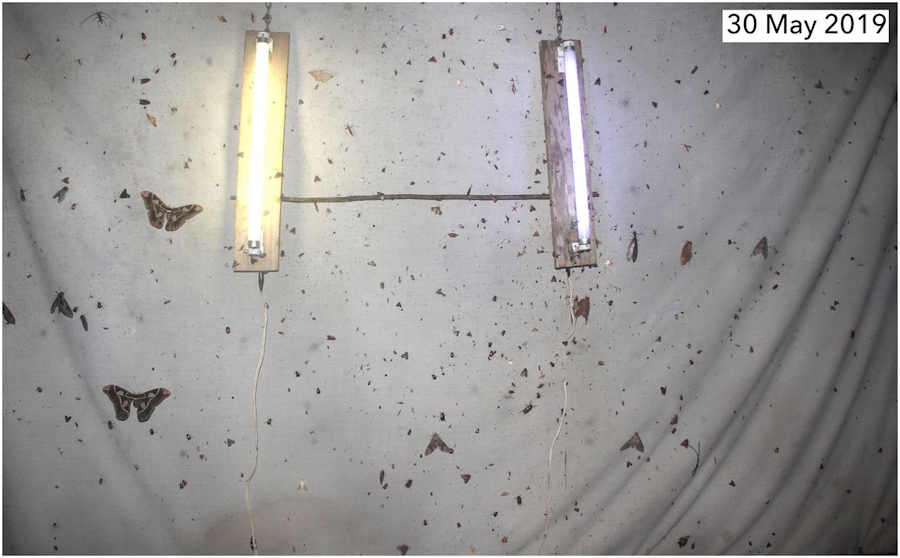
The researchers identified 3,000 different species from that only bright trap. Since then, Janzen abandoned the study of seeds to completely devote himself to documenting the still little known ecology of the moths and caterpillars.
A silent forest
Today Janzen is 86 years old and still works in the same hut, with his life and research partner, the ecologist Winnie Hallwachs. But around them, The forest has changed. The trees, once animated by an incessant path of insects, now seem immobile. Wild bees no longer buzz. The leaves remain intact, not even gnawed.
And they are precisely those leaves, shiny and perfectto frighten more Janzen and Hallwachs. They remember more a sterile greenhouse than a lively ecosystem. “It is no longer a forest. It is a museum.“
Even today Janzen continues to install the sheets with the lamps. But the result is despair.
It is the same sheet, with the same light, in the same place, in the same season, to the same lunar phase. But … there are no more drums.
Not only pesticides: the collapses are also in protected areas
The collapses observed by Janzen are not an exception. More and more scientists speak of one New phase of extinctionwhere losses even take place in remote and protected places, Far from the direct impact of man, including pesticides.
As The Guardian points out, international studies estimate annual losses between 1% and 2.5% of total biomass. Traditional causes are known: pesticides, fertilizers, light and chemical pollution, loss of habitats, intensive agriculture.
But what happens in Costa Rica goes further. Even in protected areas, where pesticides are not used, The insects are disappearing the same. And in a way “terrifying“, Says Hallwachs.
Alarming data all over the world
The phenomenon is global. In Germany, the flying insects in 63 natural reserves fell by 75% less than 30 years. In the United States, the beetles decreased by83% in 45 years. In Puerto Rico, the insect biomass has collapsed 60 times from the 70s.
In the southern US, the entomologist David Wagner He crossed Texas looking for insects. He came home empty -handed.
There was nothing. Everything was dry, burned. I saw very few lizards, no snake. Not even the predators were present.
Wagner recalls how in 2019 there was talk of an annual 1% drop in world biomass. But now, he says, that esteem was optimistic.
If we project even 2% of annual loss for 40 years, it means halving the entire tree of life in one generation. It is catastrophic.
A silent extinction
Understanding how many insects we have lost is difficult: for many species there is no basic data. Some groups (such as butterflies) have been monitored for decades, others have gone unnoticed.
And not all losses are uniform: some species resist, others even expand (such as mosquitoes or crickets), favored by changed conditions. But in general, The losers are many more than the winners.
And even those who doubt numbers can look at the indirect effects: the drop dramatic of birds, lizards and predators that feed on insects.
Those who do not believe in insect data can look at those on reptiles and birds. The food chain is collapsing, concludes Janzen.
