
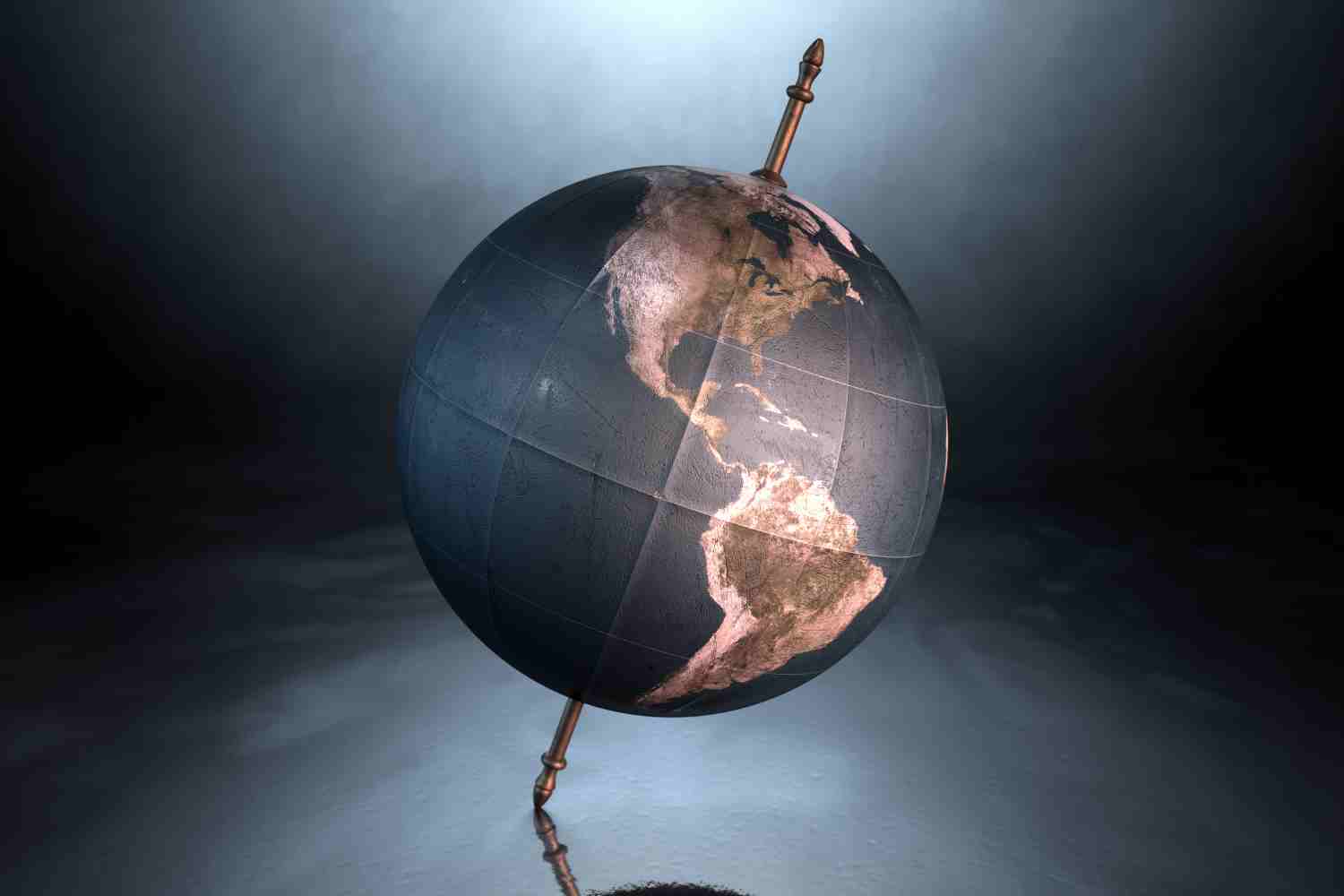
There is something deeply human in fearing what explodes, what screams, what suddenly breaks down. It is instinctive.
The wars – especially those nuclear – They do this: they cancel, devastate, break the illusion of control. Perhaps this is why, today, the idea of an atomic attack than that, now usual, of a summer without water, of a halved harvest, of a flood, where a neighborhood was a neighborhood, returns to us. Of an expanse of embers where it once breathed (and made us breathe) a forest.
Mark Lynasa scientific writer and popularizer involved in the fight against the climatic crisis for years, has recently declared that nuclear war today represents a greater threat than environmental collapse. He did it after three years of in -depth study, told in his latest book, and nobody can liquidate his thesis lightly. “There are no adaptation options for a nuclear war,” reports the Guardian. “Nuclear winter will practically kill the entire human population.”
It is difficult to disagree. And it is easy to let yourself be attempted by a risk ranking, as if you could really decide which catastrophe deserves more attention, more resources, more fear.
Yet this comparison between climatic crisis and nuclear threat risks becoming a dangerous game. Not because atomic war is not a real risk – it is – but because it takes energy from understanding what we are already living. Climate change is not a future hypothesis: it is chronicle, here and now. And every day more without action makes it a deeper, more irreversible, more unfair problem.
The climatic crisis does not have (or, better, not always) the roar of the sirens or the blinding glow of an incoming head. He often acts in silence. And precisely because it does not scream, it ends up being forgotten every time another emergency takes the center of the scene. But the two dangers are not excluded each other. Indeed, they feed. The growing scarcity of natural resources – water, food, habitable lands – is already an instability multiplier, an engine of regional conflicts, a pretext for new geopolitical tensions.
Europe and the fear of great collapse
In this context, the growing concerns of the Europeans should not be underestimated. A YouGov survey Last April shows that between 41% and 55% of the inhabitants of Western Europe consider the outbreak of a third world war in the next ten years. A feeling that is accompanied by distrust in defense systems, restlessness for relations with the United States and growing fear towards Russia, identified as the main threat.
But it’s not just a matter of missiles. What emerges is a crisis of trust in the future. In diplomacy, in institutions, in the very possibility of keeping peace, security and climatic justice together. In an era of automatic and arsenal weapons ready to launch, it is perhaps understandable that the echo of the atomic mushroom frightens more than the breath of the planet. But right here is the deception.
Stop worrying would be the real risk
It is not disaster theory: a restless Europe, an jammed diplomacy and a climate that continues to change under our eyes are the signs of a dangerous convergence. The real trap is not the comparison between threats, but the distraction. Think that we can face a risk at a time. That there is time for the climate after the war. That it is enough to turn off a fire to forget the drought.
The truth, unfortunately, is that neither of the two threats can be faced by itself. Nuclear security requires treaties, controls, patient diplomacy. The climatic crisis requires a structural, global, immediate change. Both require political responsibility, collective consciousness and courage. And if there is a lesson that we can draw from the renewed fear of the atomic apocalypse, it is this: the worst disasters are avoided only when refusing to consider them inevitable.
A future to save, in all its forms
The risk exists, but it is not yet fate. Weapons can be dismantled, reduced emissions, reconstructed cooperation. The treaties are not unnecessary paper, if someone decides to respect them. Speaking only about escalation generates resignation. Also telling the output routes, can generate action.
