
The Asian Calabrone – or Vespa Velutina – It has become one of the worst nightmares for European beekeepers. Accidentally introduced in France in the early 2000s, it quickly spread to many regions, also arriving in Italy and seriously threatening the survival of bees. His favorite prey, in fact, are precisely the Bees melliferefundamental for pollination.
But from the French region of Foreigna surprisingly simple and powerful invention arrives: an artisan trap, built with recycled materials, which has already eliminated thousands of specimens. Its creator is Jim Siclonamateur beekeeper and former retired logistics director, who decided to act when he saw his besieged hives.
An easy-to-build anti-calabrone trap, selective and cheap
Jim Siclon, now retired, has chosen to dedicate his time to the protection of bees, his great passions. When i Asian hornets They started threatening his colonies, he tried everything: even hitting them manually with a racket. But eliminating 50 a day was not enough.
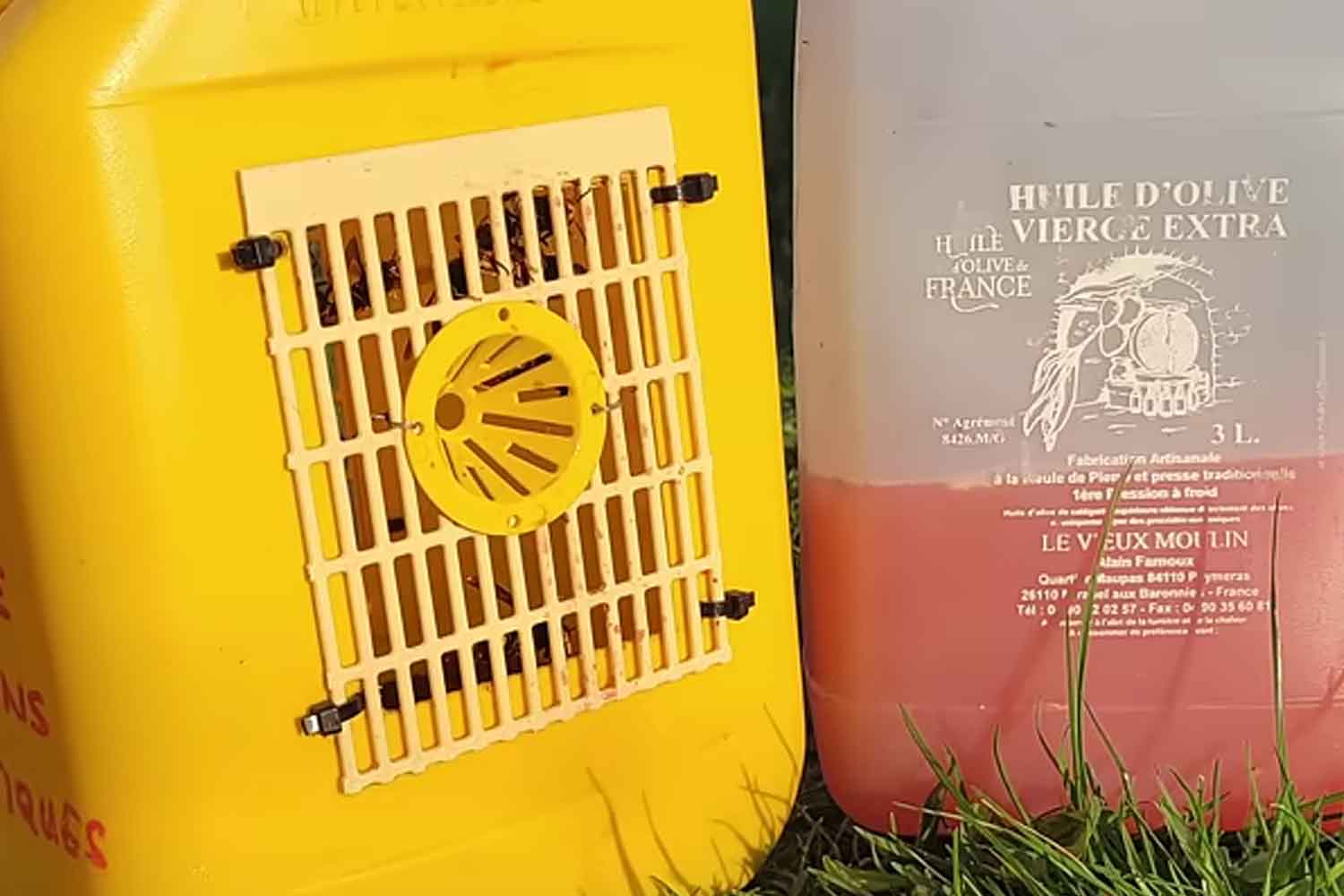
It is then that he had the intuition: reuse a 5 -liter plastic tank To create a artisan trap. The principle is simple: one funnel structure It allows the entrance of the hornets, but not that of the bees, of the European wasps or butterflies. Inside, sugary liquid is placed as bait. The result? A Selective and very effective trap: in just three weeks, with only two traps positioned in the right points, he captured 250 Calabroni.
The initiative was then extended thanks to the collaboration with other volunteers in the area. In a short time, over 6,400 specimens were captured in the region of the Loiraand all this with an investment of Less than 2 euros per trap. In addition, the device is easily operable, for quick cleaning and simple maintenance.
Next to the artisan trap, Jim also experienced one chemical technique Much discussed, but sometimes necessary. When the hornets completely prevented bees from leaving the hives, he tried an alternative solution: capture a hornet, apply a micro-gourness of insecticide and release it alive.
The idea is that the insect, returning to the nest, contaminates the rest of the colony – including the queen. In 3-5 daysthe activity of the nest can collapse drastically. Although this practice does not guarantee total elimination, the results observed in its two apiaries have been remarkable.
Jim admits that he is not enthusiastic to resort to chemistry, but underlines that, When alternatives are not enoughcan become an emergency resource.
A collective project, sustainable and within everyone’s reach
The strength of this initiative is not only in effectiveness, but also in the its accessibility. All the necessary materials – plastic tanks, grids, wire and sugar bait – are easily found in the home or low cost. On the AbeillenduForez.com website is available A complete tutorial To build the trap independently.
In a market where professional traps can cost up to 40 eurosJim’s “homemade” version represents The only economic option For many beekeepers, who often need to place dozens of devices in their land.
The initiative is also supported by Syndicat départental d’Aparture de la Loirewhich encourages every beekeeper a Start the capture already in early springto trap the queens and block the training of nests.
Jim Siclon’s is not a business, but A militant act for biodiversitya concrete example of how ingenuity, sharing and cooperation can still make the difference.
