
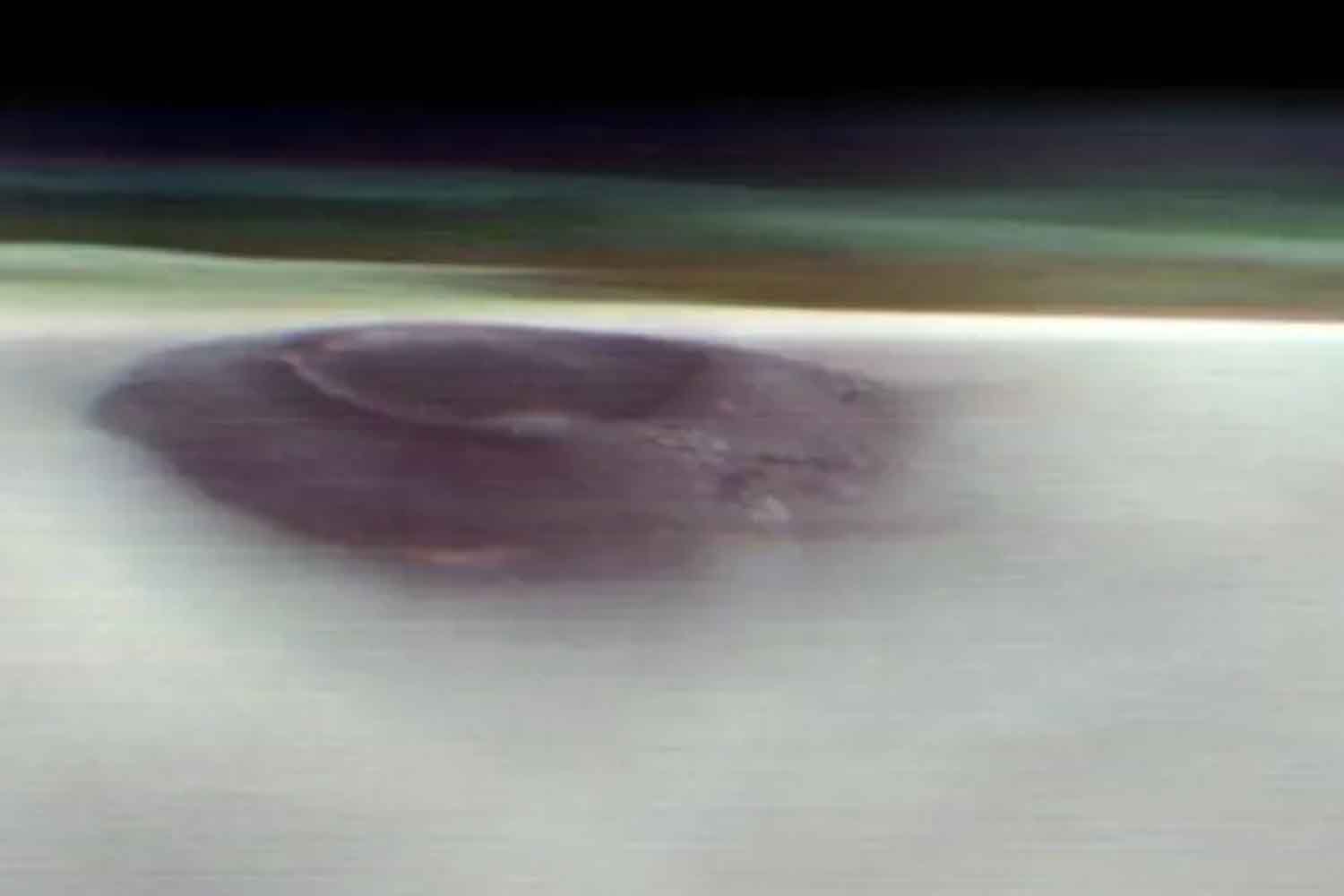
An image of rare beauty, poetic and at the same time extraordinarily useful for science. Just before dawn on May 2ndto Ben 240 million kilometers from the earththe probe Mars Odyssey Della Nasa immortalized A moment of cosmic wonder: the top of the colossal Vulcano Arsia Mons which rises beyond a often layer of Ice water cloudsstanding out against the Martian horizon Like a giant isolated in the midst of a sea of ice and silence.
What looks like a terrestrial landscape, with a mountain that challenges the clouds like the Everest among the mists of the Himalaya, is actually an alien portraitfamiliar and far at the same time. And it is also The first time in history we see A Martian volcano in this perspective: not from above, but in profile, with the top illuminated by the nascent sunin the midst of the thin reddish atmosphere of the planet.
The top of Arsia Mons emerges in the clouds in the coldest hour of Mars
Arsia Mons is not any mountain: It is one of the greatest volcanoes of the Solar Systemwith one Height of almost 20 kilometersmore than double of Mauna Loa, the most impressive volcano of the earth if measured by the ocean base. It is part of a volcanic chain located in the region of Tharsiswhich also hosts Olympus Monsthe highest mountain of the solar system, and two other giants: Pavonis Mons and Ascraeus Mons.
The view offered by this photo is something absolutely unpublished. The probe Mars Odysseyin orbit around the red planet since 2001, he performed a special maneuver: rotated 90 degreespointing the camera not towards the ground, as usual, but towards the horizon. Only in 2023 NASA began to experiment with this type of “Limb View” observations, and that of Arsia Mons is alone fourth image of this type never taken.
At this stage of the Martian year, called aphelionMars is found Maximum distance from the sun. Temperatures descend abruptly and A water clouds belt It forms around the equator. I am seasonal cloudsalready known to scientists, but Never observe like thisfrom the bottom up, with the summit of a volcano that crosses them Like a ship in a sea of fog.
“We hoped that the top of Arsia Mons appeared above the morning clouds … and did not disappoint us“, He said Jonathon Hill ofArizona State Universitywho guides the camera operations aboard the probe. The result is an image intense and suggestivebut also scientifically precious.
Not only poetry: the clouds that surround Arsia Mons tell how the atmosphere of Mars works
This image is not just a show for the eyes. It is also a mine of information For scientists who study The Marzian atmosphere. The immortalized clouds are composed of water icenot from carbon dioxide. They are formed when thecold air It is pushed up along the steep slopes of the volcano: By climbing, the air expands and cools further, until it condenses into tiny ice crystals.
During the aphelium, this process becomes more intense, allowing scholars of observe how the atmosphere interacts with the geography of the planet. “We are discovering very significant seasonal differences thanks to these images on the horizon,” he explained Michael D. Smithscientist of Goddard Space Flight Center of NASA. It is a unique opportunity for better understand the evolution of the climate on Mars.
Mars Odyssey has been active since 2001, and to date it is The longest operational mission around another planet. His initial goal was to map the chemical and mineral composition of the Martian surface, but over time it has also become anobserver of the atmosphereone spatial photographerand an essential tool for The planning of future human missions on Mars.
The merit is also of the Themis camera (Thermal Emission Imaging System), able to capture images both in the visible and infrared. The latter mode is particularly useful for identify underground ice reserveswhich could prove to be vital for Missions with human crewproviding Water, oxygen and fuel.
The Themis camera is also able to monitor the seasonsobserve The Martian moons Phobos and Deimosand document changes in dust and clouds. The image of Arsia Mons is part of A new series of observations on the horizonmore and more precious for understand atmospheric and geological phenomena of the red planet.
Beyond beauty
Arsia Mons is the more southern of the three main volcanoes of Tharsis Montes. The observations also conducted by the probe Mars Express of the ESA revealed Spectacular collapse areas on its hips: immense craters of up to two kilometers deeporiginating when the lava emptied the underlying magmatic chambers. Once empty, these rooms they collapsed under the weight of the rocks aboveleaving deep glimpses on the Marzian surface.
For engineers and scientists who are planning the next missions, both robotic and human, images like this are much more than suggestive. Offer Vital data on where and when it is better to landon how the climate behaves in certain periods of the year e which natural dangers can hinder a possible mission.
What at first glance may seem only A spectacular photois actually An essential tool for building the future of space explorationa future that, every day more, brings us closer to us to the dream of walking one day on Mars.
