
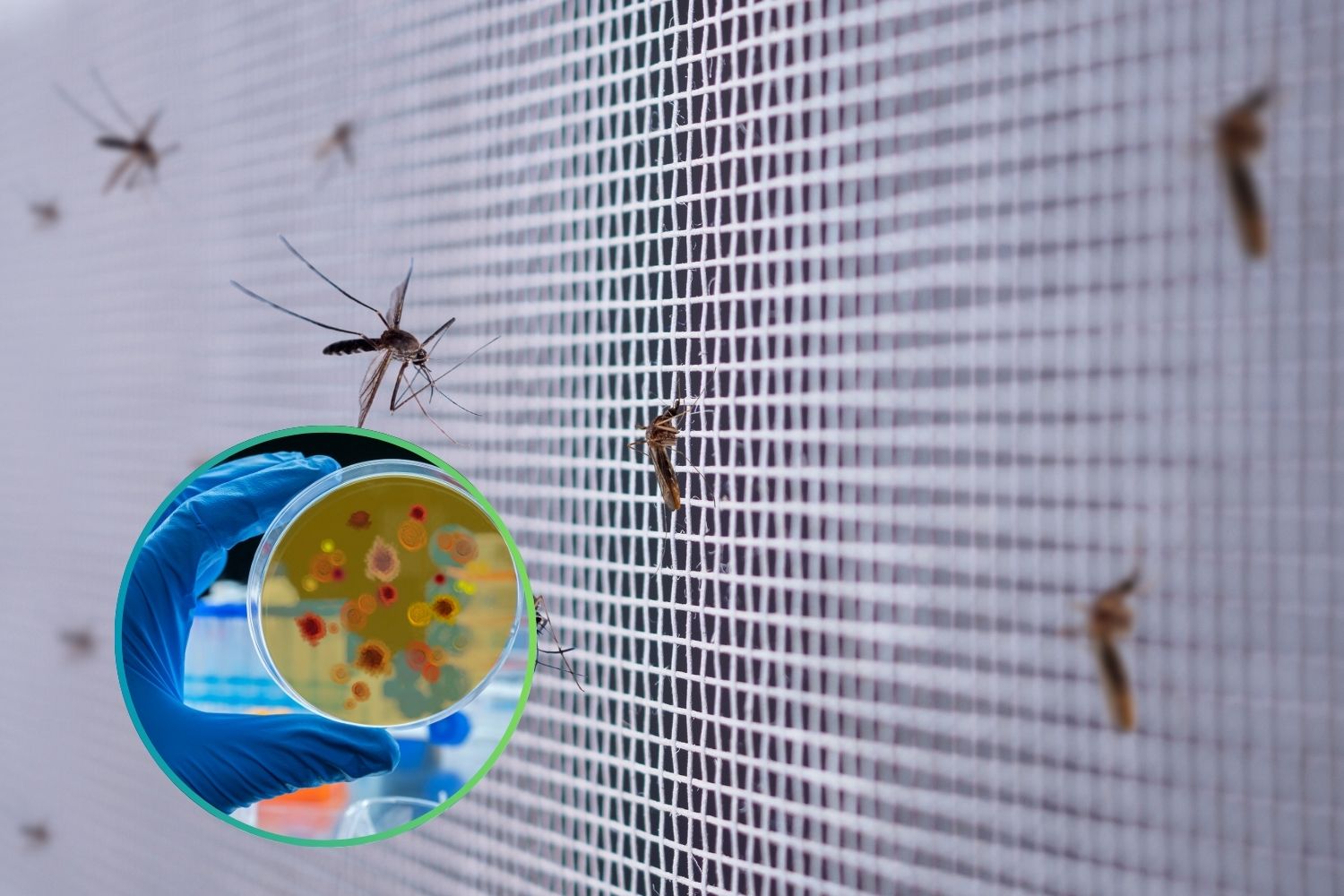
Every evening, in Burkina Faso, as soon as the sun disappears on the horizon, skies of mosquitoes begin to dance in the air, bringing with it the silent threat of malaria. It is one of the oldest evils of humanity, and still kills further today 600,000 people per yearlargely children of sub-Saharan Africa. But now, a new strategy – as bold as they are ingenious – could radically change the rules of the game: A genetically modified mushroomtransmissible through matingcapable of exterminating female mosquitoes in less than two weeks.
An international team of researchers, led byMaryland University and from theInstitut de Recherche en sciences de la Santé of Bobo-Dioulasso, has conceived a technique that seems to have come out of a science fiction novel, but which has its roots in the natural biology of insects. The goal? Drastically reduce the population of mosquitoes that transmit malaria by exploiting their reproductive behavior.
How this biological weapon really works
The protagonist of this discovery is the Metarhizium Pingshaensea mushroom already known for its lethal effect on insects. Researchers have genetically changed it to produce a hybrid neurotoxin: mortal for mosquitoes, but completely harmless for humans, animals and other species.
In detail, mosquito males are “dusty” with the spores of the modified mushroom and then released in environments that simulate natural conditions. Once free, they normally mate, but they transfer the fungus to the females during sexual intercourse. The results? Stunning: 87% of female mosquitoes die within 14 daysagainst only 4% of the control group.
And it does not end here: The mushroom does not alter the sexual behavior of mosquitoes. Females do not avoid infected males. Indeed, they continue to mate with the same frequency. A crucial detail that makes this technique extremely effective. In addition, males remain contagious for at least 24 hoursthus infecting More partner in a short time.
Professor Raymond St. Leerexpert in entomology at the University of Maryland and co-author of the study, underlines that the real advantage lies in this: “While insecticides are losing effectivenessthis approach uses a fundamental aspect of the life of mosquitoes: reproduction. And that’s right that we hit them. “
From research to the field
The work of the researchers, published in the magazine Scientific Reportswas conducted in Burkina Fasowith the aim of finding concrete solutions to be applied to the field. The team compared two versions of the mushroom: the wild one and the genetically modified one. Only the latter caused a sufficient mortality rate to be able to think of a real impact on the spread of malaria.
It is important to note that The infection is transmitted only through mating. Sharing the same space is not enough to infect females. This makes the technique extremely targeted and selective.
In a context in which the mosquitoes are changing habits to escape conventional strategies – For example, feeding outdoors instead of at home, where there are mosquito nets treated with insecticides – the mushroom represents a weapon that wanders these adaptive behavior.
Not only that: the toxin produced by the mushroom interferes with the capacity of the mosquitoes to perceive insecticidesmaking them more vulnerable also to chemical treatments. “It’s a double blow: he kills them and, if they survive, weaken them,” explains St. Leer.
However, before thinking about a large -scale application, there are still several aspects to evaluate. Wider studies are needed, the most extensive field tests and an ethical reflection onIntroduction of infected males in natural ecosystems. Also apparently secondary details, such as the time of release (close to sunset) and the position of the sites with respect to the direction of the sun, they can influence the effectiveness of the method.
Malaria is still a global threat
Despite decades of campaigns, drugs, insecticides and preventive strategies, malaria remains One of the main causes of death in Africa. According to some estimates, mosquitoes may have killed half of the human population in historythrough the diseases they transmit.
In recent years, parasites have begun to Develop drugs to drugs such as Artemisininewhile mosquitoes become increasingly resistant to insecticides. It is evident that new, alternative tools are needed, integrated with existing solutions.
And here the mushroom transmitted sexually comes into play. A simple, but disruptive technologywhich could join other techniques already known such as the Sterile Insect Technique (sit) or the use of bacteria Wolbachiacapable of blocking the transmission of malaria.
It is a continuous race. Every time we find a new weapon, the mosquitoes adapt. But with this approach, we could finally be a step forward.
In the heart of Africa, between fields and villages, it could be proper a microscopic mushroom, transmitted during the act itself that perpetuates the speciesto change the fate of millions of people.
