
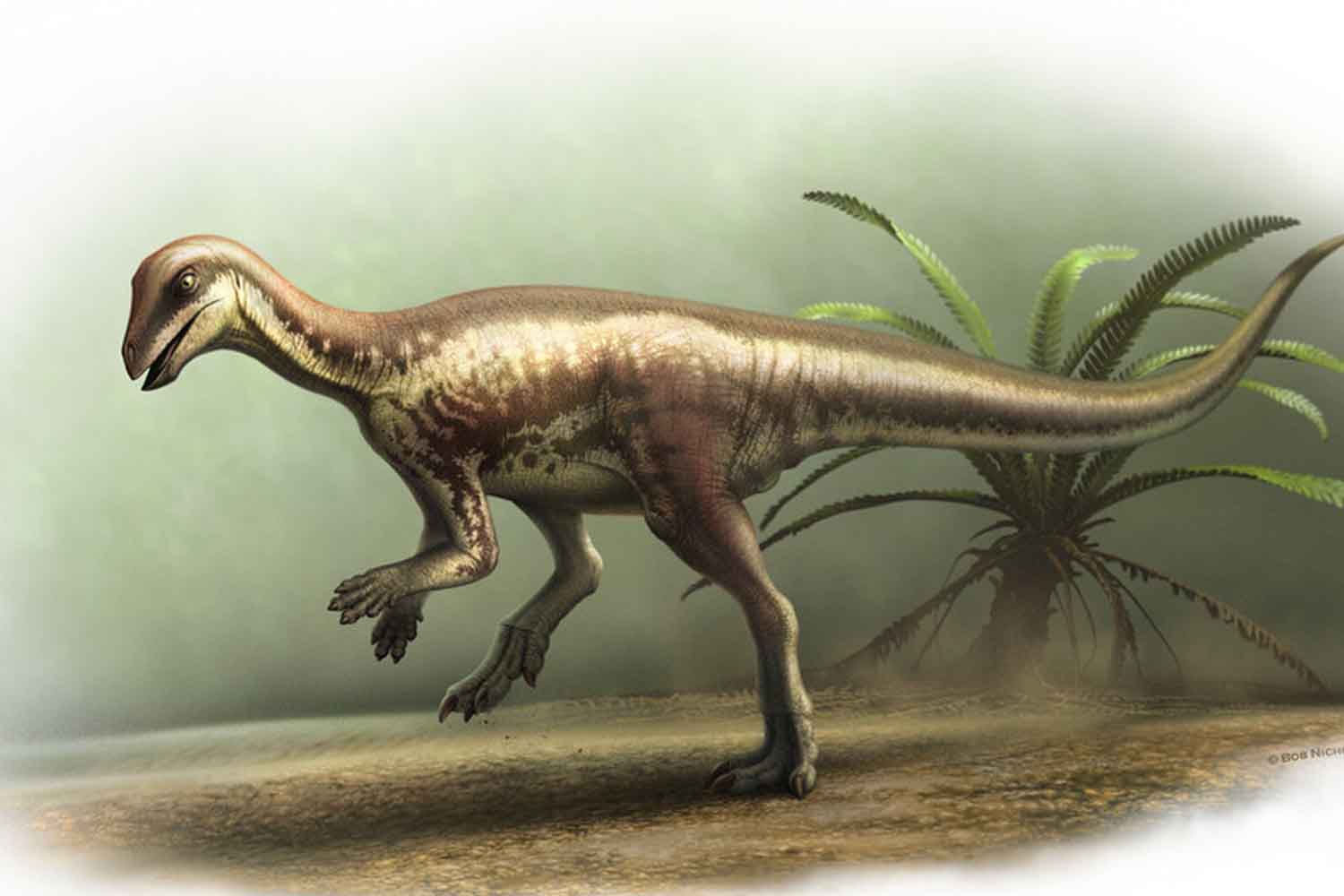
A new specimen of dinosaur, small but fundamental for paleontology, has been officially identified: it is called Enigmatursor Mollyborthwickae and is already visible to the public to Natural History Museum in London. His discovery throws new light on a group of herbivorous dinosaurs so far neglected and puts an end to a scientific case that has been persisted for over a hundred years.
The Enigmatursor fossil is the most complete ever found of its type, and its classification helps to clearly distinguish this new species from other specimens poorly interpreted in the past, in particular in the famous Morrison Formationan American geological formation dating back to the late jurssic, famous for having returned remains of iconic dinosaurs such as Allosaurus and Stegosaurus.
A small agile dinosaur lived 150 million years ago
During the late Jurassic, between 152 and 145 million years ago, the Morrison Formation was an extended alluvial plain crossed by rivers and populated by grassy giants such as Diplodocus and agile predators such as Ceratosaurus. In this prehistoric scenario, dinosaurs of small size also coexisted, such as Enigmacursora herbivore with long legs, probably capable of escaping predators thanks to speed.
The name Enigmacursorwhich means “mysterious runner”, he reflects precisely this feature. The species was dedicated to Molly Borthwickpatron whose contribution made possible the acquisition and exposure of the fossil. Despite the specimen found measuring just one meter, scholars believe that he was a young individual, since he presents neural arches – the superior structures of the vertebrae – not yet completely melted, an age indicator in the dinosaurs.
The exact origin of his death remains unknown: the bones do not show evident signs of wounds or diseases. However, his body was buried in the sediments of the Morrison Formation, where he remained preserved until his rediscovery millions of years later.
A resolved paleontological enigma
The Enigmatursor fossil was excavated between 2021 and 2022 on a private land and initially put on sale as belonging to an alleged Nanosaurusa name assigned in 1877 to another small dinosaur, but based on extremely fragmentary remains and difficult to interpret. After the purchase by the Natural History Museum, the Paleontologists Susannah Maidment And Paul Barrett They started a new analysis, coming to the conclusion that the fossils attributed to Nanosaurus were too incomplete and unsuitable to represent a species in itself.
The well -preserved bones of Enigmatursor, which include limbs, even and portions of the spine, have allowed a more precise reconstruction thanks to the comparison with similar species. Some missing elements have been digitally reconstructed. The researchers also carried out one 3D scan of the fossil, so as to make it accessible to scholars from all over the world for further analyzes.
According to the two scholars, the rediscovery of Enigmacursor opens the way to the classification of other small dinosaurs preserved in international museums but never formally identified. Some could represent new species still unknown to science. This shows how crucial taxonomic work is in modern paleontology, as Maidment explains:
Tassonomic work is often underestimated. Yet it is the basis on which all paleontology is based. If we make the classification wrong, everything else collapses. It is essential to invest resources in this field.
