
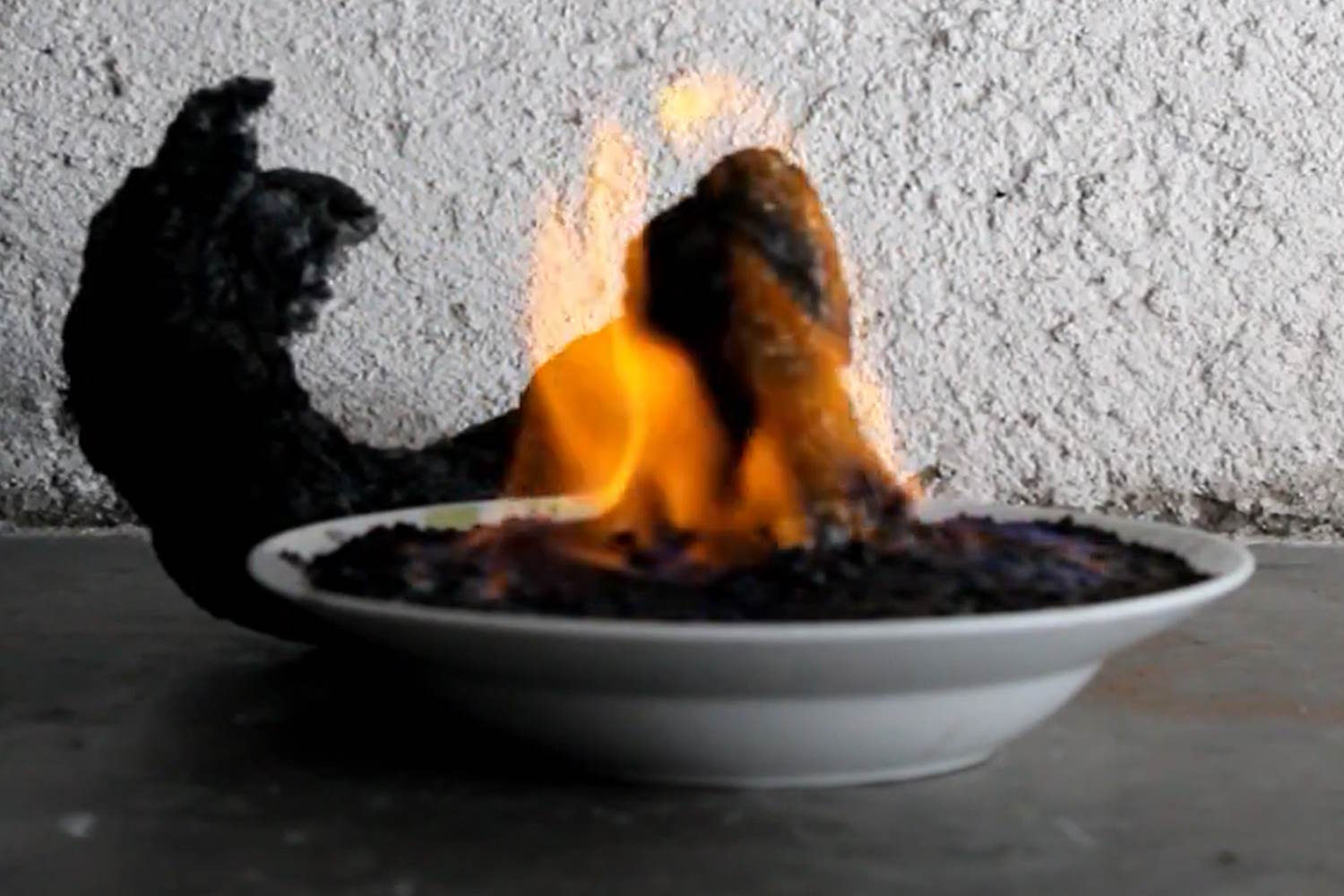
Faraone snake: no, it is not a kind of reptile, but what is formed generates from one chemical reaction “Simple” but spectacular (and very dangerous). What is produced really seems to be the gate of hell and the fumes that are created are highly toxic. Absolutely not to do at home!
Chemically the snakes of the pharaoh are the product of the thermolysis of the Tiocianato di Mercury, a chemical reaction that in a few seconds generates one great serpentine foam. Which, mixed with the heat generated (and toxic fumes) really seems to Port of Hell how legends describe it.
This reaction was discovered by Friedrich Wöhler In 1821, after the thiocyanged synthesis of Mercury, which described the product just as worm, remaining an amazed of what was happening.
For some time, the product was even sold as a firework Or a festive trick, but, as soon as his overall toxicity was clear, this practice was (fortunately) abandoned.
The chemistry behind
Mercury’s thiocianate is a dust which, if heated, produces at the beginning only a thread of smoke, but then also one strange structure similar to a snake Which is twisted and turns over as it extends upwards, sliding into a slower turns. The ash generated, in fact, becomes long and similar to a snake, giving the illusion of a snake that gets up from the ground.
Here, in formulas what happens (with no easy to determine times):
2hg (SCN)2 → 2HGS + CS2 + C3N4
Where HG (SCN)2 It is precisely the Tiocianato di Mercurio, HGS the Solfuro di Mercurio, CS2 carbon sulphide while c3N4 carbon nitrurise.
But it does not end here because the CS2irritating and flammable, reacts with air oxygen, producing carbon dioxide and sulfur dioxide:
CS2 + 3o2 → CO2 + 2SO2
At this point the temperature is climbing (the latter reaction, in fact, is exothermic) and also our carbon nitrurise decomposes itself, freeing nitrogen and cyangeno
2C3N4 → 3 (CN)2 + N2
And the mercury sulphide? He too reacts with the oxygen of the air, producing mercury and further sulfur dioxide
Hgs + o2 → HG + I know2
And here we see the snake get out of our small lump of dust, but also many toxic fumes. In addition to carbon dioxide and sulfur dioxide, mercury that forms for these temperatures produces vapors. A mix absolutely to avoid!
The less toxic version
Actually there is a less toxic way To obtain a very similar result. While always not recommending to venture into chemical practices at home, especially without experience, the “light” version is still spectacular and at least less dangerous. In fact, we can also obtain the “snake” with sugar, baking soda, sand and alcohol.
First we have to mix sugar and baking soda in a ratio of about 4 to 1, then wet everything with the sand in turn covered with alcohol and heat: the result is a long black “snake” of ash that twists, rising from the initial dust. Chemically takes place very similarly, but leaving and arriving with safer substances.
