
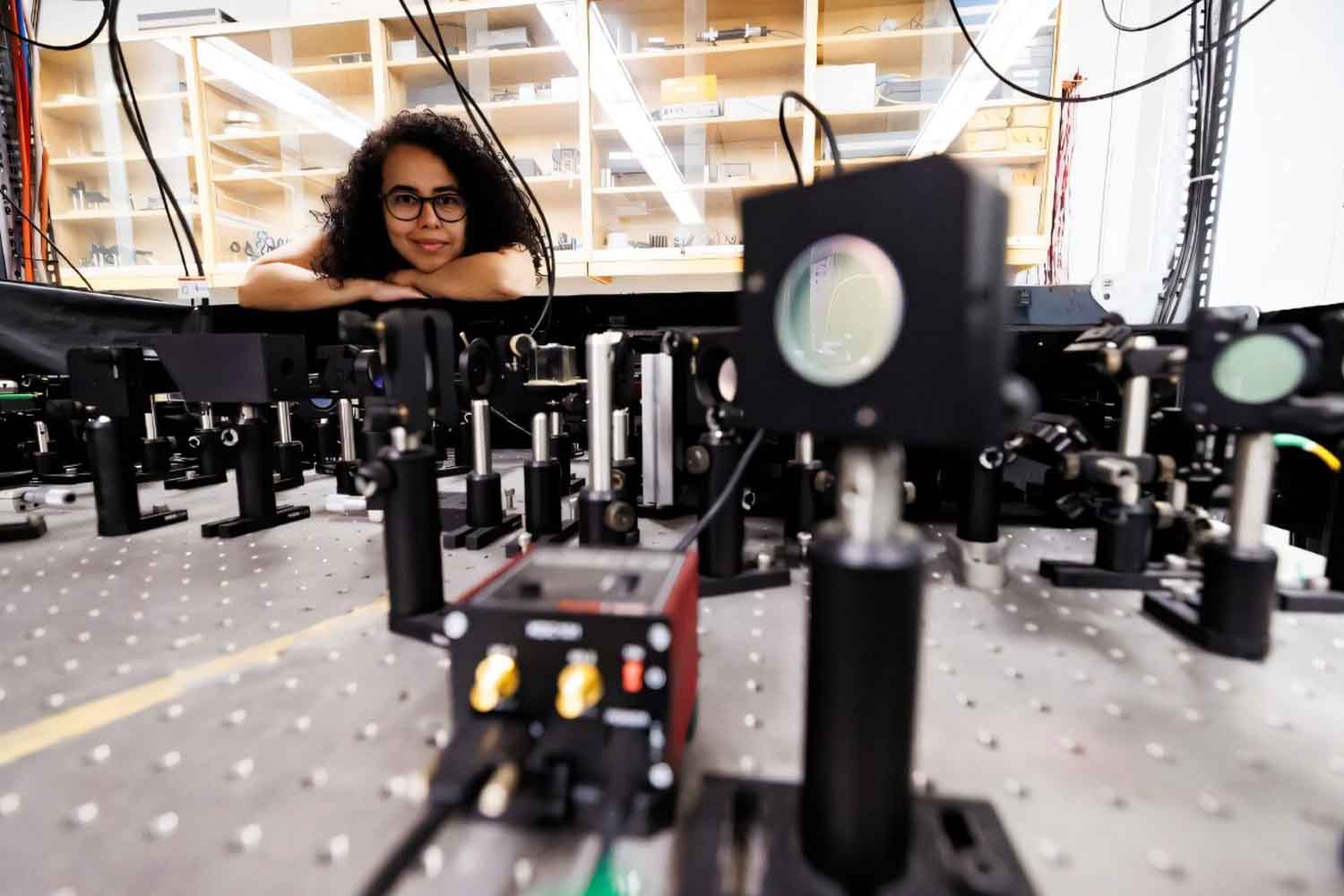
In an underground workshop full of mirrors, laser and threads, a team led by physicists AEPHRAIM Steinberg And Daniela Angulo has made an extraordinary observation: Time can take on negative values. The results, described in a preprint on Arxiv, question conventional theories on the behavior of light and matter.
The study focused on the interaction between photons And atoms. When a photon crosses a material, it is first absorbed, exciting the atom, and subsequently emitted. The time necessary for this process is usually measured in positive units. But in some cases observed, The time recorded was less than zeroas if the photon had come out even before entering.
This does not mean that time trips are possible, nor that the fundamental laws of physics is violated. According to Steinberg, the phenomenon simply shows how much quantum mechanics is distant from daily intuition_
Even among us physicists it is difficult to talk about it.
The concept of negative time divides the scientific community, but opens new frontiers for quantum physics
For decades, the concept of negative time was considered a theoretical bizarre, linked to distortions in the way light interacts with materials. However, the new experiments suggest that it is not only an optical effect. The collected data instead indicate a probabilistic behavior of timeconsistent with the essence of quantum mechanics: a universe in which events can happen in a non -linear way.
Not everyone, however, are convinced. Physics Sabine Hossenfelder defined the outflow “negative time” terminology, reducing it to simple phase feeds photon along its path. In a very popular video on YouTube, he said that it would not be a new property of the time at all. But Steinberg and Angulo defend their conclusions:
Our data are solid. We do not want to rewrite physics, but to underline how surprising quantum measurements are compared to classic expectations.
Even if the practical application of this discovery appears far away, the implications could extend to sectors such as the quantum computation and the telecommunications.
We consciously chose the words to use to tell our results. The data speak for themselves. We are ready to perfect the interpretations as we understand better what is happening.
