
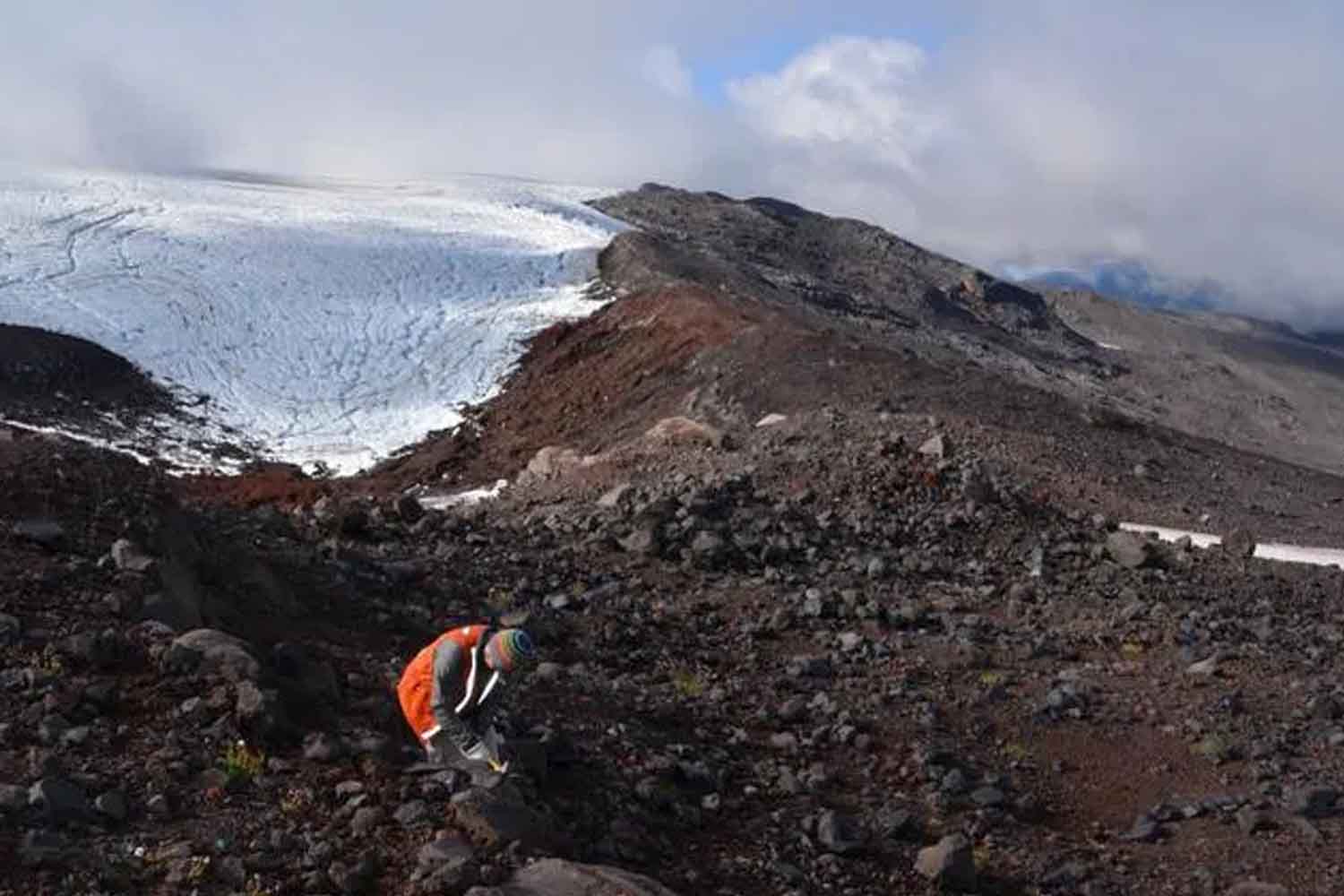
Thousands of years ago, the south of Chile was buried under a thick and impressive glacial blanket. Those glaciers, pressing on the earth’s crust, they suffocated volcanic activitypreventing the underground forces from freeing themselves. Ice acted like a natural cap, holding magma and gas below. Today, however, the situation is changing.
According to a recent study presented at the Goldschmidt conference in Geochimica in Prague, global warming could trigger the same explosive mechanism on a planetary scale: The dissolution of the glaciers relieves the pressure on the earth’s crust and the volcanoes respond … erupting with greater violence.
Pablo Moreno YaegerGeoscientist of the University of Wisconsin-Madison, the main author of the study, explained:
When the glaciers withdraw, we see more frequent and more explosive eruptions.
The connection between ice and magma
Scientists have been knowing for some time that glaciers have exerted a considerable weight on the earth’s crust. When the ice melts, the pressure drops, the magma dates back and trapped gases get rid ofoften with explosive results. Brad Singervolcanologist and co -author of the research, said:
It’s like opening a bottle of Coca-Cola: the gas under pressure comes out on the bubbles.
This phenomenon has been observed evidently in Iceland. After the end of the last ice age, about 10,000 years ago, volcanic activity on the island has increased up to 50 times compared to glacial periods. But now the scientists wonder if the same is taking place elsewhere.
Using the dating to the radioactive argon and the analysis of microcrystals, the team of researchers studied Six volcanoes in the Chilean Andesa region once covered by the gigantic Patagonian glacial capwhich extended for most of the southern South America during the maximum glacial (26,000–18,000 years ago).
The results are clear: The ice acted as caps that blocked the magmatic chambers. When these glaciers retired, the pressure decreased and the volcanoes activated. An emblematic example is The Mocho-Choshuenco volcanoborn from a huge eruption favored by the ice retirement.
Beyond Chile: 245 active volcanoes are less than 5 km from the glaciers
The fact that experts are the most alarmed is the presence of 245 active volcanoes within a radius of only 5 kilometers from glacial masses. Some of them are in particularly vulnerable areaslike Antarctica, North America, Russia and New Zealand.
Western Antarctica is the most worrying case: Under the often more than 100 active volcanoes. Among these, the glacier stands out Thwaitesnicknamed “Doomsday Glacier” (glacier of the day of judgment), which is withdrawing at an alarming rhythm.
This scenario could give life to a dangerous vicious circle. Volcanic eruptions release heat that accelerates the fusion of the ice, which, in turn, triggers new eruptions. The result? A domino effect capable of irreversibly altering global climatic balance, as Moreno Yaeger pointed out:
A positive cycle is created: the glaciers that melt cause eruptions, and the eruptions increase heating and therefore dissolution.
Furthermore, eruptions have a direct atmospheric impact. The release of aerosol sulphates reflects sunlight and can temporarily cool the planet, but The accumulation of greenhouse gases such as Co₂ and methane It can cause long -term heating. A threat that adds to the already complex framework of climate change.
A global scenario
Already in the 70s, some studies had hypothesized a correlation between glacial fusion and increased volcanic activity. But the new research provides much more solid tests, connecting The real chronology of the dissolution of glaciers to that of eruptions.
A study published in 2020 in the magazine Global and Planetary Change He also shown that the glaciers close to the volcanoes melt the 46% faster compared to the distant ones. The heat coming from the terrestrial depths could, therefore, thin the ice even “from the bottom”.
Among the risk areas include the Fall chain in North Americathe peninsula of the Kamčatka in Russia and the volcanoes of the New Zealandwhere glacial caps still cover active magmatic chambers.
Although the research does not allow to predict When and where new eruptions will take placethe alert launched by scientists is clear: we are entering a geologically unstable phase, where The underground fire responds to the call of ice that disappears.
