
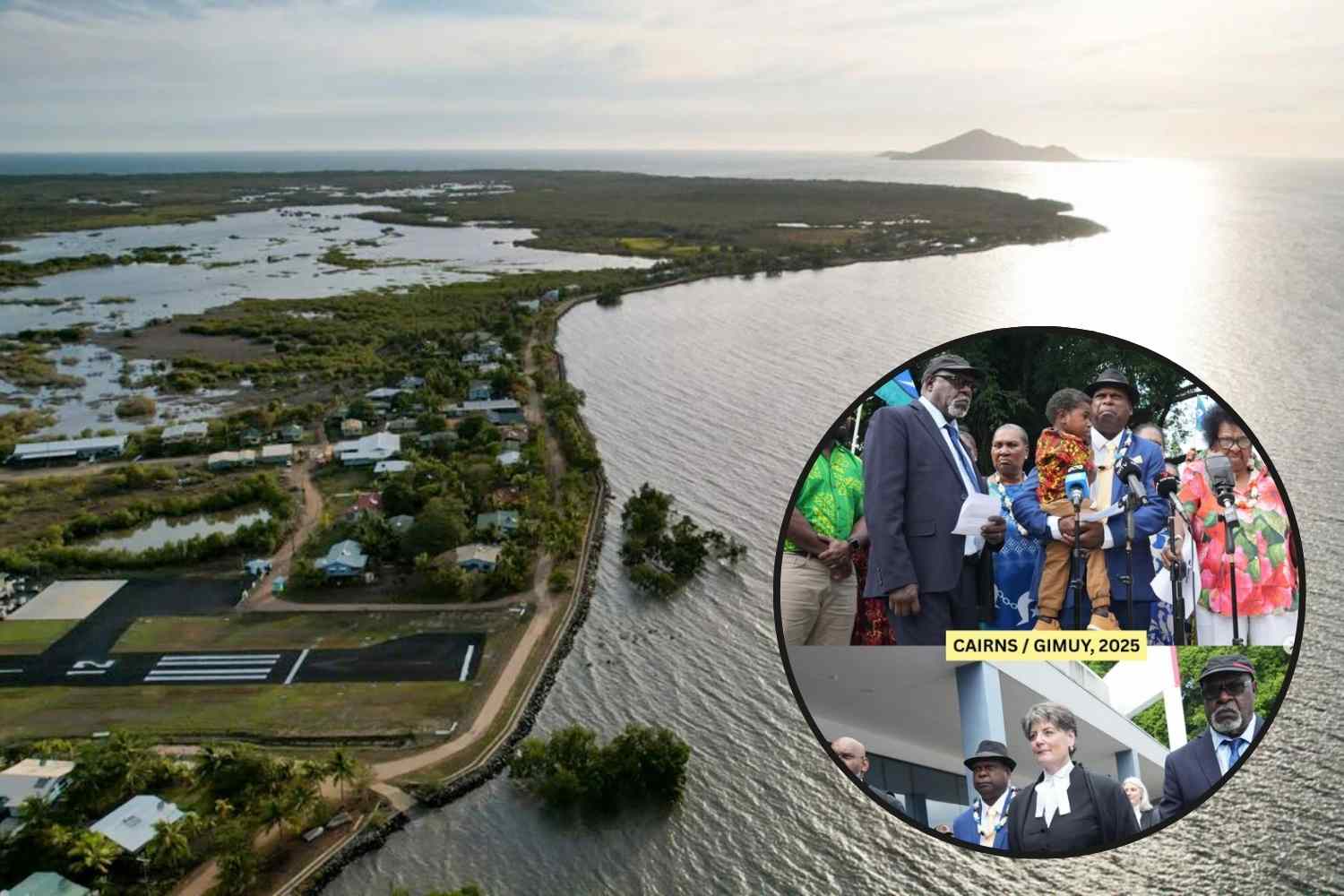
A verdict expected for years has arrived on Tuesday 15 July from Australian Federal Court: the elderly Pabai Pabai and Paul Kabai, representatives of the inhabitants of the islands of Boigu and Saibai in Strait of Torreshave lost their cause against the Commonwealth government. The reason? According to the judge Michael Wigneythe executive has no “legal duty of diligence” towards their community regarding the climatic crisis.
A battle for the climate and rights
The cause, which began in 2021, aimed to establish a precedent: legally recognizing that the state has a duty to protect indigenous populations from the impacts of the climatic crisis. The inhabitants of the islands of the Strait of Torres, located between northern Australia and Papua New Guinea, they are among the most exposed to the rising of sea level. As documented in the procedure, subsidia, the saline floods and the destruction of the coast are already compromising their habitability, as well as irreparably damaging ancestral tombs and cultivable soils.
The request of the elderly was twofold: the government should have adopted climatic objectives compatible with the limit of +1.5 ° C established by the Paris agreements, e finance infrastructures such as coastal dams to protect the territory. But for the Court, these requests are part of the “political choices”, which cannot be evaluated by a judge.
“I have a broken heart”: the weight of the verdict
“I thought the decision would be in our favor, and I’m in shock,” he said Paul Kabai In Aljazeera after the sentence, cited by the AFP agency. “What will we say now to our families?”. Pabai also expressed deep disappointment: “I have a broken heart for my family and my community”.
View this post on Instagram
Their frustration is reflected in years of mobilization to see not only the right to physical survival recognized, but also to cultural continuity. Forced migration, inevitable if the islands became uninhabitable, would compromise the link with the earth and the transmission of Ailan Kastom, traditional centuries -old practices.
A sentence that makes you discuss
Judge Wigney recognized that “the inhabitants of the islands of the Strait of Torres face a blue future” due to climate change. However, he rejected the idea that a court may oblige the government to reduce emissions according to the “best scientific data available”, because it would mean interfere with complex political processes.
Yet, the government is the signatory of the Paris agreement, which provides for the obligation of action “based on the best science”. For this reason, according to the lawyers of the complaints, Australia would have violated a commitment that should also be considered in court.
A missed opportunity for Australian law
Many had seen in this case a potential turning point similar to Mabo sentence of 1992which recognized the land rights of Australian Aborigines for the first time. In a similar way, the cause of the islanders sought the legal recognition of cultural loss due to the climatic crisis.
But once again, according to Australian law, when we enter into the merits of political decisions, the courts tend to take a step back. The distinction between politics and law remains nuanced and often exploited to avoid binding decisions.
What remains after the defeat
The decision represents a step back for the movement for climatic justice and for the rights of native peoples. However, it is not a definitive closure. On a global level, the number of causes in which the judges recognize governments the duty to protect citizens from climatic damages grows.
As pointed out in an analysis published in The Conversation, “it is only a matter of time before the right adapts”. Because the damage of climate change is not future: they are already present. And in many coastal areas of the world, as in the Strait of Torres, the border between environmental justice and social justice has become indistinguishable.
The message that comes from this sentence is clear: the Australian law is not yet ready to fully face climate challenges. But the waves, like change, do not stop at the beach line. And they will return, more and higher, to beat the doors of the classrooms.
View this post on Instagram
