
In the heart of a Japanese laboratory, the scientists of the National Institute of Information and Communications Technology (NICT) have broken any previous record, broadcasting 127,500 gigabytes per second on a distance greater than 1,800 kilometers—Ly the distance between Chicago and Dallas.
During the Optical Fiber Communication Conference held last April in San Francisco, the team presented the result to the world: a speed of 1,02 Petabit per secondmore than double the previous record and over 3 million times faster than the average home connection in the United States.
A result that, as declared by Nict, represents “a fundamental step towards the development of scalable networks and with very high ability able to respond to the growing global request of data. “
To get an idea of the scope of the goal achieved: at this speed it is possible Download the entire Netflix catalog in less than a secondor The entire Archive Archive Archive – which includes millions of books, videos and web pages – in Less than four minutes.
How the new fiber works
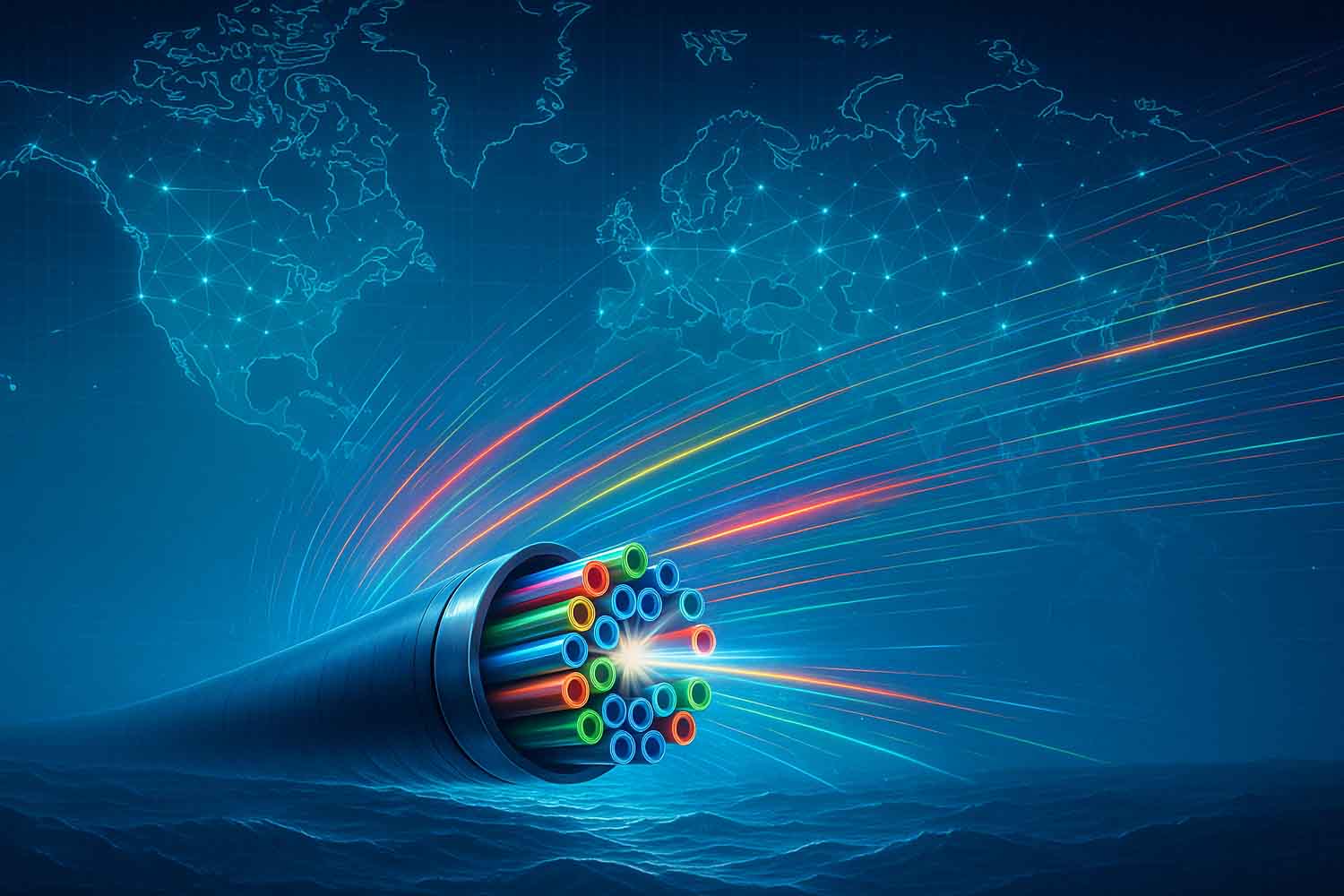
To make this extraordinary goal possible is a surprising technological innovation: A fiber optic cable with 19 coresthat is to say 19 independent glass channelsall contained in a wire of the thickness just 0.125 millimeters—Addly as much as the standard optical fibers already installed under the oceans and inside skyscrapers around the world.
The main advantage? Total compatibility with the existing infrastructure. It will not be necessary to replace kilometers of cables already laid: The new fibers can easily integrate into current systemsmaking the transition to the ultraveloce internet much more accessible and faster.
According to the official NICT report:
The research on ultra-capient transmission with 19-core optical optical fibers and advanced optical amplifiers accelerated the development of high-capacity optical communication on long distances.
In simple words, These new cables manage to transport enormous quantities of data reducing to a minimum signal losses and interference– Classic Profiles in long distance transmissions. This was possible thanks to powerful amplifiers and signal improvement techniques.
To test the efficiency of the system, scientists made the data travel to the data 21 consecutive sectionsthus simulating a total distance of 1,120 miles (about 1,800 km).
Internet of the future
In the newspaper, we think of the speed of the Internet as the speed with which you upload a video or upload the photos in the cloud. But the digital world is changing quickly.
The demand for data increases at impressive rhythms: according to Nielsen’s law, the speed of high -end user connections has grown on average by 50% every year since the 1980s. This surge puts fundamental infrastructures such as cloud, artificial intelligence, autonomous cars and video cloudomunications under pressure.
It is in this context that Japanese innovation proves to be decisive. What makes this goal even more revolutionary is the fact that it has been achieved on distances similar to those of transcontinental cables and submarines.
Today exist Over 1.4 million kilometers of submarine fiber optic cables that connect the continents. Replacing them would be impossible, but adapting them with new compatible lines and very high capacity represents an epochal turning point.
Two years ago, the same team had reached a similar speed, but on a third of the distance. Triple the range of action and double the capacity within a few years It indicates that we have not yet reached the maximum limit of what the optical fiber can offer.
Even if the record has not yet been verified independently, and it will take some time before this technology arrives in the houses, The management is now traced: The internet of the future will not only be faster. Will be radically fast. And it could arrive before expected.
