
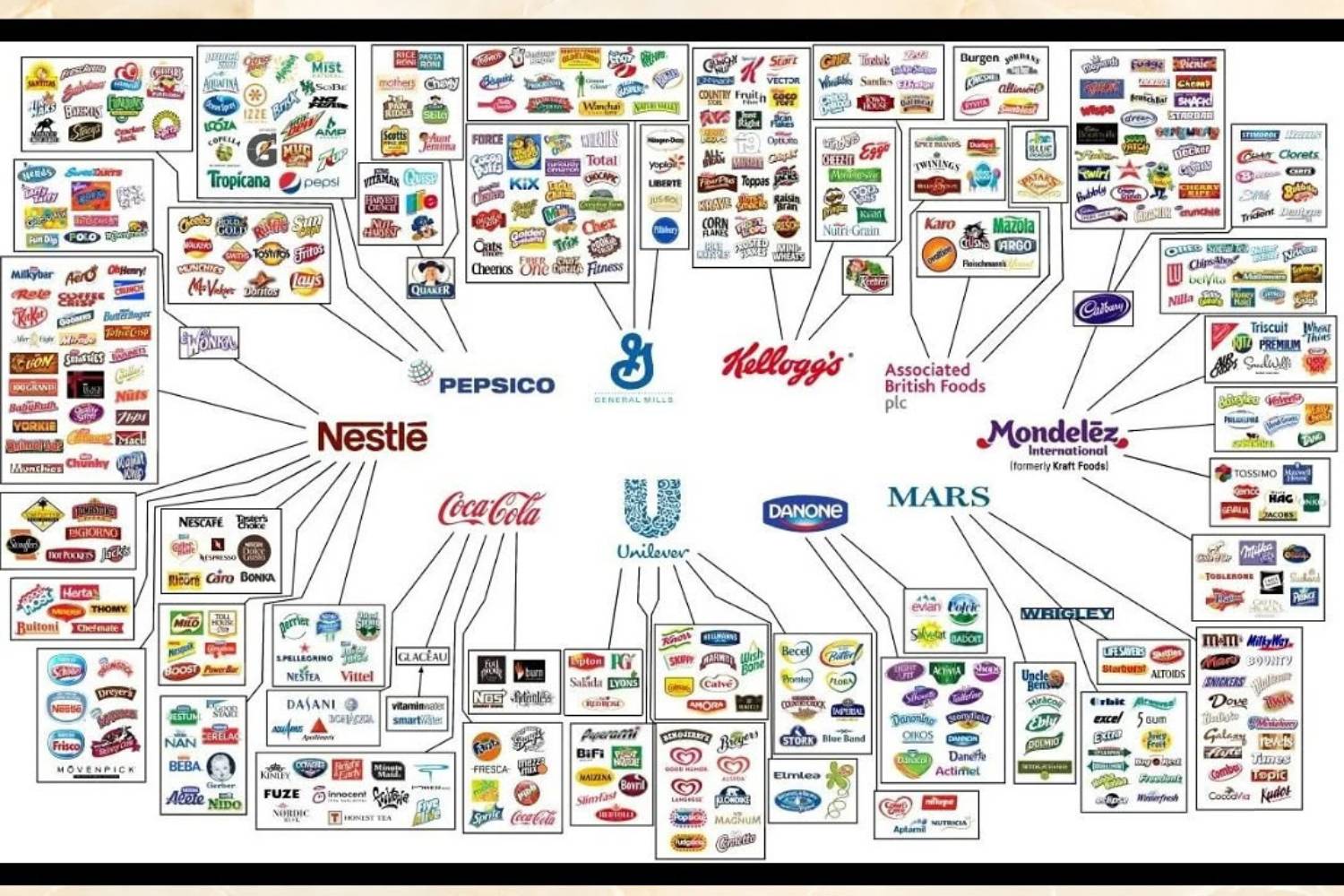
Whenever we enter a supermarket, we are bombed by thousands of apparently different products. Infinite shelves of snacks, drinks, cereals and snacks that seem to offer a wide range of choices. But behind this apparent variety there is a surprising reality: the vast majority of what we buy is controlled by just ten multinationals.
An analysis conducted by Business Insider, based on the data collected by Oxfam, reveals how these industrial giants have created a real global food oligopoly, possessing hundreds of the best -known brands in the world.
The ten masters of world food
1. Nestlé
At the top of this pyramid we find Switzerland Nestlé, an empire of over 80 billion dollars per year that extends in 189 countries with 339,000 employees. With over 2,000 brands in his wallet, check:
2. Pepsico
Born in 1965 from the merger of Pepsi-Cola and Frito-Lay, Pepsico generates over 70 billion dollars with 290,000 employees in more than 200 countries:
3. The Coca-Cola Company
Since 1886, Coca-Cola has reached 1.9 billion consumers every day with over 4,100 products in more than 200 countries:
4. Unilever
With 149,000 employees in 190 countries and a turnover of 50 billion euros, Unilever dominates several segments:
5. Danone
Founded in 1919, Danone uses over 100,000 people in more than 120 countries, specializing in:
6. General Mills
Since 1866, General Mills has been operating in over 100 countries with 35,000 employees:
7. Kellogg’s
Founded in 1906 by WK KELLOGG, it operates in 180 countries with 34,000 employees:
8. Mars
Since 1911, this family business has generated over 35 billion dollars with 130,000 employees in 80 countries:
9. Mondelez International
Born in 2012 from the split of Kraft Foods, it operates in 160 countries with 80,000 employees and 26 billion dollars of turnover:
10. Associated British Foods (ABF)
Founded in 1935, this conglomerate uses over 130,000 people in 53 countries:
The consequences of this monopoly
This concentration of power generates cascade effects that touch every aspect of our life:
On the economic front, the reduced competition allows profit margins that in some sectors exceed 40%, with the costs that inevitably fall on consumers.
For public health, the massive promotion of ultra-processed foods has contributed to the global epidemic of obesity, diabetes and cardiovascular diseases. The World Health Organization has documented how aggressive marketing, especially towards children, is directly connected to the increase in these pathologies.
At the environmental and social level, Oxfam’s “Behind the Brands” report highlights how these supply chains are often associated with deforestation, loss of biodiversity and problematic working conditions.
Power is in our hands
Knowing this map of global food power must not discourage us, but make us aware. Whenever we do the shopping, we exercise an economic vote. Choosing local, organic or smaller and ethical products means directing the system to a more sustainable and right future.
Real food diversity was born from our ability to look beyond family labels and discover alternatives that really respect people, workers and our planet. The change starts from the shopping cart.
Don’t you want to lose our news?
You may also be interested in:
