
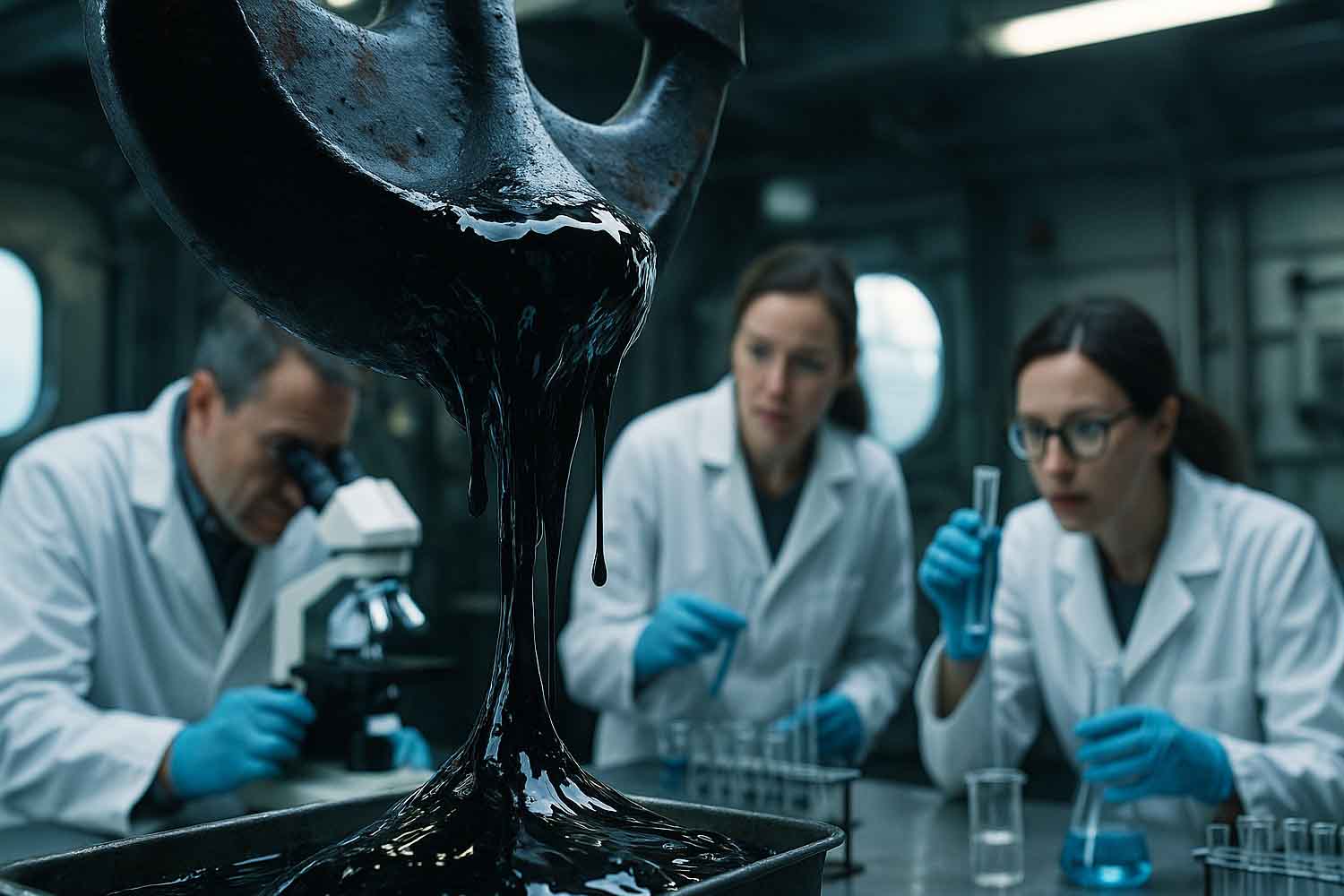
Sticky, black, without smell but with a decidedly anomalous appearance: this is how Supgoo001 presented itself, the mysterious substance found on the helm of an American research ship. At first glance it seemed only dirty. Instead, under the lens of the scientists, an unexpected small ecosystem proved to be, inhabited by microorganisms for the most part unknown.
A discovery born by chance
It all started with a dark patch flowed by the helon’s helon, research ship of the University of Minnesota Duluth, just returned from an expedition to large lakes. The crew was not expecting anything strange, until one of the on -board technicians, seeing that anomalous substance, decided to take a champion of it and take it to the laboratory.
There was no precise hypothesis, only the curiosity to understand what that strange melma was. Under the microscope, the surprise: Shipgoo001 contained life. A lot. Anaerobic organisms, that is, capable of surviving without oxygen, which lived within a closed and isolated metal space, where no one would have ever thought of looking for.
According to researchers involved, some genetic sequences identified in the melma recall already known bacteria, similar to those who live in extreme conditions and polluted environments: oil sludge, coastal industrial areas, or deep marine seabed. But there is more. A part of the present DNA has no comparison known in scientific databases. They are new microorganisms, never classified before.
An ecosystem born in an artificial place
Scholars have underlined how this discovery shows how much life is capable of adapting, even in environments that seem completely inhospitable. The helm of a ship is a closed space, isolated from water and air, without light, cold, made of metal. It is not a place where you would expect to find something alive, much less such a complex microbial community.
Precisely this anomaly pushed the team to investigate more deeply. According to the microbiologist Cody Sheik, the Melma would have formed over time in an environment similar to those that the human being creates: pipes, tanks, metal cavities. Artificial environments that could host hidden ecosystems, still completely unknown.
Shipgoo001 may have formed over time starting from residues of old lubricants, accumulated in the helm in the years following the purchase of the ship, which took place almost thirty years ago. Another hypothesis suggests that the substance arrived there through the so -called “navy snow”, small agglomerations of organic material that sink slowly and transport microbes from other environments.
For now, no theory has been confirmed. But what hit many scholars is that everything started from a simple question: “What is this stuff?”. An apparently banal question, which however opened the door to a scientific discovery.
Studies in progress
The researchers are working on a scientific publication that will contain the complete sequencing of the DNA present in substance. The data will be made available to the scientific community to facilitate future studies. Some identified bodies, in particular metharogens, could have an important value for the development of alternative biocarbulants, exploiting biological processes already present in nature.
In the meantime, the team has started a new monitoring phase, collecting samples on other boats to check if Shipgoo001 is an isolated or more widespread phenomenon than you think. A small observation gesture has turned on the spotlight on a new microcosm still to be explored.
Don’t you want to lose our news?
You may also be interested in:
