
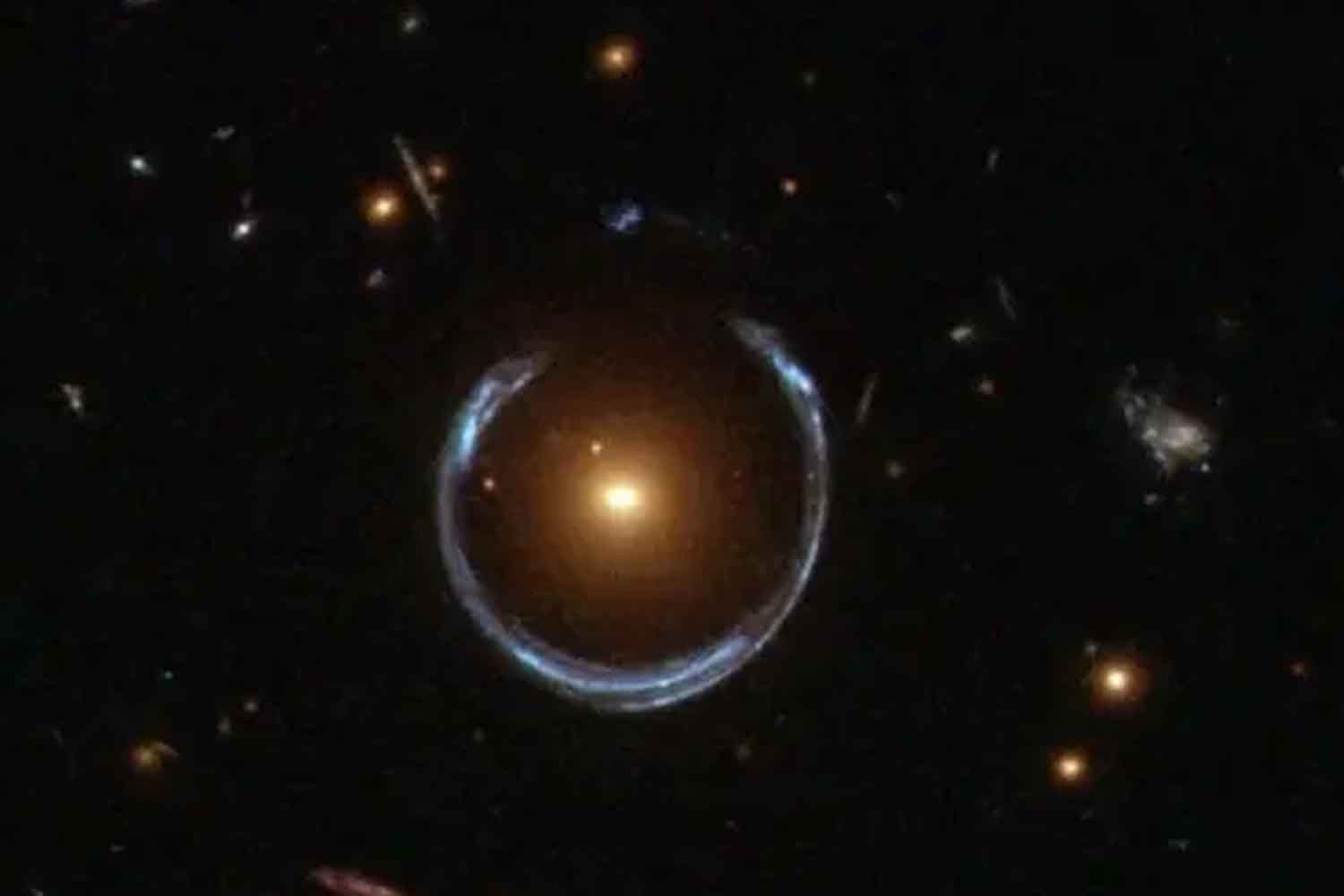
An ultra -reminiscent black hole, perhaps the largest ever identified, was discovered in the center of the Cosmic Horseshoe Galaxy (Cosmic Horse Iron). Its mass is equal to 36 billion times that of the sunabout 10,000 times higher than that of the black hole of the Milky Way.
Is located a 5 billion light years from us and, thanks to its extreme gravity, fold the light of an even more distant galaxy, forming a Einstein ring Perfectly visible in the images of space telescopes. Stars close to the cosmic monster are accelerated at speed of about 400 km per second.
How the giant black hole was discovered in the Cosmic Horseshoe
There Cosmic Horseshoe It is one of the most massive galaxies ever observed. Its huge mass deforms space-time and acts as a gravitational lens, distorting light from even more distant objects.
The team ofUniversity of Portsmouth (United Kingdom), in collaboration with theUniversidade Federal Do Rio Grande do on In Brazil, he combined two methods: the stellar kinetics (study of the motorcycle of the stars) and the gravitational lens. This technique has made it possible to measure the mass of the black hole even at such a high distance, which is normally not possible because the distant galaxies appear too small to directly observe their central region.
Second Thomas Collettprofessor of astrophysics and co -author of the study published on Monthly Notices of the Royal Astronomical Societythe black hole approaches the maximum theoretical limit provided for these objects.
A new way to identify black holes hidden in the universe
For Carlos MeloPhD student in Brazil and the first author of the research, the most interesting aspect is that this method allows you to identify “silent” ultramassicci black holesthat is, without detectable energy emissions.
Scientists speculate that the Cosmic Horshoe giant was born from the merger of several supermaxicci black holes, originally present in the galaxies that have joined over time.
The discovery came during a study on dark matter of the guest galaxy. Now the team aims to use the data of the space telescope Euclid of the European Space Agency to look for other similar giants and better understand the evolution of galaxies.
