
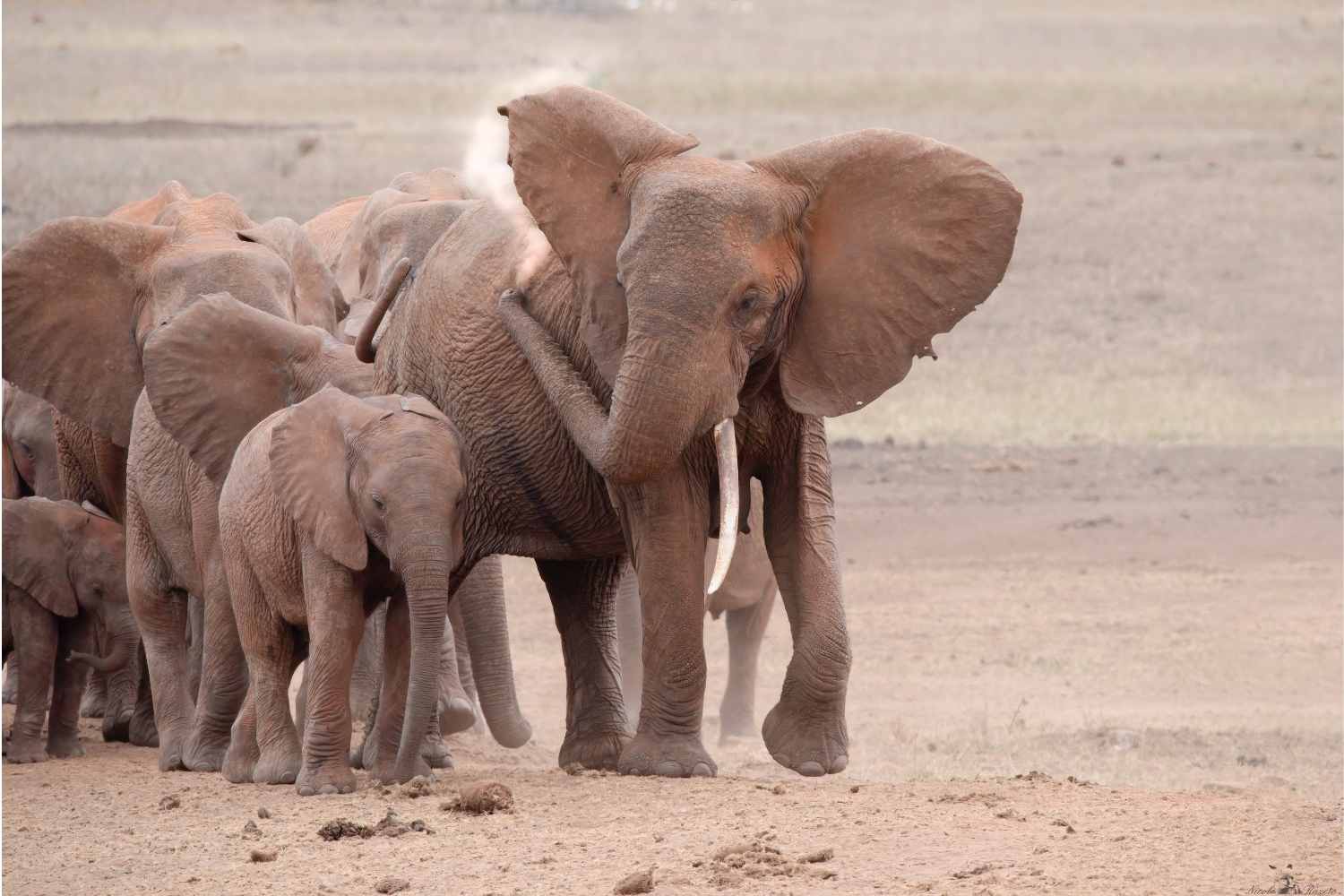
There is a memory that walks on four legs, a living library of Savane and forests imprinted in the mind of a matriarch. And today, that memory is likely to be canceled forever.
On August 12, the World Elephant Day is celebrated, dedicated this year to a little told aspect: the role of adult females in the guidance and memory of the herds. Under the theme “Matriarche and Memories”, the anniversary puts the figure of the Matriarch at the center, custodian of migratory routes, water sources and survival strategies, a heritage of knowledge that is handed down from generation to generation.
But this recurrence of the WWF also wants to be an urgent call. In a century, Africa lost more than 90% of its elephants: from the 12 million estimated at the beginning of the twentieth century to approximately 415,000 surveyed today. The two species – the Elephant of Savana (Loxodont Africana), “In danger”, and that of forest (LOXADONTA CYCLOTIS), “In critical danger” – are threatened by poaching for ivory and conflicts with human communities. Illegal trade kills about 20,000 specimens per year, a selective threat that affects above all the older and larger individuals, often precisely the matriarche, beheading the social structure of the herds and erasing decades of knowledge. To this are added the tensions for food and water, aggravated by deforestation and drought.
In Asia, the situation is no less worrying: they remain just between 8,000 and 11,000 elephants in nature, distributed in eight countries. They now only occupy 5% of the historical area. Considered “ecosystem engineers”, model the habitat and create micro-ecosystems even in their footprints. Also known as the “gardeners of the forest”, in fact they play an irreplaceable role by dispersing seeds and nutrients through their excrements, essential for the regeneration of many arboreal species.
An increasingly complicated coexistence
Cohabitation is the central knot. India has created a favorable legislative and cultural framework, with annual compensation for damages (equal to an average of $ 4.79 million per year between 2009 and 2020) and a rooted respect for the pachyderm. In Thailand, the proposals include the creation of new conservation areas, the activation of effective compensation systems, the involvement of monitoring groups of local communities and the transfer of greater powers to the proximity authorities. In Malaysia, an experimentation showed how threatening sounds, from the roar of tiger to the hum of bees, can discourage the elephants from approaching the fields: in particular, the tiger roar proved to be the most effective, causing a reaction in 33% of cases, followed by the hum of bees (23%).
The WWF, active for over 30 years in key countries such as Cameroon, Gabon, Central African Republic and Democratic Republic of the Congo, works on multiple fronts: from the “Zero Poaching” program, in collaboration with the Traffic Organization to reduce ivory trade, to the project “A forest for elephants” in the Tridom (Gabon, Cameroon, Congo), with photratappole and genetic analysis, up to Integrated approaches as Safe, which aims to guarantee security for security People and fauna, habitat protection and effective monitoring. The commitment also includes direct support to local communities through the development of sustainable economic activities, environmental education and schooling support.
Often the cultural perception of elephants influences their destiny: where they are seen as part of the local identity, the protection is stronger; Where damage prevails, hostility increases. To save the elephants, laws and patrols are not enough: it is necessary to strengthen the link between community and fauna, combine conservation and development, and keep the memory of the matriarche alive.
Don’t you want to lose our news?
You may also be interested in:
