
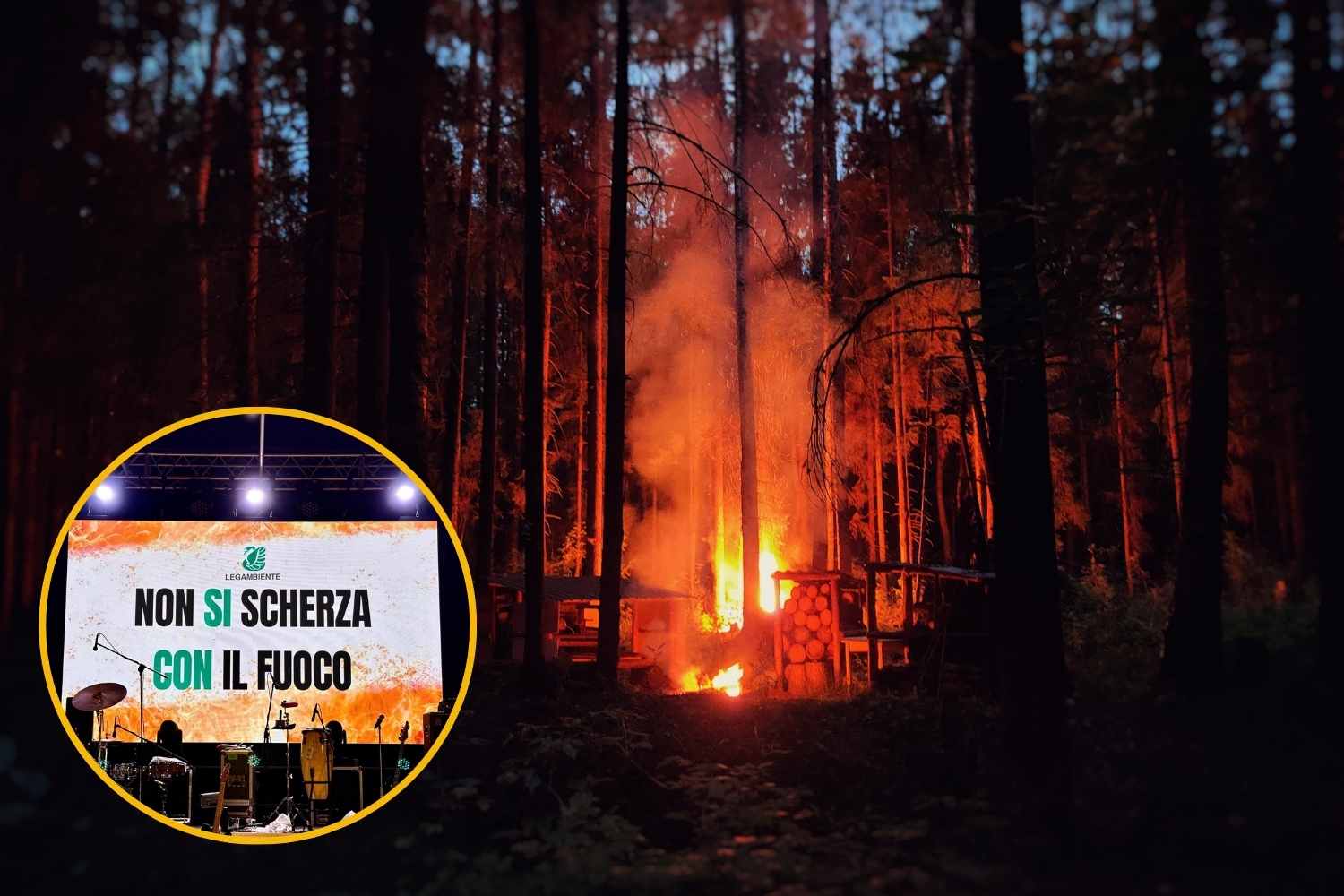
In just over seven months Italy has lost over 56 thousand hectares of territory due to fires, a surface higher than that burned throughout 2024. This is what emerges from the report “Italy in smoke” released by Legambiente A Festambiente, the national festival in progress in Coppecia (GR).
According to the processing of the association on Effis data, from 1 January to 31 July 2025 there were 851 fires which devastated 56,263 hectares – equal to 78,800 football fields – exceeding 50,802 hectares of 2024
The fire that recently devastated the Vesuvius National Park, thirty years after its institution, has been defined by Legambiente “a blow to the heart”. Antonio Nicoletti, national manager of protected areas, recalled that “bonfires, climatic crisis and loss of biodiversity” are increasingly serious threats for parks, which require “integrated governance and territorial policies consistent with the ecological transition and global objectives on climate and biodiversity”.
The analysis also reports a surge of the bonfires in the second half of July: from 30,988 hectares burned between January and 17 July, it was 56,263 hectares on 31 July, with 198 fires in just fourteen days.
For the national president Stefano Ciafani, the response cannot be limited to the forest fire -fighting plans: “We need an integrated approach based on prevention, detection, monitoring and active contrast, in synergy with forest plans and adaptation to climate change. It is necessary to update the land registry of the areas traveled by the fire and extend the penalties provided for the wooded fire at any stake”.
In Festambiente, Legambiente also awarded the national prize “Zero emissions parks”, now in its fifth edition, to enhance virtuous experiences in protected areas and in the neighboring territories. Seven winners, selected for separate collection practices, circular economy, green purchases, agroecology, sustainable mobility and biodiversity protection.
Among these, the Park of the Belluno Dolomites, with a separate collection rate of 87.6%, and the Asinara National Park, which applies 95% of the minimum environmental criteria and has set up a manager for green purchases. The Monte Genzana Alto Giizio regional reserve in Abruzzo for the European Sustainable Tourism Charter, the Tuscan Archipelago National Park with the “Walking Festival”, and the Mountain Green Agriturismo in the Tosco Emilian Apennines were also awarded.
From Molise comes the apiary of the community of Castel del Giudice, a network of beekeepers united in the protection of biodiversity and rural economy. Recognition also at the Montano Consortium of the Montana East Mountain Union for the sustainable management of the mushroom collection.
Tuscany is the region with the most awarded and has also received a special mention for the Maremma regional park, which celebrates its 50 years. An award on ECDESIGN was awarded with PEFC to the architect Mauro Friar of the IUAV for the innovative and sustainable use of the wood.
These examples, Legambiente underlines, show that protected areas can be circular bioeconomous engine, sustainable tourism and biodiversity protection. But without a strengthening of prevention policies, the risk is that the Italian natural heritage continues to be eroded by the fire, aggravated by the climatic crisis and the human impact.
Don’t you want to lose our news?
