
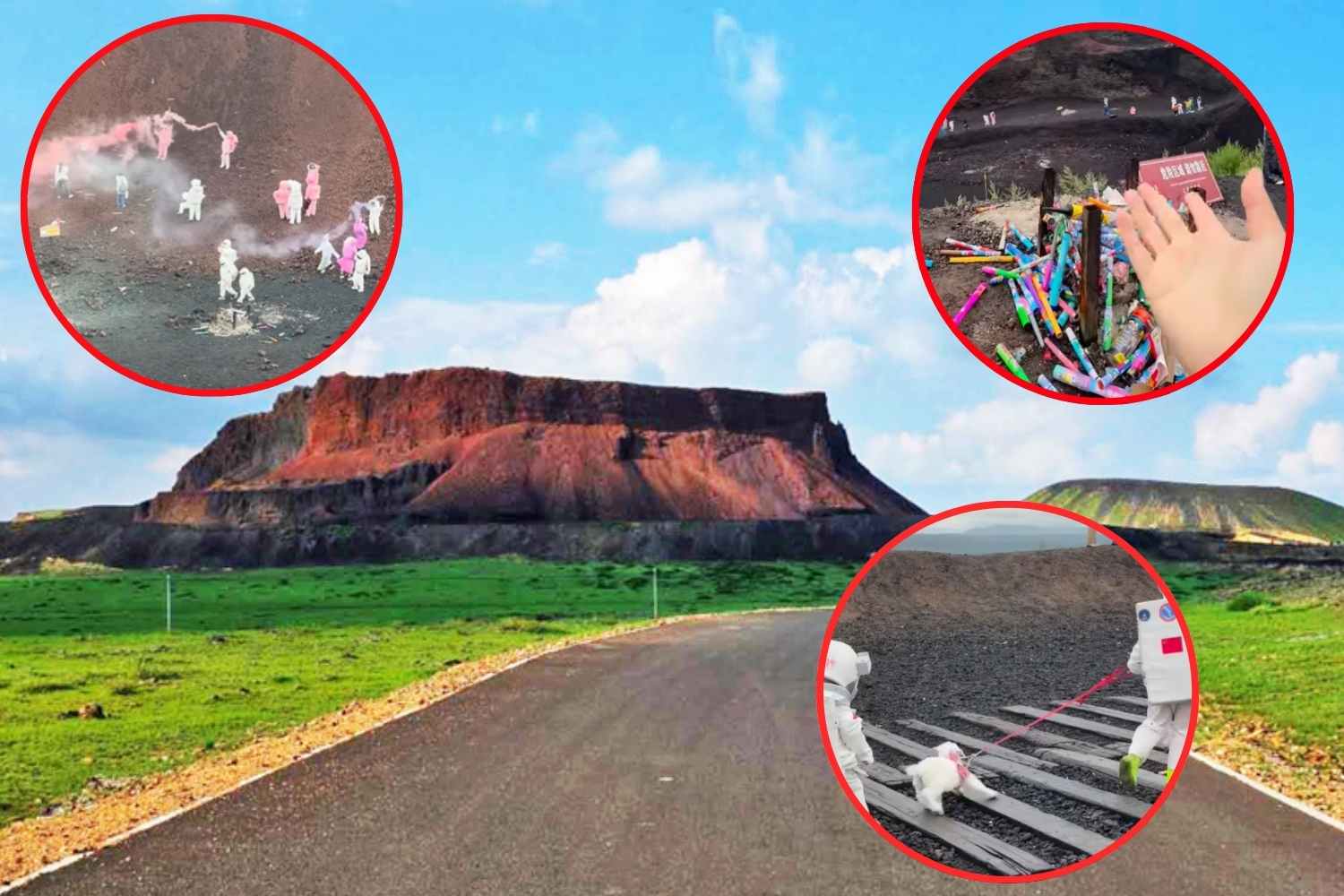
What was supposed to be one of the most suggestive stages of his long train journey from Singapore to Milan has turned into one of the most bitter experiences. Giovanni Arena, Travel Creator, Forbes Under30 and founder of the Inclusive Travel Project Poy, visited the Wulanhada Volcano Geopark, in the internal Mongolia (China), attracted by the surreal beauty of two ancient volcanoes that have recently been open to tourism.
“I think this is the most disappointing experience of my whole life,” says Arena in the King published on social media. The scenario is very particular: the landscape remembers Mars and tourists disguise themselves as astronauts to be photographed. But behind the scenography, as the words and images of Arena tell, a poorly edifying reality tell.
Colored smoke bombs … abandoned on the ground
Arena documents in the video how visitors can buy colored smoke bombs to take more “effect” photos around the crater. Once consumed, however, many abandon them directly at the foot of the volcano.
“On the spot they buy this smoke … and then they throw it, throw it here … what a disgust,” comments Arena, framing the remains of the smoke bombs scattered on the ground.
A gesture that is not only unsightly, but harmful to a fragile natural area of great geological value. The waste left on volcanic soil risk lying there for years, compromising the ecosystem and experience of future visitors.
Lambs used as photographic “props”
As if that were not enough, Arena shows another scene that defines as “deplorable”: tourists who torch and immobilize Agnelli to take souvenir photos.
“It is as if the question could not worsen. Torcchchopcho the lambs … to take pictures. But what am I seeing?” He says in the video.
Unfortunately, this type of animal exploitation is not uncommon in some tourist destinations, where the fauna is transformed into attraction at the expense of the well -being of animals.
View this post on Instagram
When tourism becomes an accelerator of pollution
The case of Wulanhada Volcano Geopark is an evident example of how tourism, if not managed with clear criteria, can transform from economic resource into a source of environmental degradation. Here the impact is not invisible: it is seen to the naked eye. The smoke bombs used for photos not only release toxic fumes, but leave chemical slag difficult to remove, which accumulate directly on the volcanic soil.
In contexts like this, where the opening to tourism is recent and the influx of visitors grows rapidly, the absence of effective rules and controls risks irreversibly compromising a unique habitat. It is a phenomenon already observed in other “new” and “instagramable” destinations: the race to offer spectacular experiences, without evaluating the environmental impact, leads to a rapid wear of the natural heritage.
Environmental conservation experts emphasize that places with fragile ecosystems, such as volcanic or desert areas, have very long regeneration times. A refusal left there today can remain visible for decades. And when contamination is chemical, it is not just aesthetic: the soil itself can undergo difficult alterations to be remedied.
Arena concludes her story with a phrase that sounds more like a warning than as a simple disappointment: “I hope that one day this place can change and enhance the treasure she has in her hands”.
A warning that highlights how the true wealth of a place is not in the gadgets sold to tourists or in improvised photographic sets, but in its ability to preserve its beauty.
Don’t you want to lose our news?
