
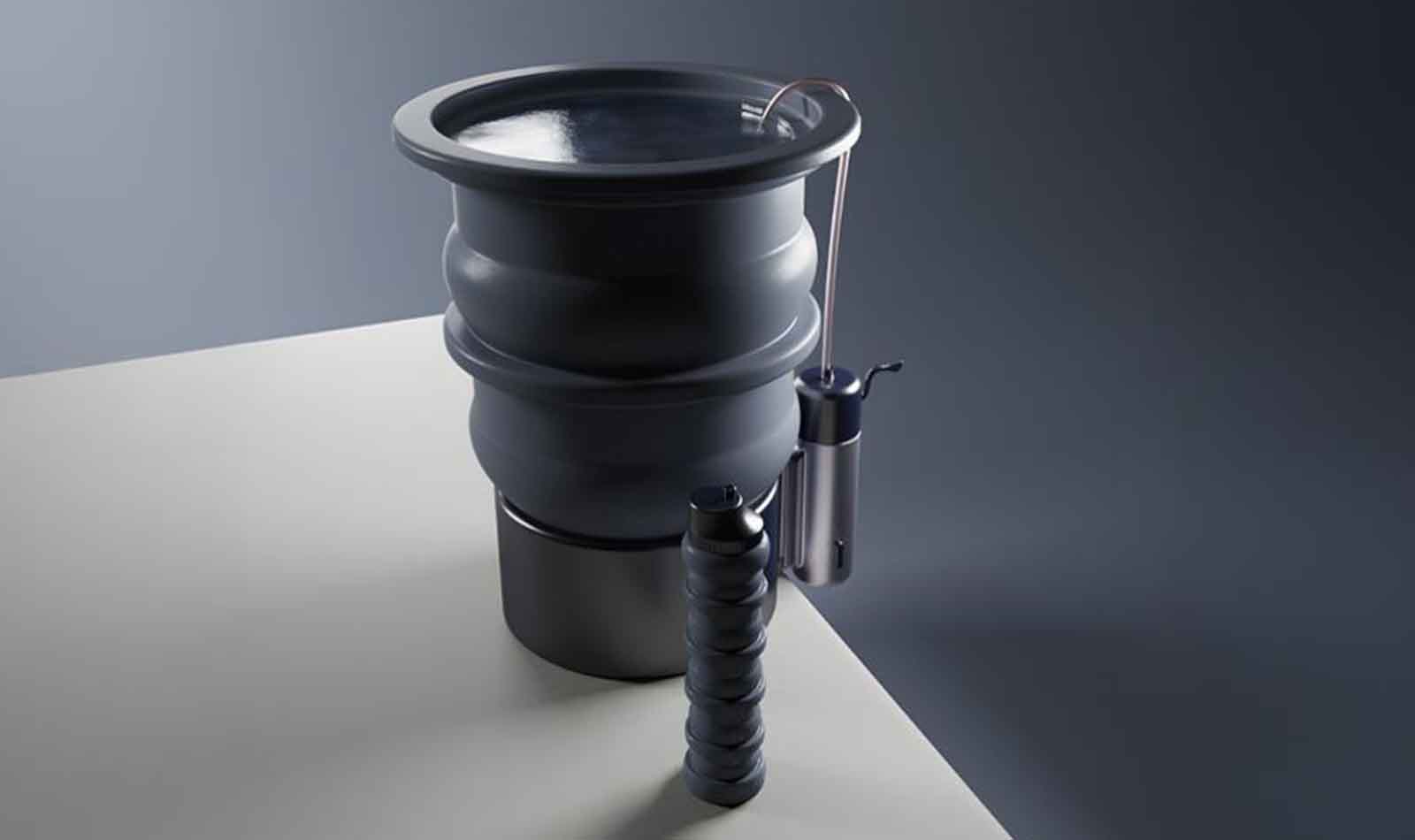
In case of natural disasters, humanitarian crises or simply in places where clean water is not a guaranteed right, having access to an efficient and autonomous purification system can really make the difference between living and surviving. It is from this awareness that an emergency water purification kit is born, designed to be easy to use, transportable and usable by anyone, without the need for electricity, technical knowledge or complicated instructions.
The kit uses a high efficiency membrane filter, through which the water is pushed thanks to a small engine powered by solar energy or a manual crank, to be used in the absence of light. The project, developed in the context of a degree thesis, was guided by the desire to create something that had a real impact on people’s lives.
An intuitive design that combines efficiency, sustainability and cultural inclusiveness
At the center of the system there is a folding container, designed to perform two functions: when compressed, it contains and protects all the elements of the kit; Once expanded, it becomes the main water tank to be filtered.
Inside are:
The operation is immediate: the container opens, the filter is fixed, connect the tube and choose between the engine or crank. The pressure generated allows the water to cross the membrane, retaining impurities, bacteria and pathogens. A simple gesture that transforms dirty water into a safe resource.
A conscious design choice
The research work started from a precise question: what is missing, today, in existing purification systems? After examining different technologies – such as sand filters, UV and chlorination – the choice has fallen on the semi -permeable membranes, which offer the best compromise between effectiveness, portability and sustainability.
Compared to the devices that use the only force of gravity, the introduction of a mechanical pressure system represents a true innovation. The result? Greater efficiency, the possibility of using finer membranes and a clearly higher quality of water. All this, without depending on energy infrastructure.
But the most important aspect remains usability: each element of the kit has been designed to be used even by those who do not have technical training or do not know the language. An accessible design, to guarantee autonomy, safety and dignity even in the most difficult contexts.
Next developments and a clear goal
Even if the device is already fully functional, the work does not stop. The next phases provide for the optimization of some fundamental technical elements, such as the choice of the most suitable electric motor and the precise measurement of the water output pressure, which will help to define exactly the maximum porosity of the membrane used.
Another essential step will be the introduction of an counter-lavage system for cleaning the filter, necessary to ensure its long-term duration and efficiency. The goal is clear: bring the project to large -scale production, making it accessible to NGOs, humanitarian entities, isolated communities and citizens affected by sudden water crisis.
The project is among the Italian candidates for the 2025 edition of the James Dyson Award, the international competition promoted by the James Dyson Foundation and currently active in 28 countries and regions of the world. A prize that invites young designers and engineers to propose concrete solutions to real problems.
Don’t you want to lose our news?
You may also be interested in:
