
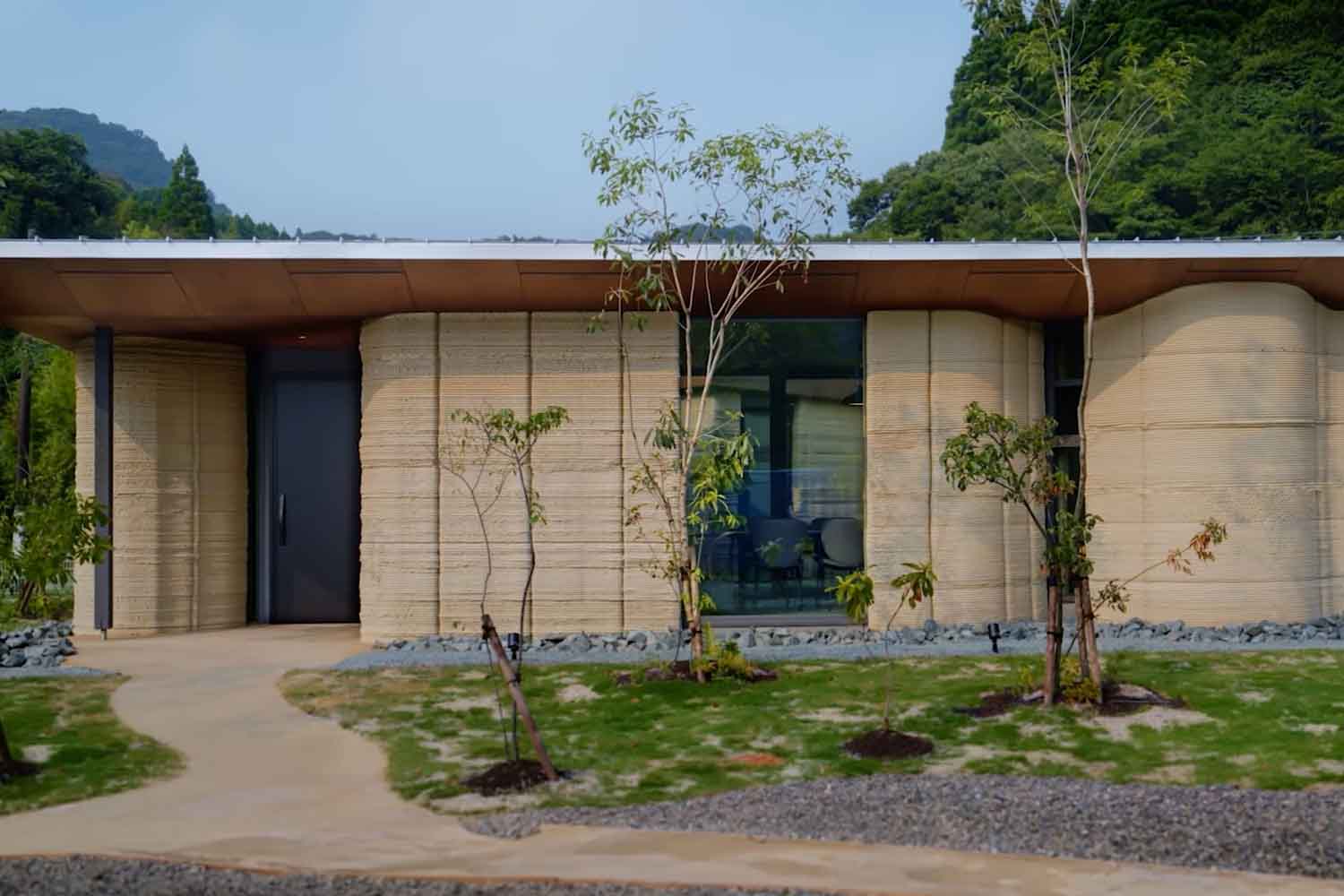
In Japan there is a house that seems to come from the future, but that actually has its roots in the earth – literally. It is the first home printed in 3D almost entirely with local soil, without a drop of cement. In Yamaga, in the prefecture of Kumamoto, Lib Work Ltd. completed the first model of this revolutionary home on 22 July 2025. The work was developed together with robotic engineers and an Italian company specialized in 3D printers. The entire process was managed with the support of artificial intelligence, from design to realization, in what the company calls “a territory never explored before, without reference points in the building tradition”.
Because building on the ground is more sustainable and can last longer
In recent decades, the construction sector has innovated little in materials and methods, unlike sectors such as the automotive one, which have focused on technology. With this new house, Lib Work has chosen to invest in recycling, sustainability and reduction of CO2 emissions, combining 3D printing with natural materials reinforced to guarantee resistance and aesthetic quality.
The model just presented, the Lib Earth House Model B, is made without concrete, material with high environmental impact and responsible for large quantities of industrial waste. The walls are composed only of natural elements, with the earth as the main ingredient. Compared to the previous Model A, which contained a small part of cement, the resistance has increased by about five times, while the production emissions have been strongly reduced.
The innovations introduced are awaiting patent, but the company has already opened the pre-orders for those interested.
Smart houses, autonomous and with walls “who take care of themselves”
In addition to the choice of materials, the house integrates technologies that increase its functionality. The walls are equipped with sensors that detect temperature and humidity in real time, preventing condensate formation and maintaining optimal comfort over time.
Through smartphones or dedicated monitor, air conditioning, lighting and bathroom systems can be controlled at a distance. The house is also energetically independent, thanks to a solar system connected to a Tesla Powerwall battery to store the energy produced.
The project also includes an internal courtyard designed to make the most of natural light and encourage ventilation, thus reducing energy consumption for lighting and cooling.
Recycling architecture and design inspired by Kintsugi
According to the partners of the project, including where arup and partners, the use of local land and easily removable and recyclable components allows to minimize the waste generated at the end of the building’s life cycle.
The 3D printer manufacturer, Wasp, has defined the house as a perfect balance between minimalism and organic inspiration, with an aesthetic that recalls Kintsugi, the Japanese philosophy that enhances the beauty of imperfections and natural materials.
Finally, the Maket Technologies technological partner stresses that the goal is no longer to produce identical homes faster, but to design personalized, optimized and accessible homes to everyone. Lib Work aims to create 10,000 units by 2040, even if the costs have not been communicated at the moment.
Don’t you want to lose our news?
You may also be interested in:
