
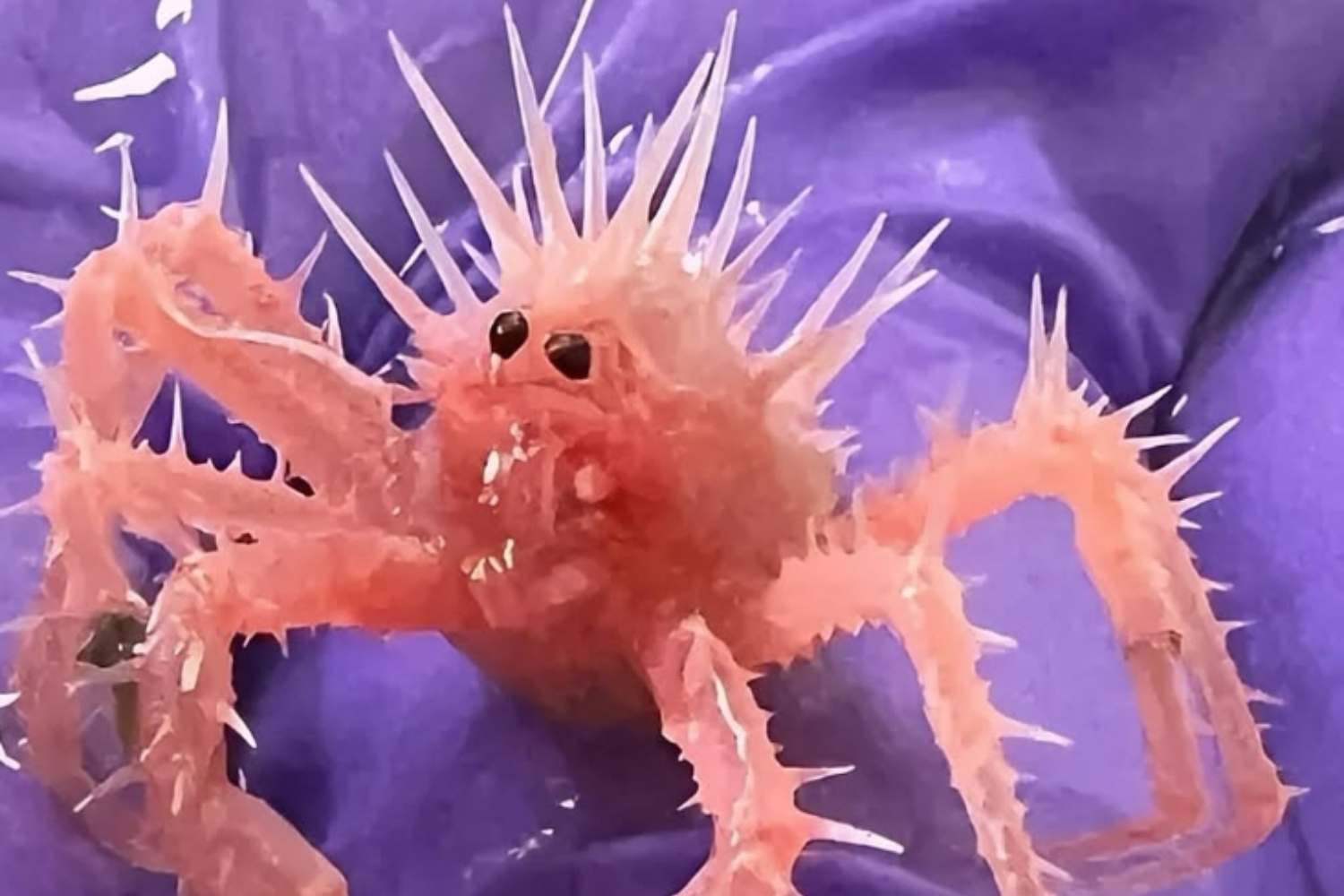
During a mission of cleaning the seabed in the Gulf of Mexico, Noaa researchers found an incredibly fascinating small creature: a small real pink crab, just as much as a finger. The animal was accidentally collected while the scientists removed a plastic bag from deep corals, part of a project to restore the habitats damaged by the 2010 Deepwater Horizon disaster.
The experts identified him as probably belonging to the Neolithodes Agassizi species, famous for his pointed thorns and the bright color. Despite the tiny dimensions, the small crab has become viral on social media, with videos that show it sitting on purple gloves, as if it were a small thorny alien ready for its first floor to be star.
The evolution and habitat of the Red Royal crabs
The adults of Neolithodes Agassizi live at depth between 200 and 1,900 meters and can reach up to 12 cm from the head to the tail, not to mention the long legs. These crabs are not true crabs, but they descend from the paguri crabs and have lost the need for the shell about 25 million years ago. The evolutionary phenomenon that has led many species not related to developing a similar form is called carcinization or convergent evolution.
The little ones, often vulnerable, use other creatures as a refuge. Some hook to small sea pigs for protection, while others, like the protagonist of our story, seem to have taken advantage of the plastic bag as a temporary surrogate. Ingenious survival strategies sometimes unfortunately conditioned by the man of man.
They are fundamental for the maintenance of the biological balance of the seabed
The small crab was preserved in the Smithsonian Institution invertebrates collection, available to scientists for future studies on marine biodiversity and to deepen the restoration projects of the gulf ecosystems of Mexico. These bodies, albeit tiny, contribute significantly to the maintenance of the biological balance of the ocean seabed.
In addition to the scientific value, the small crashing has also conquered the public thanks to its thorny and unusual appearance by demonstrating how even the smallest inhabitants of the seas can fascinate, educate and remind us of the importance of preserving the oceans and reducing plastic pollution.
In Tiny, Spiky, Bundle of Cuthenes! This Little Crab Was Found During An Operation In The Gulf of Mexico Which Collected Samples of Mesophotic and Deep-Sea Coral Species for Lab Rearing and Propagation.Credit: Noaa Office of National Marine Sanctuaries
Posted by Noaa Fisheries Service on Tuesday, Janogy 7, 2025
Don’t you want to lose our news?
You may also be interested in:
