
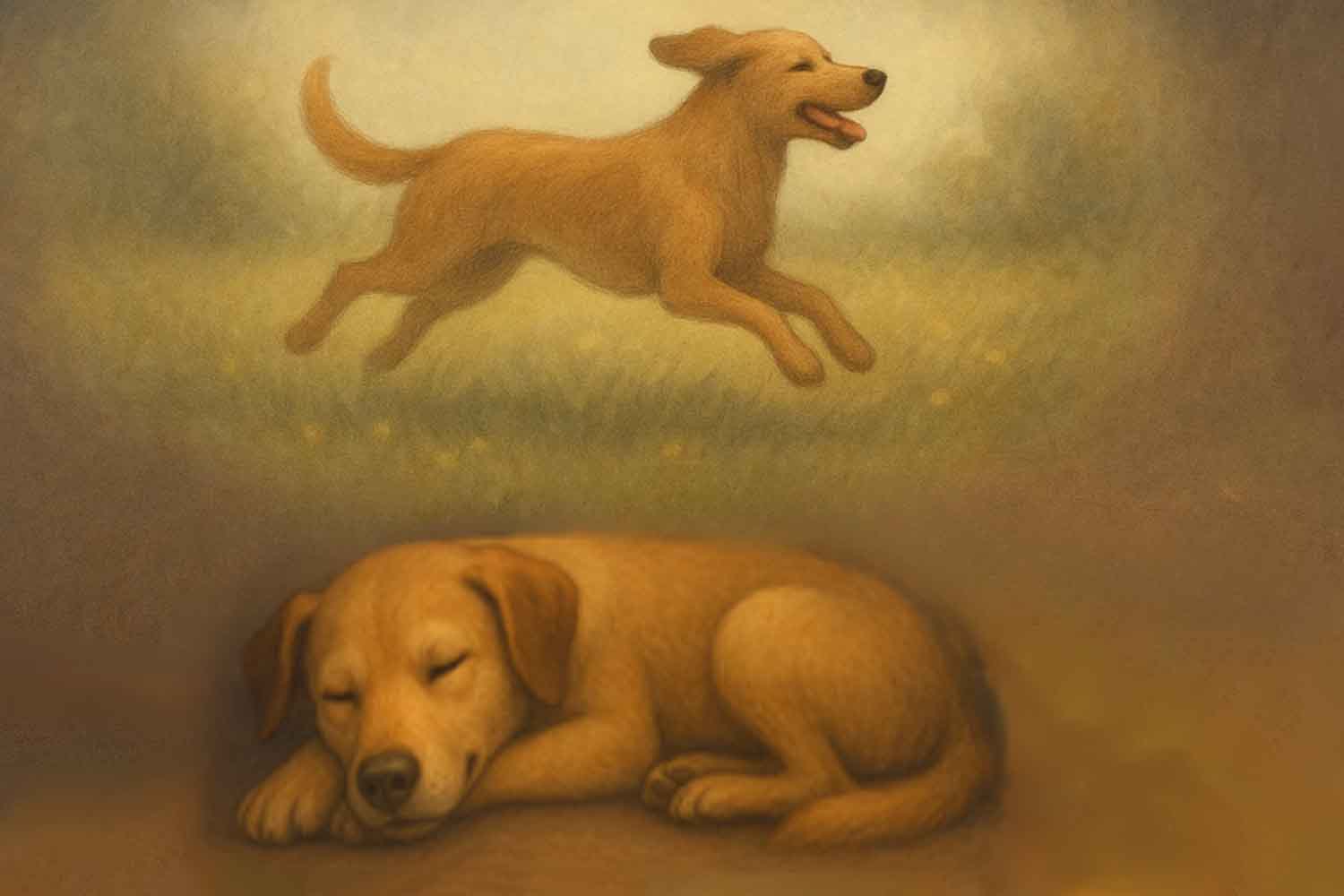
Dogs that move their legs as they sleep, cats that emit verses in sleep, pigeons that seem to agitated on the trespolo. All signs that we no longer ignore today: science confirms that animals really dream, and do so surprisingly similar to human beings.
For centuries we thought that dreaming was only ours. In reality, almost all animal species have a sleep phase called Rem (Rapid Eye Movement), in which the eyes move quickly under the closed eyelids and muscles completely relax. It is in this phase that, in mammals and birds, the areas of the brain related to memories and emotions are activated, exactly as it happens to us.
To understand first that animals could also dream was Aristotle, already in 350 BC, observing the behavior of the quadrupeds. But only in the last century the research began to provide concrete answers. Starting from the 1950s, researchers identified the Rem phase in humans and, a few years later, even in cats. From there a long exploration of the dream animal world began.
Animal dreams are memories
To take a huge step forward was the Massachusetts Institute of Technology (MIT), where a team of neuroscientists conducted a fascinating experiment. The researchers trained rats to run in a circle, then monitored the activity of their brain during the vigil and, later, during sleep.
The part of the observed brain was the hippocampus, a key area for the formation of memories and spatial orientation. Analyzing the electrical signals of the individual nerve cells, the scientists discovered that during the Rem phase, the rats activated exactly the same brain areas used while running as awake. Not only that: the patterns of neuronal activity were so precise that it would allow to understand in which point of the path they were in the dream and if they were running or stopped.
The manager of the study, the neuroscientist Matthew Wilson, explained that this clearly shows how animals recall experiences lived, just like us. Dreams, in fact, also serve animals to consolidate memory, rework information and “put order” among the experiences of the day.
Birds also dream
Dreams are not an exclusive of mammals. Another study, conducted by the Max Planck Institute for Biological Intelligence, analyzed the brain of the pigeons during REM sleep. The results? The brain areas involved in the elaboration of the movement and vision, the same that are activated during the flight, were fully active even in sleep.
According to Mehdi Behroozi of the University of Ruhr of Bochum, the pigeons dream of flying, just as human beings can dream of walking, swimming or guiding. Also in this case, it is a mechanism useful for memory, which shows how much the dream is an evolutionary brain function, shared among many species.
During the day, the brain stores a large amount of information, but only a part is really consolidated. The rest is organized during sleep, especially in the Rem phase, thanks to the work of the hippocampus. This applies to us, but now we know what an animals also happens.
As Wilson said:
Dreams are an offline experience. A moment when the brain reviews and re -elaborates what he has experienced. Animals do exactly the same thing: they put the pieces of their day back together.
These discoveries not only help us to better understand animal behavior, but also open a new perspective on the relationship between us and the other species. Dreaming is not a human privilege, but a vital function of the brain that crosses the animal kingdom.
Don’t you want to lose our news?
You may also be interested in:
