
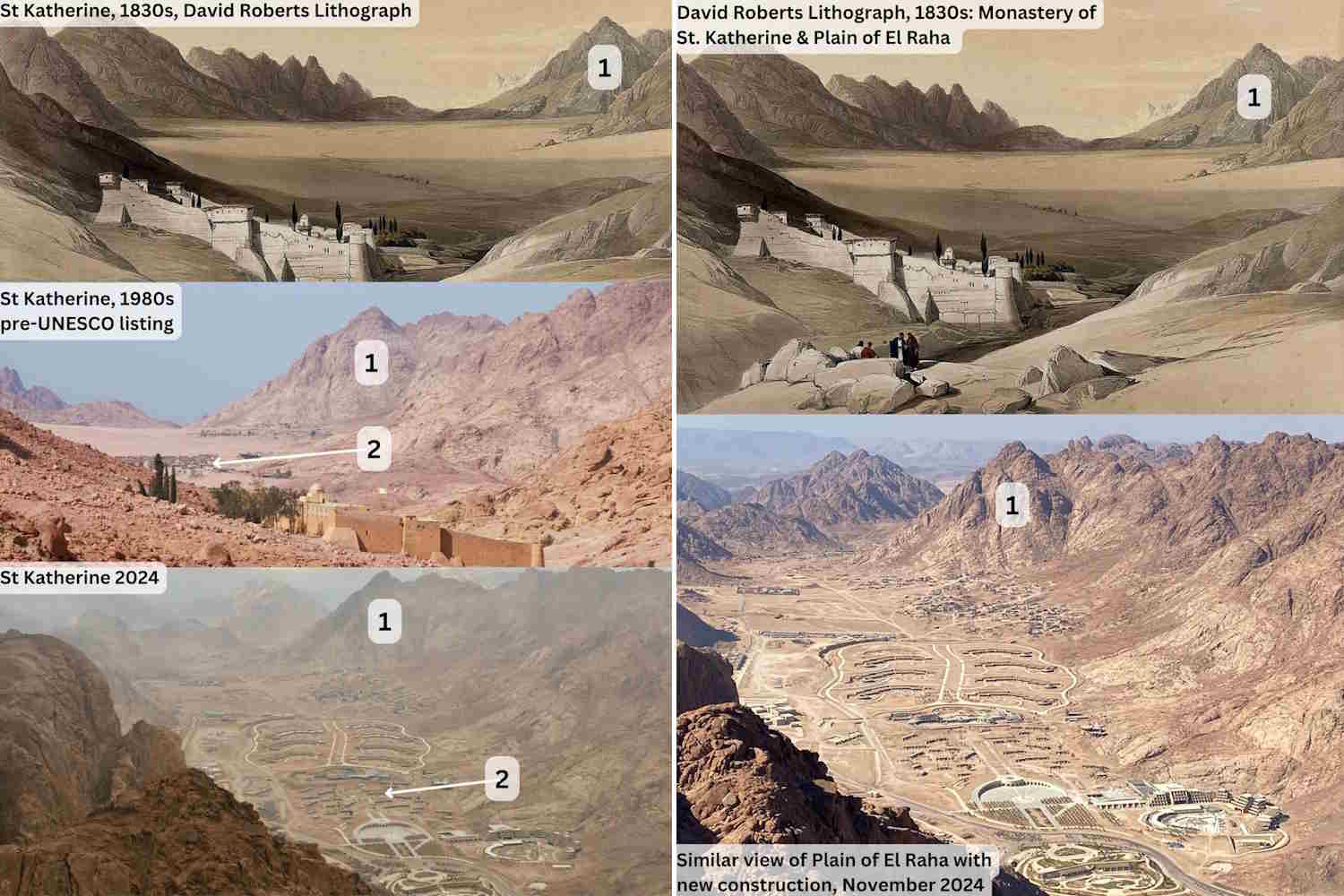
Luxury hotels, sumptuous villas and commercial areas in the area surrounding the monastery of Santa Caterina, the oldest Christian monastery inhabited continuously in the world. We are on Mount Sinai, Jabal Musa For the premises, which the Egyptian government would like to transform into a mega tourist system (complete with expansion of the small airport nearby and the construction of a cable car).
That’s right. If for years, visitors have ventured on Mount Sinai with a Bedouin guide to admire the dawn on the pristine rock landscape or participate in other excursions led by the Bedouins, all this may no longer be enough, in the name of an increasingly globalized tourist offer and equal to itself. And of the project from the name that leaves little room for imagination: Great Transfiguration Project, The great project of the transfiguration.
One of the most sacred places in Egypt – an UNESCO World Heritage Site that includes the monastery, the city and the mountain – revered from Jews, Christians and Muslims, and where Moses would have received the ten commandments (here, according to the Bible and the Koran, God spoke to the prophet from the ardent Roveto), in short, it could soon transform and lose any peculiarity. At the obvious, of course, of the ecosystem of the desert and local communities.
And the local Bedouin community?
Jebelaya tribe, known as the Guardians of Santa Caterina, what will it be? According to reports from the BBC, this traditional Bedouin community has already seen its homes and demolished fields with poor compensation (if not null). They were even forced to extract the bodies from the tombs of their cemetery to make room for a new parking lot.
This is not the development that Jebeleya see or ask – Ben Hoffler, British travel writer who has worked in close contact with the Sinai tribes, says loudly. But only what is imposed from above to encourage the interests of foreigners at the expense of those of the local community. A new urban world is being built around a Bedouin tribe of nomadic origin – he added. It is a world from which they have always chosen to remain separated, to whose construction they have not agreed, and which will change their place forever in their homeland.
The role of Greece
The monastery of Santa Caterina is not only the oldest Christian monastery in the world still active, but also a unique place for dialogue between cultures and religions. In fact, next to the Byzantine Basilica, it also houses a small Fatimide mosque: a living symbol of peaceful coexistence between Christians and Muslims.
But for months, in the light of this wicked project, its survival has been at the center of diplomatic tensions between Greece and Egypt. It all started in May, when an Egyptian court established that the monastery stands on state -owned land, effectively limiting its rights to the main building only and the surrounding archaeological sites. A decision that, after years of disputes, has triggered hard reactions in Athens.
The archbishop Ironymos IIhead of the Church of Greece, denounced the sentence as a real expropriation: “This spiritual lighthouse of orthodoxy and hellenism is now facing an existential threat”.
Also the archbishop Damianosguide of the monastery, spoke of “serious blow and shame“, Even coming to resign due to the internal divisions between the monks.
The Greek Orthodox patriarchy of Jerusalem, which holds ecclesiastical jurisdiction on the site, recalled that Santa Caterina has enjoys the antiquity of a special protection since ancient times: a letter attributed to the prophet Muhammad itself guaranteed security and compared to this sacred place.
In light of tensions, Greece and Egypt finally signed a joint declaration, with which they commit themselves to safeguard the Greek-Orthodox identity of the monastery and its immense cultural and spiritual heritage.
“Special gift” or unsustainable interference?
Egypt has started this project already in 2021: the plan provides for the opening of hotels, eco-Lodge and a large visitors, as well as the expansion of the small airport nearby and a cable car for Mount Sinai.
All propagated as “a gift from Egypt to the whole world and all religions”.
Although the works seem to have blocked, at least temporarily, due to financing problems, the El-Raha plain, in view of the monastery of Santa Caterina, has already been transformed. The construction of new roads continue.
Already in 2023, UNESCO had expressed its concerns and had invited Egypt to stop the project, to verify its impact and to elaborate a conservation plan. This did not happen.
Last July, the World Heritage Watch sent an open letter asking the UNESCO World Heritage Committee to insert the Santa Caterina area on the list of world heritage sites in danger.
Sinai, tourism grows but the Bedouins remain on the margins
Egyptian tourism, after difficult years marked by the pandemic and now by the war in Gaza, tries to get up. This is the justification of the government that now to 30 million visitors by 2028.
This is why it has been for decades that the Bedouins denounce that they are treated as second -class citizens. Their marginalization dates back to much earlier: Sinai, occupied by Israel in 1967 and returned to Egypt only in 1979, saw the construction of the large tourist destinations on the Red Sea explodes in the 1980s, such as the Arci-Nota Sharm El-Sheikh.
Today, in Santa Caterina, the story could be repeated. A large hotel is under construction in the El-Ra plain, next to smaller buildings that are changing the appearance of the valley. Here too, the workforce comes mainly from other parts of the country, while the Bedouins remain promises of “redevelopment” of their residential areas.
The monastery of Santa Caterina, a spiritual heart and a World Heritage Site, for centuries has been an isolated refuge. The arrival of the resorts on the Red Sea has already brought thousands of visitors, often in daily trips, attracted by symbolic places such as the ardent rush or the museum that houses precious pages of the Sinaitic code, the oldest copy almost complete of the new testament.
Now, however, his surroundings risk changing forever. If the religious and historical value of the monastery will remain unchanged, the context that surrounds it – made of silences, secular lifestyles and Bedouin identities – seems destined to transform itself irreversiblely.
Sources: BBC / World Heritage Watch
Don’t you want to lose our news?
