
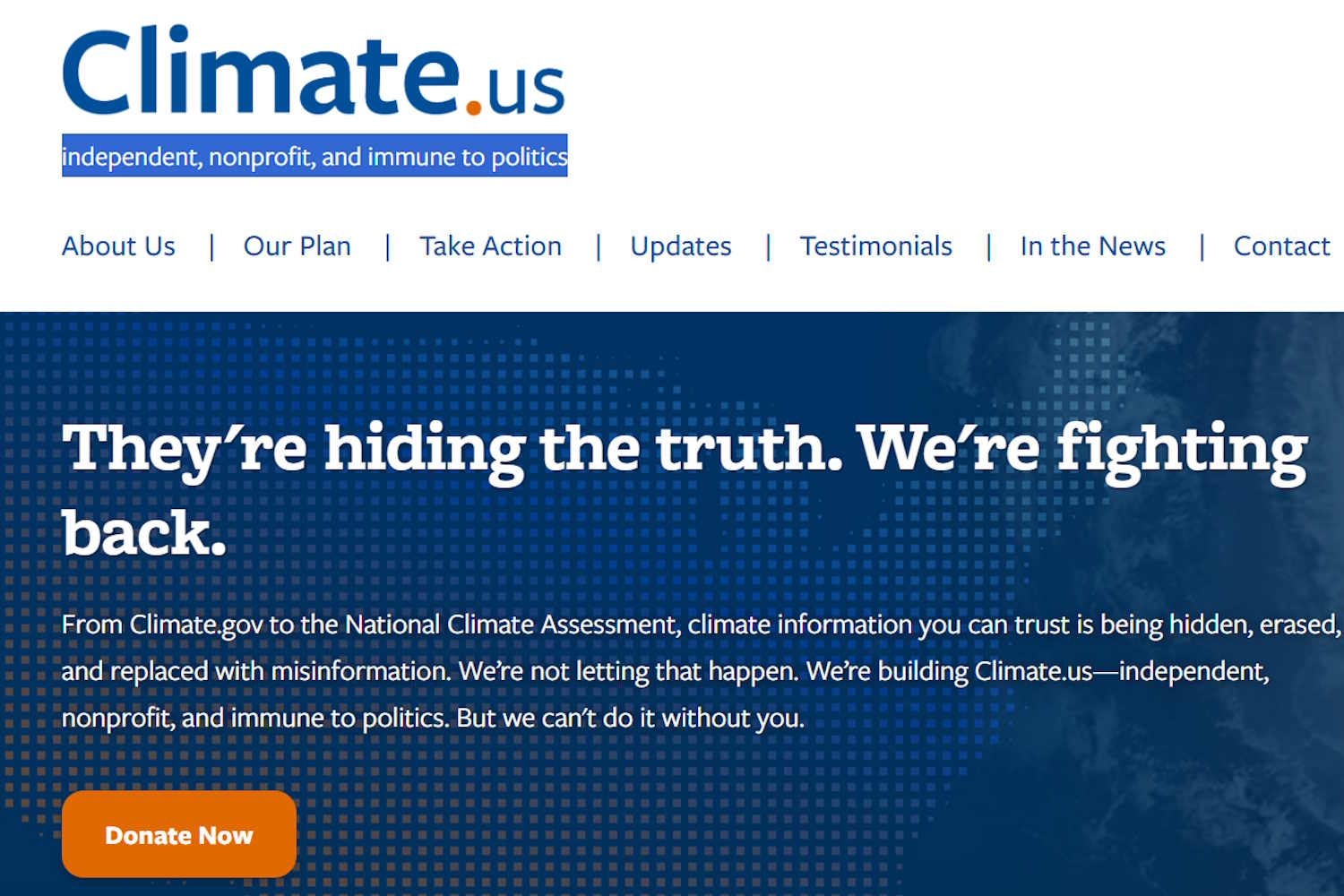
Donald Trump continuously attacks science (and other dozens of things): shortly before the summer, in fact, his administration had blocked access to the Climate.Gov website, the Noaa public portal that explained the climate to the country, firing almost the whole team, starting with the editor in chief Rebecca Lindsey.
But Rebecca did not give up and, determined to continue to raise public awareness of global warming, has recruited several of its former colleagues and researchers through a non -profit organization to found a new site. From there he was born climate.us (“Independent, nonprofit, and immune to politics “it is defined) that now has the aim of republishing what has been removed and offering concrete services, from mapping of the risk of floods to climatic literacy for administrations and communities.
Trump has never made a secret of his distrust towards climate policies: in the first term he has already paraded the USA from the Paris agreement and has now repeated the move. In addition, he has proclaimed an “energy emergency” to push oil and gas, removing stakes from offshore drilling and federal soils, including protected areas in Alaska. Result: from the first moment, an abrupt inversion compared to the biden line on renewables and emissions cut.
The point is that the climatic crisis also runs when nobody looks at it: floods, heat waves, peaks of flashing lightnings, insurance companies that give up entire areas. If the official channel is closed, other channels open. If a database disappears, it is reconstructed and shares in a mirror.
Because the truth is this: censorship is noisy, the climatic crisis is relentless. We can spend weeks to indignation for the darkening of a site – and we have to do it – but if we do not put the content back in the center (data, services, decisions) we are only losing precious time. The climate does not wait for the bureaucracy or the ego of politicians.
Sources: Climate.us / The Guardian
Don’t you want to lose our news?
