
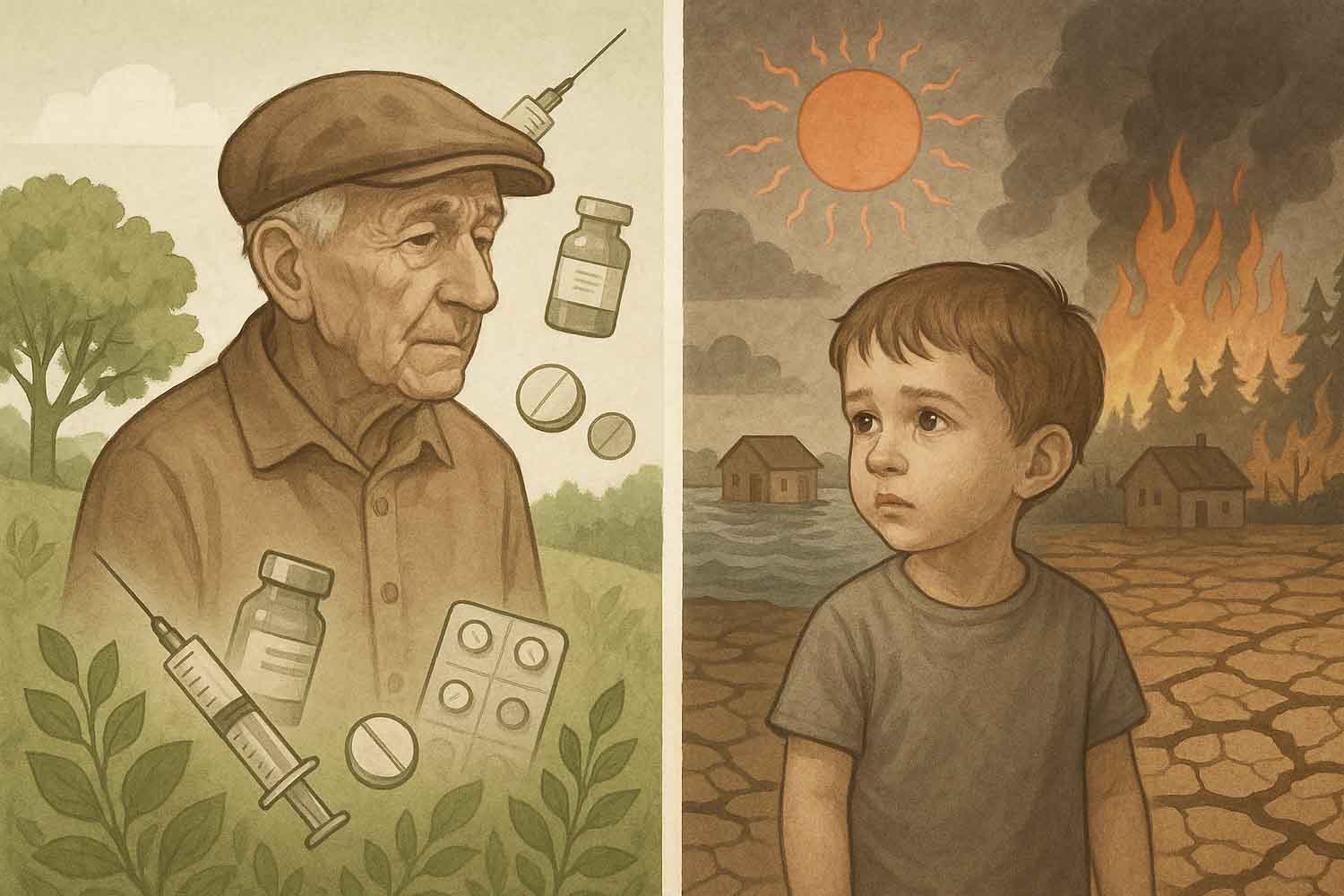
For over fifty years, life expectancy has grown consistently in most of the industrialized world. But today, according to a new study published on Pnas (Proceedings of the National Academy of Sciences), this trend has stopped. The work, coordinated by the demographer José Manuel Aburto of the Max Planck Institute for Demographic Research, shows that the growth of longevity has reached a plateau and, in some cases, has started slowing down significantly.
The researchers analyzed the data from 23 industrialized countries, comparing different forecasting techniques. The results are clear: for the generations born after 1939, the annual increase in life expectancy has more than halved, passing from six months to just two or three months more by year of birth.
The progress of the past are not repeating: childhood mortality is already minimal, and seniority no longer drives longevity
Between 1900 and 1938, health progress, vaccinations, the diffusion of antibiotics and better hygienic-acting conditions had allowed rapid growth in longevity. At that time, the life expectancy in rich countries went from 62 to 80 years in a few generations. Today, however, those room for improvement are largely exhausted.
Mortality in the first years of life is already at historic lows, and even if medicine continues to make progress, interventions on the third age do not have the same structural impact that had the health reforms of the early twentieth century. For this reason, according to the data collected by the study, those born in 1980 in all probability will not reach 100 years, and none of the cohorts analyzed has realistic possibilities to exceed this threshold.
The slowdown is not just a statistical data. The forecasts on longevity are a key tool for planning pension systems, health policies and public investments. If the average life does not grow as expected, new strategies are needed: both for governments and for citizens who will have to review long -term savings and expectations.
The new generations will live less for a long time and in a more unstable atmosphere
In May 2025, another study – published on Nature And led by the researcher Luke Grant – underlined another criticality. The children born in 2020 will be exposed, during their life, to a much higher number of extreme climatic events than previous generations.
Using climatic and demographic models, the team calculated that even if global warming was contained within 1.5 ° C, more than half of the born in 2020 will experience unprecedented heat waves. If the increase is to reach 3.5 ° C, the percentage would rise to 92%.
In addition to the heat, the younger generations will have to face prolonged drought, forest fires, floods, loss of crops and other environmental crises. The impact will be heavier for the less equipped communities, which have fewer resources to adapt. According to the authors of the study, it is a real intergenerational injustice: those born in the 21st century will contribute less to emissions, but will undergo the worst consequences.
The combination of stable life expectancy and climatic crisis
The two studies speak of different areas – longevity on the one hand, climate on the other – but come to a similar conclusion. The younger generations risk not only to live less for a long time, but also to do it in more difficult conditions.
In the last century the idea that each new generation would have lived longer and better than the previous one has spread. Today, the data tell another story: the earnings in health and well -being are no longer guaranteed, and indeed they are questioned by the growing climatic pressure and the end of the great health progress of the twentieth century.
These are not catastrophism, but analysis based on concrete data. Recognizing this new reality is the first step in rethinking public policies, social security systems, environmental strategies and individual choices.
Don’t you want to lose our news?
You may also be interested in:
