
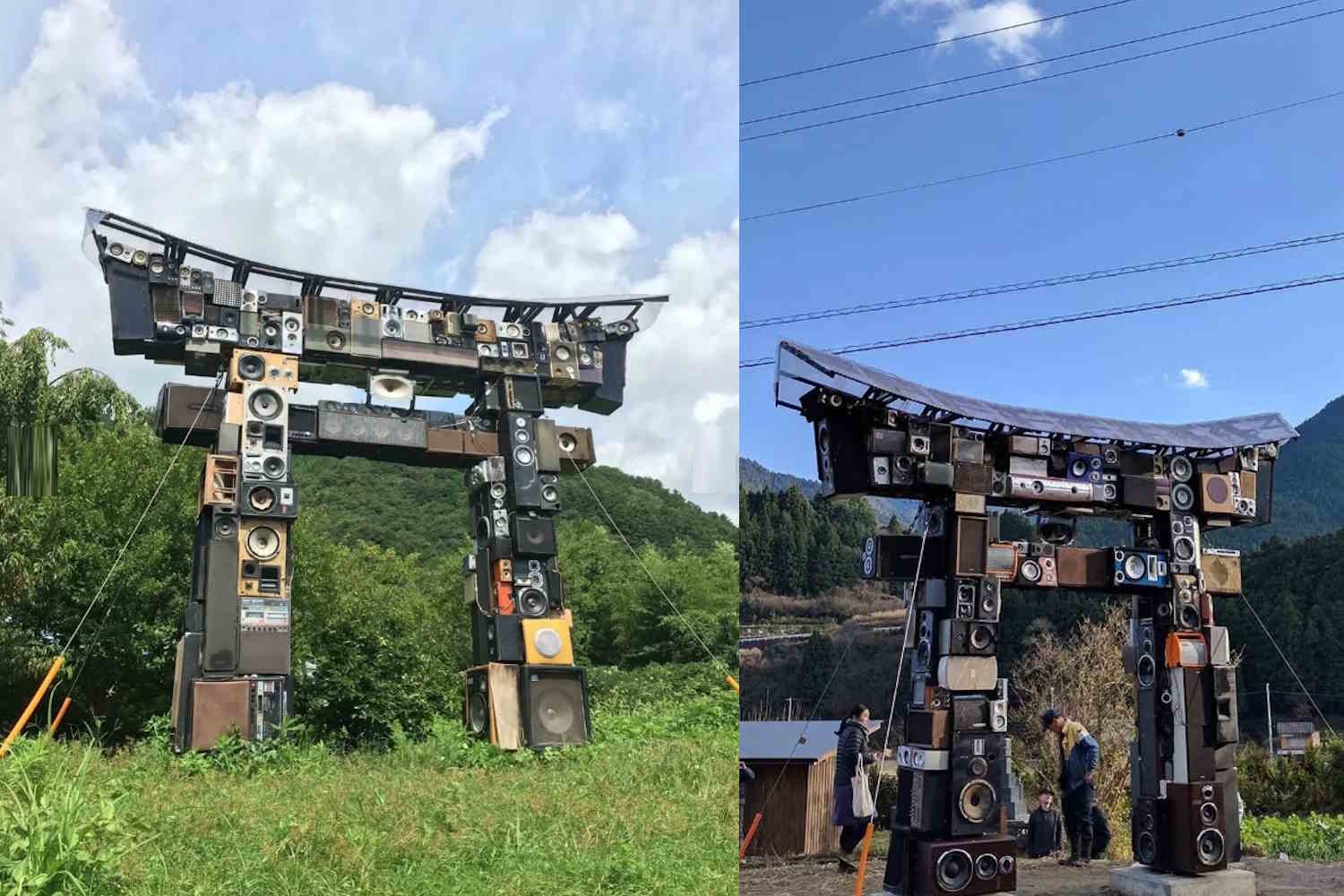
In a small village immersed in the mountains of the Prefecture of Tokushima, in Kamiyama, until a few years ago there was a work capable of surprising anyone who met her. These were the Tori Gate Karaoke, a portal made entirely with about 300 recycled speakers, assembled to form the classic Myōjin structure, typical of the Shinto sanctuaries. The idea, born from the mind of the sound artist Benoît Maubrey, unexpectedly united the Japanese tradition with contemporary technology.
The installation, which had made its first appearance at the Kobe Biennale in 2016, had then been transferred to Kamiyama, a place known for its cultural and artistic projects that often enhance recovery materials and new expressive forms.
An interactive work that blends spirituality and technology
Torii was not only a monument to be observed: anyone could connect their phone or another device and spread music, voices or sounds through the structure. The system allowed connections via bluetooth, line-in, microphone socket and even with old 8-track boxes. In this way, the portal became a real sound door that amplified personal content by transforming them into shared experience.
What made it even more particular was the choice to use used speakers, with a deliberately imperfect audio. This detail was not a defect, but part of the message: the work wanted to tell the accumulation of time and excesses, a stratification that gave voice not only to the music of the moment but also to the memory of the objects themselves.
The result was an unusual mix: on the one hand, the symbolic value of Torii as a threshold between the earthly and the spiritual world; on the other, the freedom to give life to a personal soundtrack that spread through the mountains of Kamiyama.
The end of the Karaoke Tori Gate and the legacy of the work
Unfortunately, in 2019 the Karaoke Torii Gate was destroyed by a typhoon, ending an experience that had made the valley a unique place of its kind. Despite his disappearance, the work remains a significant example of how contemporary art can reinterpret ancient symbols, stimulating new reflections on communities, participation and collective memory.
Today the memory of that sound portal survives in the testimonies and images shared online: a work that has been able to mix irony, technology and spirituality, leaving an indelible sign in the history of Kamiyama.
Don’t you want to lose our news?
You may also be interested in:
