
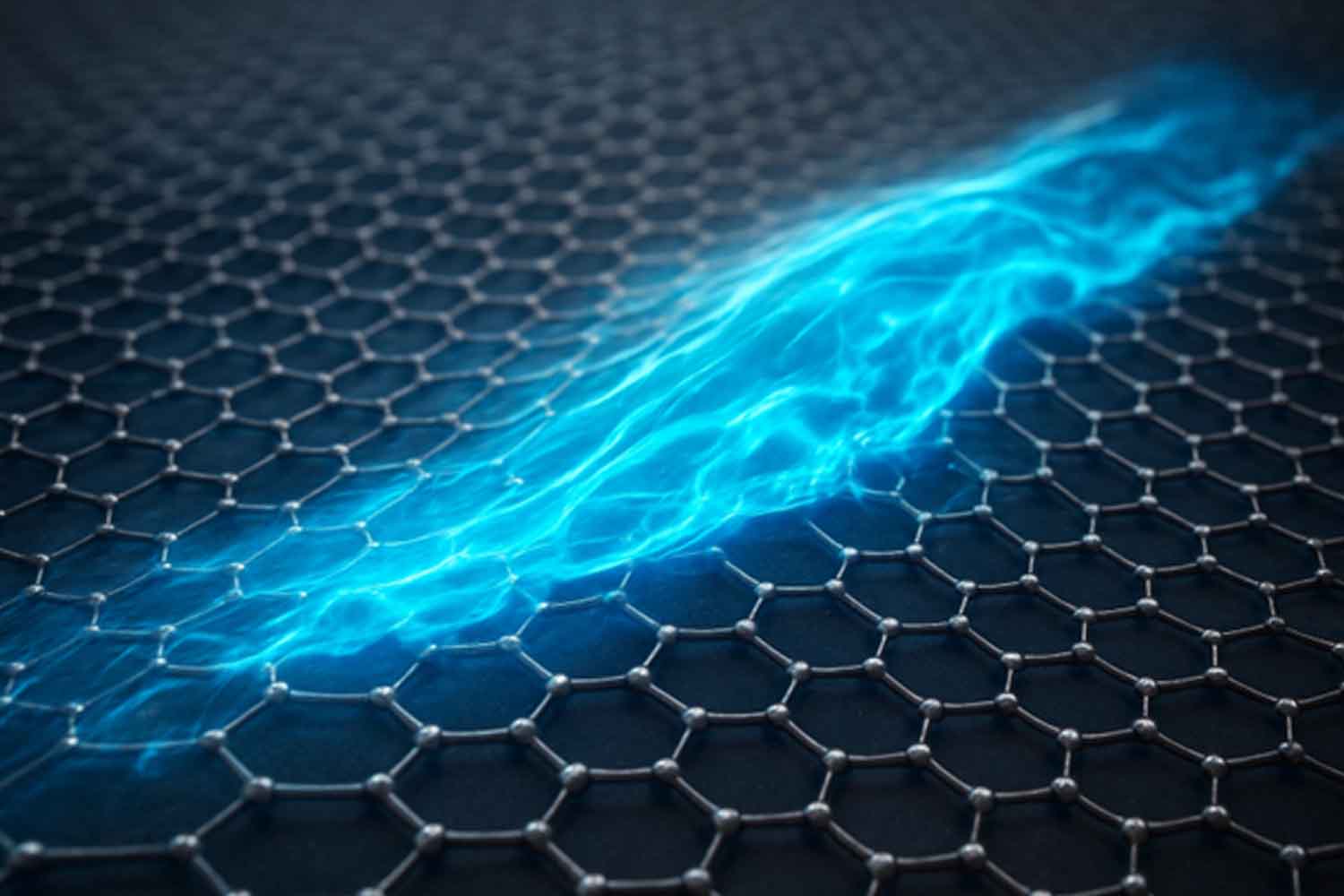
A team of researchers discovered that, in particular conditions, graphene behaves in an opposite way to the provisions of a physical law considered universal. Here’s what it means and why it could change our way of studying the universe.
The graphene It is a subtle material as a single layer of carbon atoms, but it is more resistant than steel and leads electricity Better than copper. Discovered in 2004 by Andre Geim and Konstantin Novoselov, who for this received the Nobel Prize for Physics in 2010today he continues to be talked about.
A new study, conducted byIndian Institute of Science in India and from National Institute for Materials Science In Japan, he observed really out of the ordinary behavior: When the graphene is “regulated” on its side pointor when, his thermal and electric conductivity we knew.
The graphene violates the law of Wiedemann-Franz
In detail, the researchers discovered that graphene, one of the basics of material physics. This law says that, in a metal, The more a material leads electricity, the more he leads heatand that the relationship between these two properties is proportional to the temperature.
But in the graphene the opposite happens: The more thermal conductivity increases, the more electric decreasesand vice versa. A Deviation of 200 times with respect to the provisions of the law. This behavior had already been mentioned in a 2016 study, but it is the first time it comes experimentally confirmed clearly.
It’s not over here. The researchers also observed that, in this state, graphene behaves like a quantum fluid almost perfect, that is without internal friction. This makes it similar to Plasma of Quark and Gluonia form of present subject Just after the Big Bang And recreated today in the great accelerators of particles such as CERN.
According to the team of scientists, graphene could become A low -cost platform to study complex phenomena like thequantum entropythe Thermodynamics of black holesor even the quantum gravity.
And thanks to its extreme sensitivity, it could also be used as quantum sensorable to detect very weak magnetic fields.
“It is incredible how much there is still to be understood on a single layer of graphene, even after twenty years after its discovery,” commented Arindam Ghosh, one of the authors of the study.
After 20 years, graphene is still a mystery to explore
Twenty years after its first extraction, the graphene continues to displace the scientific community. From “miraculous” material for electronics, today it turns out to be A real natural laboratory To explore concepts to the limits of modern physics.
It is no longer just about improving batteries or electronic devices. The graphene could help us to better understand the universeleading us to review some of the laws that until yesterday seemed immutable.
