
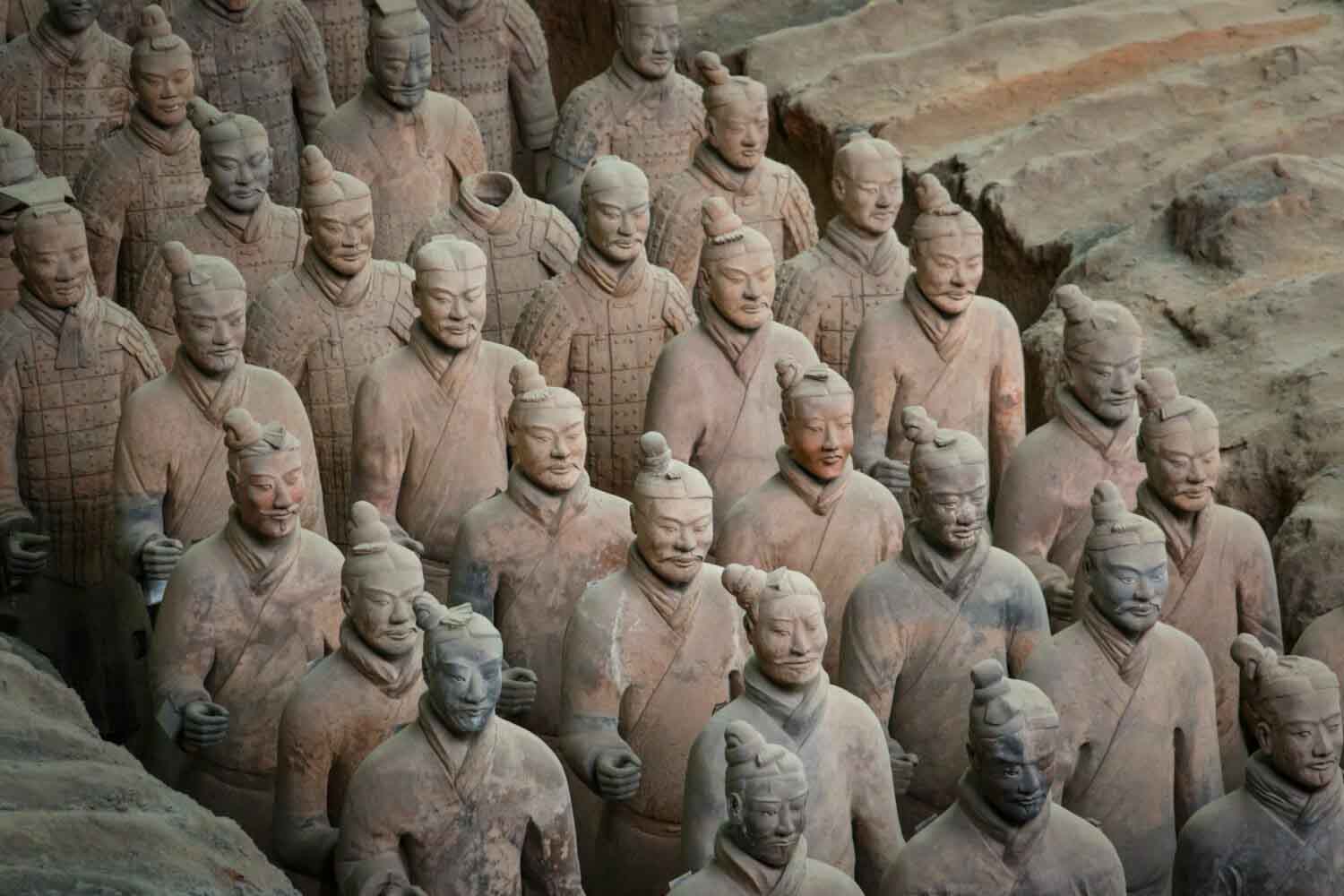
It is a story that began by chance, almost fifty years ago, when some farmers from the Chinese province of Shaanxi were digging a well. Instead of the water, they found something that nobody expected: a statue of clay with a natural size. He was the first of terracotta warriorspart of an underground army built more than 2,000 years ago to accompany the emperor Qin Shi Huang in the afterlife.
Today, that site returns to the center of attention thanks to an even more enigmatic discovery: A 16 -toned wooden coffinhidden at 16 meters deep, surrounded by treasures never touched by tombs thieves. Archaeologists speak of thousands of ancient coins, Weapons, armor, objects in jade, kitchen utensils and even two camels made of gold and silver.
According to the first hypotheses, it could be the tomb of Prince Gaoone of the children of the emperor. An almost mythical figure, cited in the ancient Chinese texts but never confirmed so far by archaeological evidence.
Legend takes shape
In 2011, the researchers identified Nine large funeral chambers Near the mausoleum of the emperor. One of these, over 100 meters long and still sealed, proved to be different from the others. When the strong rains threatened to flood it, archaeologists were forced to intervene.
Jiang Wenxiaothe head of the team, said:
The tomb is incredible. Built with an out of the ordinary precision, deep, immense. We thought had already been sacked, like almost all the ancient ones. And instead it was intact. Nobody had ever touched her.
Inside, the finds speak clearly. Each object has a precise meaning in Chinese culture: Jade is purity, weapons are protection, coins represent wealth, exotic animals power and strength. Everything suggests a very high rank character. But who?
In the historical text Shijiwritten by Sima Qianit is said that after the death of the emperor, the youngest son, Hu you have, took power by eliminating the other brothers. Among these, Gaoone of the eldest children, would have asked to be killed in order to rest next to the fatherfaithful until the end. Nobody knew if it was a legend or a historical fact. Until now.
Confirming the identity will not be easy
Even if the clues seem to lead to Prince Gao ,. The wood of the coffin is very damaged, e DNA could be deteriorated after 2,000 years. Archaeologists are evaluating different techniques: chemical analysis, comparison of finds with other similar objects, and even attempts to reconstruct the genetic profile. But it will take time, and a lot of caution.
Even if it were not Prince Gao, the discovery remains fundamental. Demonstrates how little we know little about the mausoleum of emperor Qin Shi Huangand how sophisticated the construction of the tombs in ancient China was. More than two millennia have passed, yet the secrets of that period are still emerging, centimeter after centimeter.
If you want to know more, Netflix has dedicated the documentary to discovery “The Mysteries of the Terracotta Warriors”which reconstructs step by step the excavation and the hypotheses that are making historical and archaeologists discuss all over the world.
