

The new annual report Education at a Glance 2025published by the Organization for Economic Cooperation and Development (OECD), launches a serious alarm on the skills of the Italian adult population and reveals an educational system with lights and shadows, marked – in Italy – by a low number of graduates and a teaching staff among the oldest in the world.
The most worrying figure emerges from the Piaac survey on the skills of adults: about a third of Italians (27%) has a level of understanding of the texts (Literacy) equal to or lower than level 1, which means that it is able to understand only short, simple texts and on family topics. A real “functional illiteracy” which highlights a lack of fundamental skills to actively participate in social and economic life.
The problem does not even spare those who have reached the highest levels of education. Although the degree offer protection, 17% of Italian graduates stop at the same low level of competence, showing difficulties in interpreting and evaluating dense or complex texts. The situation is even more critical for those with a low qualification: 58% of adults who have not completed the upper secondary school are in this condition. Although in Italy the gap of skills between the different levels of education is less marked than countries such as Germany, the general picture remains critical.
Few graduates and an education that is not enough to work
All deficiencies that fit into a context of low tertiary education. Italy is confirmed as one of the OECD countries with the lower percentage of graduates: only 22% of adults between 25 and 64 years of age have a tertiary security, compared to an average of 42%. Even among young people (25-34 years), despite a slight increase, the share of graduates (32%) remains very far from the OECD average (48%).
A low level of education translates into difficulty in the labor market. Employment rates in Italy are lower than the OECD average at each level of education. Owning a degree increases the chances of finding work (85%employment rate), but the advantage is less marked than other countries. In addition, those who lose their jobs struggles to find it: 41% of unemployed graduates have been for more than a year, a percentage that rises to 57% for those with a low qualification, indicating structural problems of the market.
A positive sign, however, comes from the young Neet (those who do not study and do not work), whose percentage between 18 and 24 years of age drastically fell from 25% in 2019 to 17% in 2024, although it remains higher than the OECD average (14%).
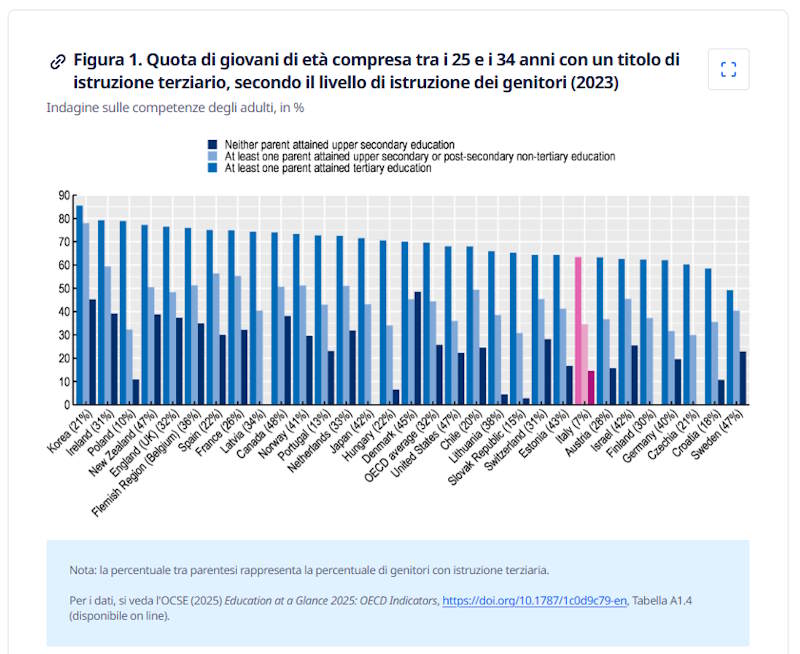
The roots of the problem: a system under pressure
The OECD report highlights some structural critical issues of the Italian educational system. One of the main ones concerns investments: if the expenditure for compulsory school is in line with the international average, the Italian University is significantly sub -childhood, with an expense per student of 14,713 USD, much less than 21,444 USD of the OECD average.
Another critical factor is the teaching staff: Italian teachers not only perceive salaries lower than the OECD average, but also represent one of the oldest teacher populations in the world. In fact, the report shows that the statutory salaries of Italian teachers are lower than the OECD average. A primary school teacher with 15 years of experience earns 45,593 USD, against an OECD average of 59,673 USD. The same goes for first grade secondary school (49,539 USD against 61,563 USD) and second degree (50,917 USD against 63,925 USD).
Finally, more than half of the teachers (57% in primary and 52% in secondary) is 50 years or more, a fact that asks questions about generational change and teaching innovation. On the other hand, the data is certain: the Italian classes are on average smaller, with 18 students in the primary and 20 in the secondary secondary school, a potential advantage for the quality of the teaching.
Here the complete report.
