
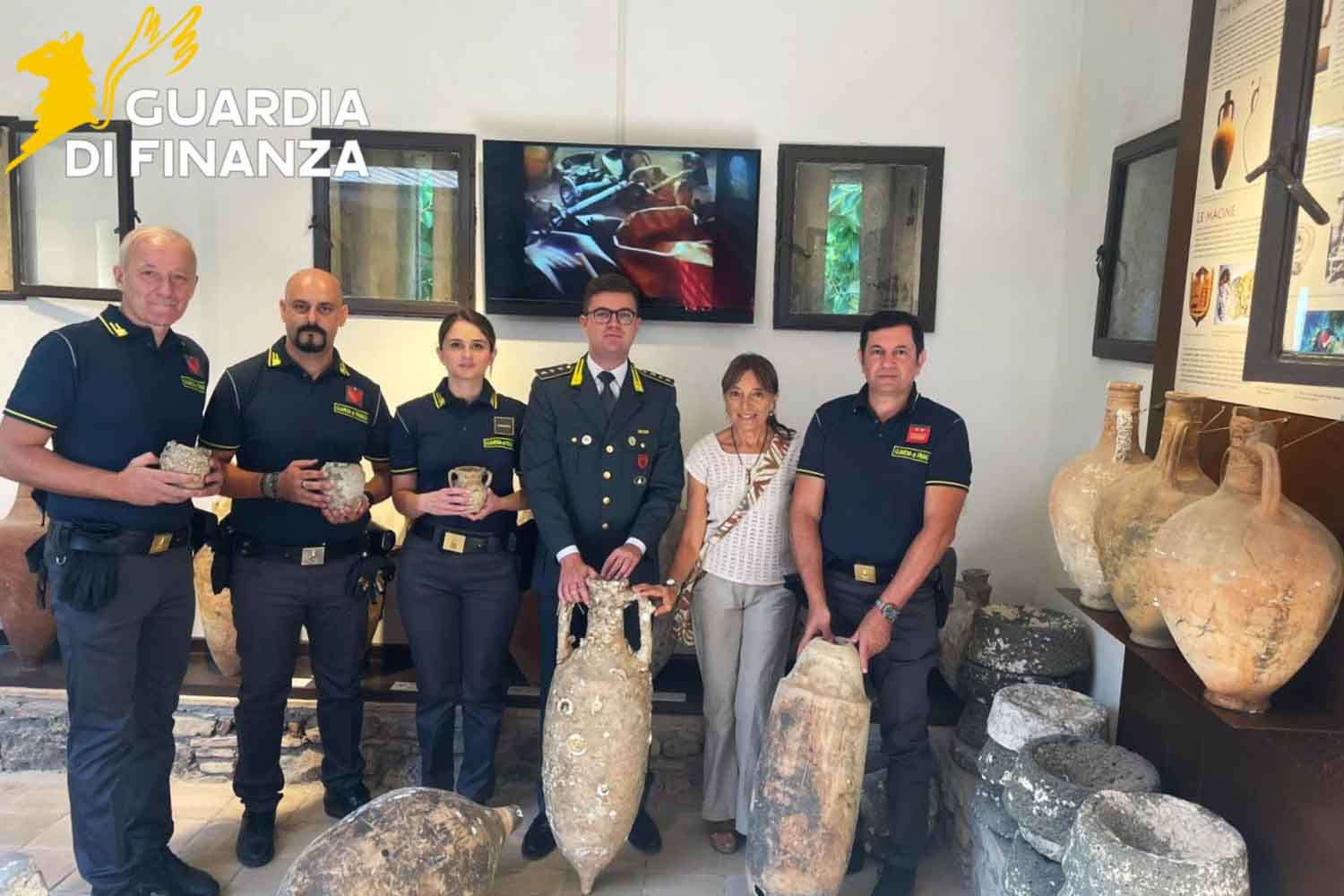
During an environmental control service in Trappitello, a hamlet of Taormina, the financiers of the provincial command of Messina came across something unusual. Along the argument of the Santa Venera streambetween resulting materials and old clothes thrown between the vegetation, some bags with an irregular shape have been noticed. Inside, wrapped in newspaper and covered with marine sediments, they were there six ancient amphorae: three large and three smaller.
The discovery, which took place in an area of uncontrolled abandonment of waste, immediately triggered the kidnapping. Objects were found to be archaeological findsas confirmed subsequently by a report of the Superintendence to the cultural and environmental heritage of Messina. Now they are safe and will be exposed to the public at the Archaeological Museum of the Naxos Taormina Parkwhere they can be studied and enhanced.
The amphores found date back to the first century BC and the period between 1600 and 1800
The three larger amphorae were dated between the The century BC and the 1st century ADRoman era. The smaller ones, on the other hand, traced back to a period between the 1600 and 1800. It is not yet clear how these artifacts are finished along the stream, but the presence of sediments suggests a long stay underwater, perhaps linked to shipwrecks or trade commercials by sea.
After the technical evaluation and the official recognition of their historical value, theJudicial Authority of Messina He released the authorization for delivery to the Archaeological Park. The material transfer took place the September 25thmaking a small fragment of local history accessible again to the community, saved in a completely fortuitous way.
An operation between environmental protection and defense of cultural heritage
The context of the discovery is emblematic. The area in question, abandoned and controlled, is similar to many others in Sicily and Italy, where illegal abandonment of waste He often also hides traces of history. In this case, the joint work between the Guardia di Finanza and the Superintendency has made it possible to recover six objects that, otherwise, could have been lost or end up in the black market of cultural heritage.
The Public Prosecutor of Messina has opened an investigation for dispersion of cultural heritagecrime foreseen by the Code of Cultural Heritage. The investigations are still in progress and at the moment the responsible for the concealment of the finds are not known.
With their exposure to the public, these objects will be able to return to perform the function for which they have survived over time: tell the pastnot only as an archaeological testimony, but also as an example of how much the territory can still reveal – and how much it is necessary to continue protecting it.
