
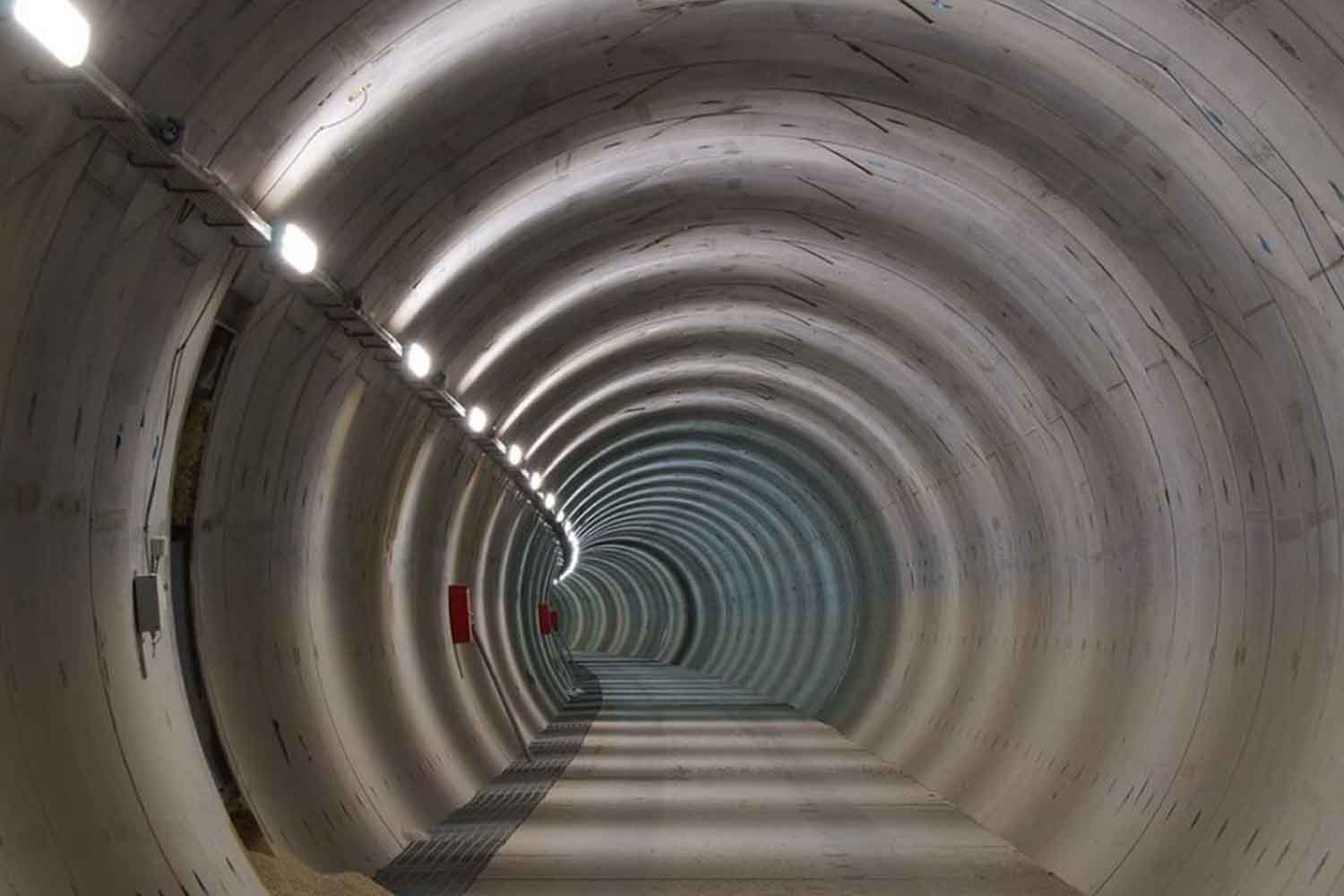
In mid -September 2025, a mechanical cutter knocked down the last meter of rock at 1,370 meters below the Brenner pass, in the Alps, completing the underground connection between Italy and Austria. This is a fundamental step in the construction of the Brennero basic gallery, destined to become the longest railway tunnel in the world.
The work is part of a wider vision: to create a continuous railway corridor from Helsinki in Palermo, to encourage the sustainable mobility of goods and passengers in Europe.
The excavation has a symbolic and technical value: for the first time the Austrian and Italian work fronts under the Alps unites. An event also followed by the political authorities of the two countries. But beyond institutional presences, the relevant figure is that this passage represents a turning point for the construction of an infrastructure destined to radically change mobility in one of the busiest and most polluted areas in Europe.
Halved travel times
Once completed, the Brenner Gallery will allow to reduce the travel time between Verona and Monaco of Bavaria of two and a half hours, making the train an alternative real and competitive compared to the road and even the plane for medium-long sections.
The project is part of a larger network of European railway investments:
All these interventions are scheduled for completion by the beginning of the 2030s. The Brenner Gallery, specifically, should be operational by 2032, the year in which the first trains will begin to circulate.
A gallery to reduce freight traffic by rubber between Italy and Austria
The Brenner Gallery is one of the most imposing railway project ever built in Europe: 230 kilometers of overall underground infrastructures, of which 110 kilometers for the two main tunnels (one for each direction of travel), which will connect Fortress, in the province of Bolzano, in Innsbruck, Austria.
The goal is not only to improve the speed of railway connections. It is above all to reduce freight traffic on rubber, which today congests the Brenner motorway and pollutes the Alpine valleys. Over 2.5 million trucks and about 50 million tons of goods pass through the passage every year. Currently, only 30% of freight traffic occurs on rail. The rest is on the road.
With the new tunnel, we aim to reverse this proportion. Or, at least, to rebalance it. The freight trains, thanks to a more linear and less pending route, will take 35 minutes to cross the stretch. Today 105 are needed. Even for passenger trains, a reduction of times from 85 to 25 minutes is expected. An advantage that could make rail transport more competitive, also for companies.
A project with some unknowns
The Brenner Gallery is part of the Scandinavo-Mediterranean Corridor, a transe European transport network that connects Sweden, Norway, Finland, Denmark, Germany, Austria and Italy. The railway track should facilitate commercial and passenger connections in a more sustainable way, helping to reduce the environmental impact of transalpine traffic.
But there is no shortage of critical issues. First of all, Germany is late with the creation of the access routes to the gallery. In addition, Confindustria Alto Adige has already made it known that it will not be possible to give up the roads, pointing out that, at least in the short term, the transport by rubber will continue to be central.
The excavation of the exploratory tunnel was not easy. In some sections we worked under the Isarco river, where it was necessary to adopt the technique of freezing of the ground: through the use of liquid nitrogen, the underground water was frozen to stabilize the soil and avoid infiltrations.
BBT if, the Italian-Austrian public company that manages the project, said it has respected all environmental prescriptions. Environmental compensation interventions are also planned in the territories affected by the construction sites.
204 kilometers out of 230 of the total galleries were currently completed. As for the main tunnels, 100 out of 110 kilometers have been made. The completion of the work is scheduled for 2032, the year in which it is estimated that the first trains will start transit.
You may also be interested in:
