
In the squares of the world, symbols often have more strength than words. Just a gesture, a color, a daily object to transform the protest into a collective image. We recently seen it with the pirate flag of the straw hat of One Piece which exceeded the boundaries of the fandom and turned into a symbol of youth protest.
From the streets of Jakarta to the squares of Kathmandu and Paris, he is waved by young people as a manifesto against corruption, censorship and authoritarianism. The smiling skull with straw hat summarizes the desire for freedom and resistance of the Z generation, becoming a universal rebellion language shared especially through social media.
Different Nations, Same Flag. Freedom Everywhere – from Indonesia & Nepal to Gaza, Italy & France. Who’ll Raise It Next?#Onepiece pic.twitter.com/rrilotfwx9
– 𝘕𝘰𝘢 (@Noapiecex) September 11, 2025
But the flag of One Piece is not the only one: recent history tells us about masks, colors, gestures and even fruits or toys capable of transforming itself into shared political signs. Let’s discover together the symbols that have made the protest visible all over the world visible.
Guy Fawkes masks: anonymity and rebellion
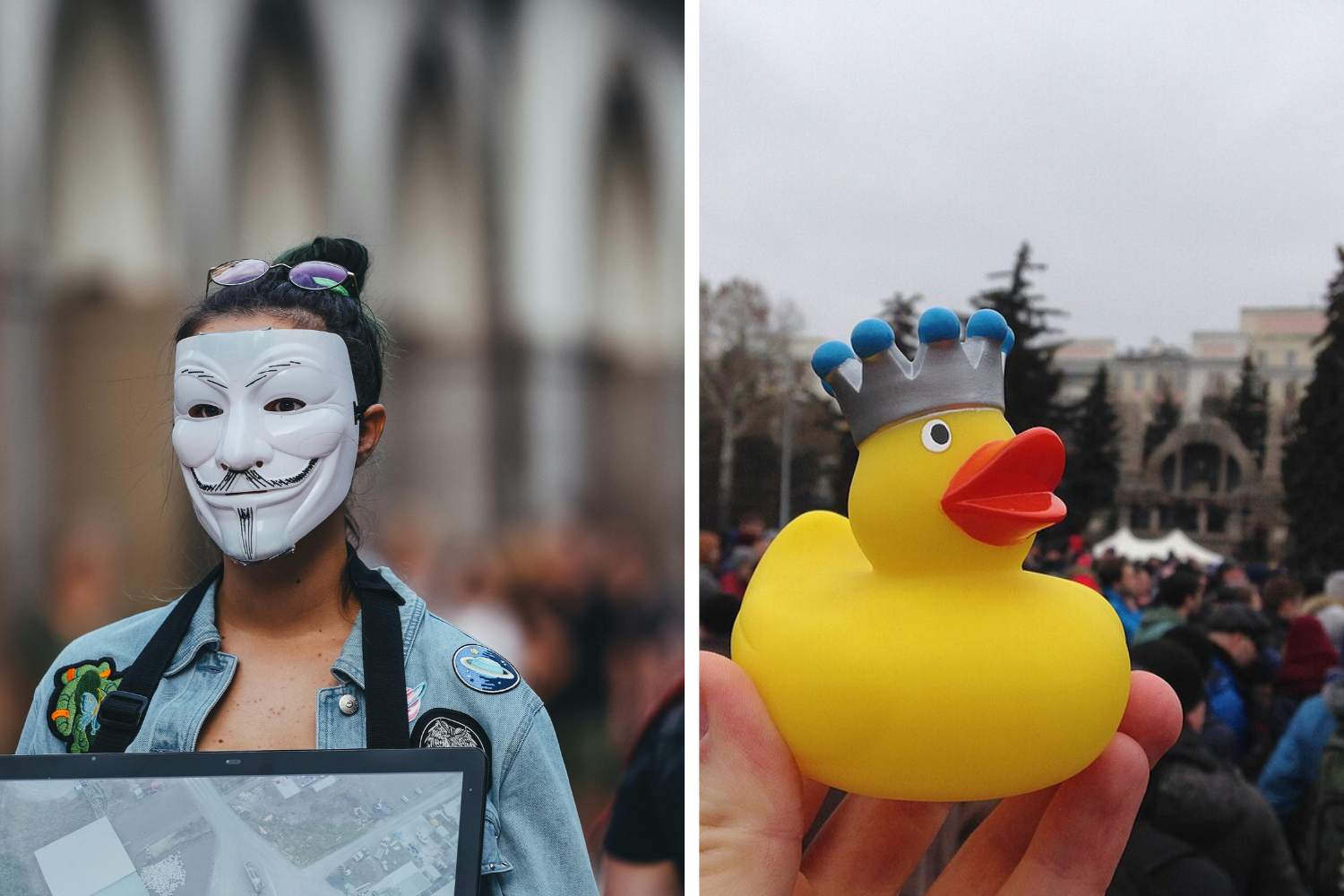
There is no symbol that has better embodied the rebellious anonymity in the 21st century: the mask of Guy Fawkes, made famous by the film V for revengehas become the visual icon of dissent against centralized power. It represents the collective anonymity in protests and not for nothing has become the emblem of the organization of Anonymous Hackers.
Used during the protests of Occupy Wall Street, against Acta or by the Indignados movement, it allows each protester to join an invisible multitude, symbolically opposing the centralized power. Its visual and cultural impact has transformed a historical face into a global icon of peaceful but powerful dissent against authoritarian and anti -capitalist.
#Peru: Anonymous launches #Opperu In Response to recent Violent Government Repassation. Several Websites, Including Those Belonging to the Police, Have Been Targeted in Protest;
Anonymous Calls for Police to Respect Human Lives and the Freedom of Peaceful Assembly and Protest. pic.twitter.com/lyit5bsqr2
– Anonymous (@youranoncentral) November 14, 2020
Feminist handkerchiefs: visual and identity struggle
Even the colorful scarves have become protest tools and political identity: from the pañuelo Verde in Argentina for the right to abortion, to the Chilean red handkerchief to the Spanish purple scarf, each color communicates solidarity and collective resistance. The strength of these symbols lies in their ability to transform the squares into real visual protest paintings, where each color tells a story of struggle and determination.
These fabrics – worn in the neck, on the wrist or as a bandana – transform the body into a sign: a simple but clear gesture, which makes a community visible that claims rights, autonomy and dignity. For example, the green handkerchief has its roots in feminist assemblies in Argentina and has become a symbol of hope and resistance in the struggle for legal abortion over time.
Hermosa Película “Belén” de @Fonzidolores Basada en el book Somos Belén de @anaecorrhea
Profundda, Sensible Y with Algo de Picardía. Como Fue nuestra Lucha por el derecho to the abortion legal, free seguro y.
Vayan at Cine Y Lleven on Pañuelo Verde
pic.twitter.com/lzigj0ebys
– Mercedes Trimarchi (@mercedestrimar) September 19, 2025
The three fingers raised: the gesture of challenge
Inspired by Hunger Gamesthe gesture of the three raised fingers was adopted by the democratic movements in Thailand, Myanmar and Hong Kong as a silent sign of dissent. It is done by raising the index, the medium and the ring finger and holding the thumb on the little finger, raising his hand with the palm facing outwards as a sign of greeting.
This cinematographic gesture has become so real politics, so much so that in many countries it has been censored. For the first time it was used after the 2014 Thai coup, becoming a sign of freedom, equality and fraternity. The pro-democracy demonstrators continued to use it even during the protests of 2020-2021, risking arrests and repression by the army. Activists such as Parit Chiwarak and Panusaya Sithijirawattanakul have contributed to spreading the symbol in the events against authoritarianism.
The three-finger greeting was then adopted in Hong Kong during the 2014 umbrella movement and subsequently in the 2019-2020 protests. Thus has become a recognizable sign of resistance against the Chinese government, symbolizing the desire for democracy and civil rights.
In Myanmar, after the state of state of 2021, the demonstrators used the gesture to oppose the military regime. Local celebrities such as Paing Takhon and Dave Leduc have made him an emblem of solidarity and peaceful resistance, despite the violence and arrests suffered by the participants.
In Indonesia, the three-fingers greeting was adopted by Ganjar PraNawo as a symbol of his election campaign for the 2024 presidential elections. The move symbolized resistance and civic commitment, recalling the pro-democracy movements of Thailand and Hong Kong. A derivative, the four -finger greeting, emerged as a symbol of united opposition against the candidacy of Prabowo sub -Sottlanta, creating a viral movement on social media.
Southh Saatnya Indonesia Merapkan Three-Finger Health, SEPERTI FEMAN-TEMAN MAHASISWA by Thailand Dan Masyarakat by Myanmar Sebagai Bentuk Perlawanan Terhadap Militer. If We Burn, You Burn With Us. https://t.co/mbyjybilh pic.twitter.com/xwkl2za0eu
–
(@PowPowTrol) March 17, 2025
Anguria and Kefiah: Palestinian resistance symbols
In Palestine, watermelon and Kefiah have become symbols of identity and struggle. Wearing a kefiah or bringing watermelon during events means affirming one’s cultural and political resistance, making the struggle for freedom and dignity visible through recognizable and symbolic elements globally.
Watermelon has become a Palestinian symbol from the 60s-70s, after the six-day war (1967), when Israel forbade the exhibition of the Palestinian flag and its colors (red, green, black and white). The Palestinians found a creative way to get around the censorship: expose or drawing slices of watermelon, which reproduced exactly the same colors as the flag.
A fruit that thus became an act of artistic and silent resistance, so much so that in the 80s even the paintings depicting Anguries were seized by the Israeli authorities. Today, watermelon is back in protests and above all online, becoming a pop and viral symbol of daily resistance, widespread in the form of emojis, adhesives and murals.
How Did The Waterlon Become A Symbol of Resistance for Palestinians? pic.twitter.com/afighdvsnl
– Aj+ (@Ajplus) June 15, 2021
Kefiah (white and black square scarf) is instead a more rooted historical and political symbol. Originally a widespread headdress among the Arab farmers, in the 1930s and 1940s it became a sign of Palestinian identity and was adopted by the fighters against the British mandate. In the 1960s Yasser Arafat made it famous by wearing it on all public occasions, transforming it into a universal political sign of Palestinian resistance.
The Kefiah network motif, according to some interpretations, recalls the nets of the fishermen of Gaza, while the black lines would represent the Palestinian fields. Today it is worn all over the world as a gesture of international solidarity and, despite the controversies and exploitation, it remains one of the most recognizable emblems of the Palestinian cause.
The yellow ducks who challenged the Thai monarchy
They only looked like beach toys, instead they became a political icon. The yellow inflatable ducks, which appeared for the first time in the squares of Bangkok in 2020, have transformed a student mobilization into a global movement of creative resistance. It all began during the events against the government of Prime Minister Chan Ocha and against the absolute privileges of the monarchy of King Rama X. Thousands of students asked for resignation, constitutional reforms and a downsizing of the powers of the crown, in a country where the law of Lesa Majesty provides for up to 15 years in prison only for criticizing the royal family.
The first ducks arrived almost by chance: used as a improvised barrier to protect themselves from the jets of water mixed with chemicals and tear gas launched by the police. In a few days, that harmless and childish object turned into something more: a protest mascot. The demonstrators brought them to the procession, they repaired behind as if they were shields, wore them in the hair or decorated them with ironic writings. Their image bounced on social media and in the international media: the armed power and the untouchable monarchy ridiculed by a yellow inflatable.
The nickname came soon: “Yellow Duck Revolution”. A name that sounds light, almost comic, but that contains all the strength of the Thai youth protest. The ducks were the opposite of violence: a sign of peaceful and creative resistance, capable of dismantling the rhetoric of monarchical sacredness and showing the world a movement that used irony as a political weapon. Just this reversal of meaning made the ducks so powerful: gaming objects transformed into symbols of freedom. For the first time, the monarchy – for decades considered untouchable – was contested openly, and with the simplest and most effective language: that of visual satire.
Along with the ‘Hunger Games’ Health, Rubber Ducks Have Become The Symbol of Bangkok’s Anti-Government Protestors. These Duckies Were Shot At A Protest in Ratchaphrasong on 3 September. pic.twitter.com/5kwpbehxon
– Tim Russell Photography
(@Timrussellphoto) Octaber 6, 2021
You may also be interested in:
