
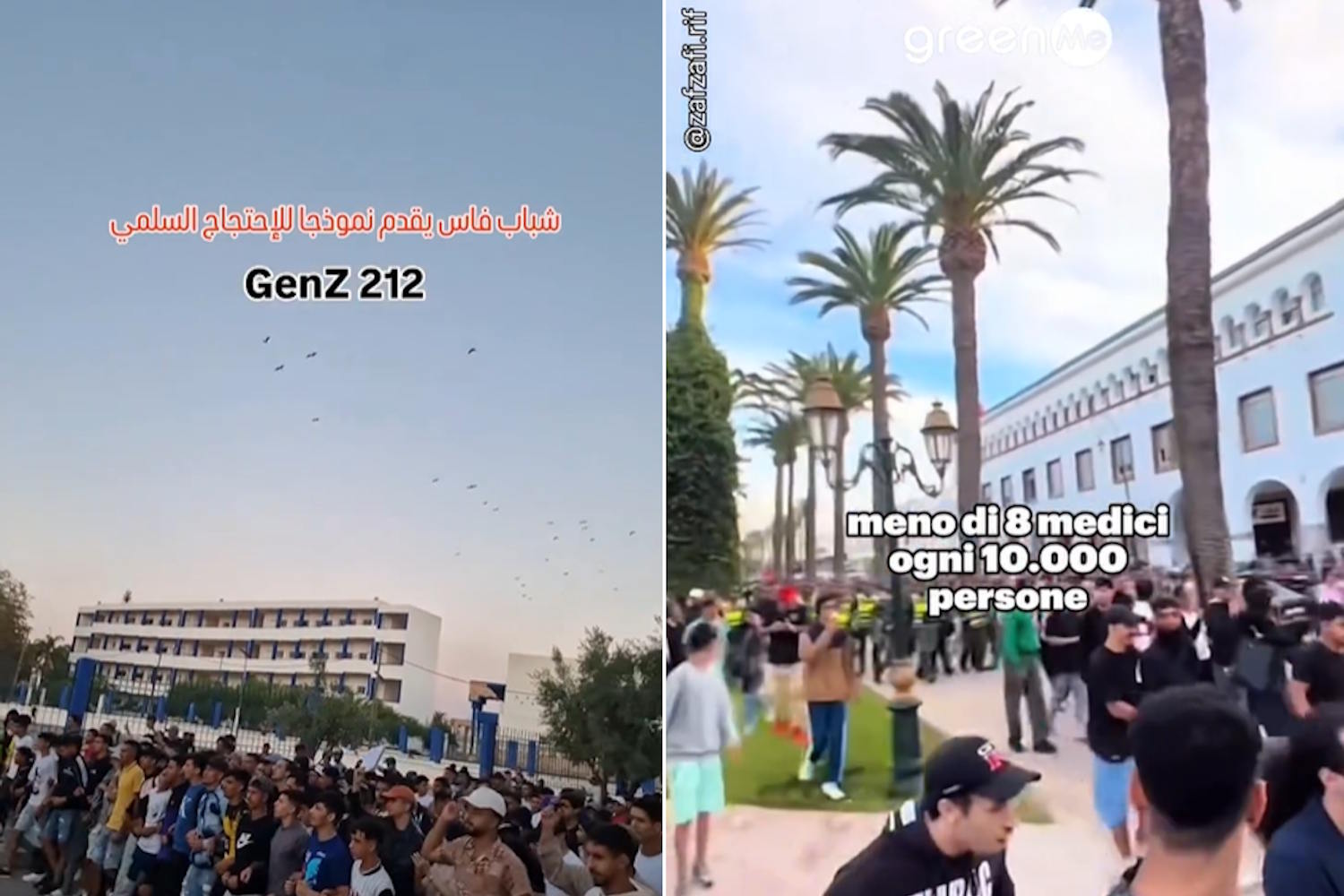
After Nepal, Sri Lanka, Bangladesh and Madagascar, young people from Morocco are also invading the streets. They are those of the “GenZ 212” movement, with reference to the age of those who come to demonstrate together with the country’s international prefix (+212, precisely). But why are young people protesting?
These are the most significant protests seen in Morocco since the Arab Spring (2011) and the more limited Rif uprising (2016).
What’s happening in Morocco: the Gen Z protest shaking the country
In recent days, Morocco has been hit by an unprecedented wave of social mobilisations: at the helm of these protests is Generation Z, who are calling for radical reforms and dignified living conditions. The movement, which emerged on social media and spread to dozens of cities, is highlighting profound tensions: between levels of inequality, the fragility of public services and a growing fracture between the aspirations of the new generations and the priorities of the State.
View this post on Instagram
The origins of malaise
Several factors intertwine as detonators of youth malaise in Morocco:
- Healthcare and education in crisis
The protesters’ main demands concern urgent investments to strengthen hospitals, clinics, schools and universities. The data speaks clearly: the healthcare system is under pressure and some dramatic episodes, such as the death of pregnant women due to the lack of adequate medical support, have unleashed a wave of collective anger. In short, while stadiums are being built for international football events, healthcare and educational facilities remain in disrepair - Unemployment, precariousness and lack of prospects
The youth unemployment rate is high, and for many there are neither jobs nor training opportunities. Economic insecurity weighs on the new generations, who strongly feel the distance between the promised “progress” and daily reality. In some rural areas, the soul of the protests has found fertile ground: territories with poor infrastructure, difficult access to services, administrative abandonment - Government, misaligned priorities and contested resources
The protesters contest the direction of public spending: too much effort for major works linked to the 2030 World Cup, too little for basic social needs - Digital coordination and collective identity
The protests do not have a single leader but were born and grown through online platforms: TikTok, Discord, anonymous groups have played a central role in organizing and spreading the movement. In a short time, GenZ 212 gathered tens of thousands of members, becoming a virtual center of youth debate and mobilization
The development of the protests: escalation and repression
The demonstrations, which began between the end of September and the beginning of October, quickly spread to large and medium-sized cities, but also to rural areas far from the spotlight. In many squares the protests were initially peaceful, but in many contexts they turned into clashes with the police. Scenarios of tension, arrests, injuries and even victims emerged throughout the week.
View this post on Instagram
“We don’t want the World Cup, we want healthcare”, “Hospitals first, not stadiums”
This protest is more than a moment of anger: it is a clear sign of deep tensions in Moroccan society. Generation Z, raised in an interconnected world, which sees reference to global practices of mobilization via social networks, has broken down geographical and social barriers: squares are no longer just the space of large cities, but also of marginal rural areas.
For Morocco, the test is crucial: being able to respond to the anger of the new generations with real solutions can determine the evolution of social stability and the development model.
Sources: Reuters / AP News
