
Winds of peace are finally blowing across the world. Or rather on that part of the world towards which all eyes are now focused (let’s not forget that there are endless wars and internal conflicts in many other remote corners that no one talks about, but that’s another story).
A few hours after the announcement of the Nobel Peace Prize (tomorrow 10 October by the Norwegian Committee), the idea becomes pressing (unhealthy, at least, for most) that Donald Trump could receive it, for having pushed towards an agreement between Israel and Hamas. But are we sure it would be the right choice?
Many say that the Norwegian Nobel Committee, made up of five members appointed by the Storting (Norwegian Parliament), will not be caught off guard by the smoke and mirrors. But we can be sure that among the 338 candidates for the Nobel Peace Prize for 2025 (of which 244 individuals and 94 organizations), the Tycoon’s name also appears. But we cannot know for sure for at least half a century: the list of candidates for the Nobel Peace Prize, in fact, is published 50 years after the award of the prize, in accordance with the statutes of the Nobel Foundation.
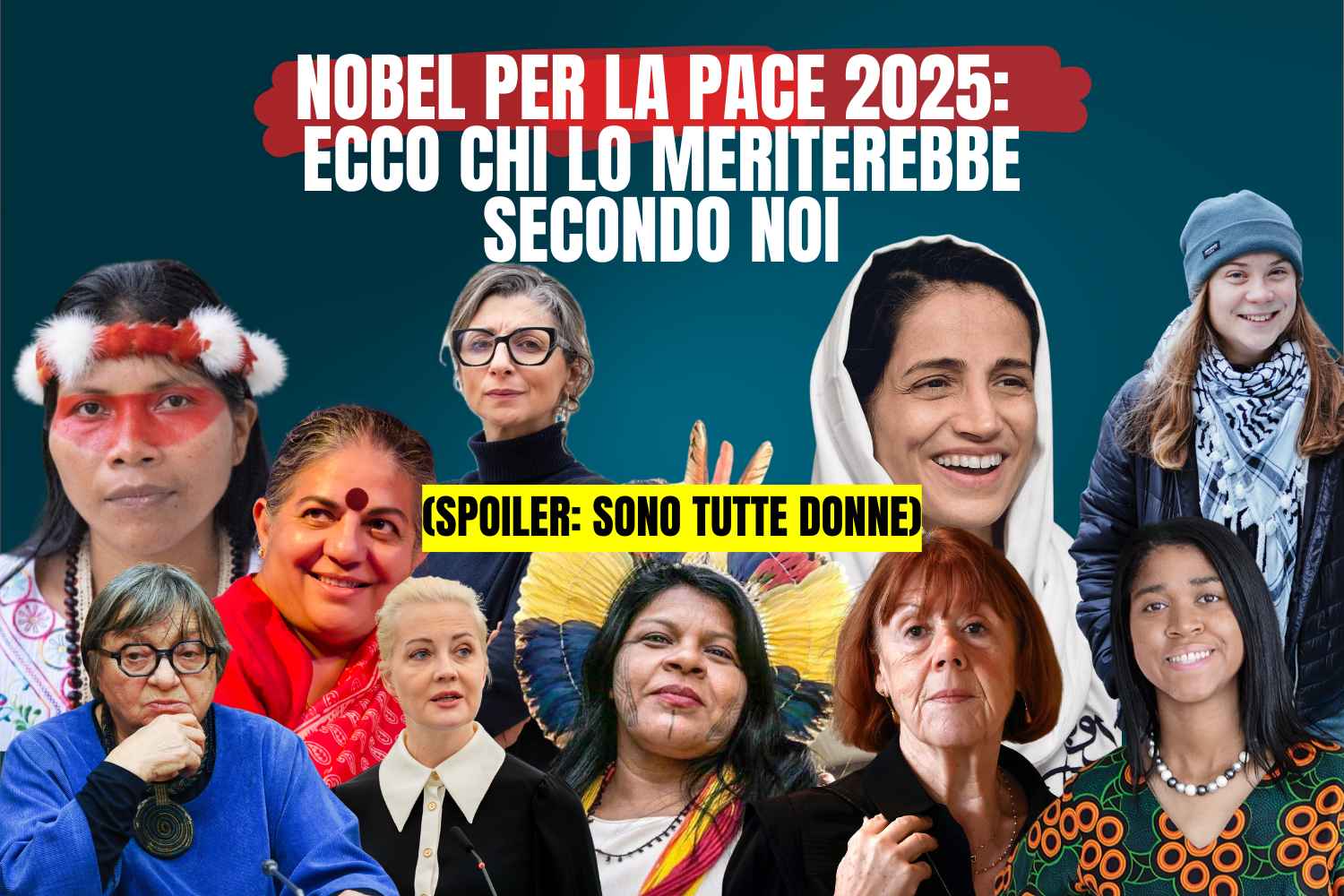
In any case, we thought a lot about who might deserve the Nobel Peace Prize this year and, wow!, only women’s names came up. On the other hand, of the 111 people awarded the Nobel Peace Prize from 1901 to today only 19 are women. The first time this prize was awarded to a woman was in 1905, to the Austrian writer Bertha von Suttner.
Here are 10 women who could receive the Nobel Peace Prize in our opinion
Nemonte Nenquimo (Ecuador)
Indigenous leader of the WaoraniAmerindian population of Ecuador, activist and symbol of resistance. Born in 1985 in the province of Pastaza, Nemonte grew up immersed in the dense greenery of the Amazon, where her education did not take place at school, but under the thousand-year-old foliage of the forest. In 2024, together with her partner and activist Mitch AndersonNemonte Nenquimo published the memoir We Will Be Jaguars. In 2020, TIME listed her among the 100 most influential people in the world. Additionally, he has received the prestigious Goldman Environmental Prize and the United Nations Champions of the Earth Award.
We talk about it here: Nemonte Nenquimo: the Amazon warrior who taught the world what it means to resist
Sônia Guajajara (Brazil)
Indigenous leader and politician, very active on the national and international scene in the defense of native populations. Brazilian President Lula entrusted the Ministry of Indigenous Populations to her in 2022, the first Brazilian ministry for the protection of indigenous peoples, whose rights have been brutally trampled on every day.
Vandana Shiva and her organization Navdanya (India)
Indian activist and environmentalist who fights to promote organic agriculture, free from GMOs, and fair trade, putting women and their autonomy at the centre. His is the battle against Monsanto and all the agribusiness multinationals.
Here is our interview: Vandana Shiva, women’s freedom passes through food: “the future is in your hands, take care of the Earth”
Nasrin Sotoudeh (Iran)
A human rights lawyer, she took on the defense of women who had protested against the obligation to wear the hijab and was arrested on 13 June 2018. She was subsequently accused, among other things, of “conspiracy against the system” and of insulting the Iranian spiritual leader, Ayatollah Ali Khamenei and sentenced to 33 years in prison and 148 lashes.
Gisèle Pelicot (France)
Having become a symbol against sexual violence and chemical submission, her husband drugged her for years to make her unconscious and allow other men to rape her, recording everything. Gisèle renounced her anonymity and asked for the trial to be public, becoming a symbol of the fight against rape culture and sexual oppression. The protests following the trial and its visibility helped put pressure on French authorities to review rape law, including the notion of “consent” as a central element. She has appeared in international lists such as “100 most influential women” (BBC) and among the 25 most influential women of 2024 (Financial Times).
Greta Thunberg (Sweden)
Environmental activist, often proposed for reasons related to climate change and global justice, founder of the Youth Strike for Climate movement. Greta is not just an individual activist: she has catalyzed thousands (in many cases millions) of young people around the world with “Fridays for Future”. Its role sparks a strong debate, but also global attention on climate risks and drives political action. The symbolic power of mobilizing young people from every continent is often seen as an act of “preventive peace”: trying to prevent environmental crises from degenerating into conflicts.
Francesca Albanese (Italy)
Albanese’s name is very divisive at the moment (just like Greta Thunberg’s). UN special rapporteur on the Palestinian territories, her activity is already deeply included in international dossiers on conflicts and human rights. Albanese has produced reports alleging serious crimes: in the report “Anatomy of a Genocide,” he argued that there are “reasonable grounds” to believe that Israeli actions in the Gaza Strip may constitute genocide. In 2025 she published a report analyzing the economic system of the Israeli occupation, going so far as to speak of the “economy of genocide”, and was awarded the “Dries van Agt Prize” by The Rights Forum, which recognizes commitment to defending human rights and international law in Palestine. She was also recognized as “UN Person of the Year” on PassBlue for her commitment in 2024.
Yulia Navalnaya (Russia)
Widow of Russian opponent Alexei Navalny, human rights activist. After her husband’s death in prison, Navalnaya took on the responsibility of continuing her fight against Putin’s regime, turning personal tragedy into a public commitment against authoritarianism. He has already received human rights awards, such as the “Magnitsky Human Rights Award”. She was listed among the 100 most influential people of 2024 by Time.
Luisa Morgantini (Italy)
Historic Italian activist, already cited several times for awards for peace and involved in international causes. Active for decades on issues of peace, non-violence, solidarity and rights – not as a recent “media phenomenon”, but with a constant life path. She has held important positions: MEP from 1999 to 2009, vice-president of the European Parliament with responsibility for policies for Africa and human rights. In the European Parliament she participated in strategic commissions: development, women’s rights, constitutional affairs, human rights. Finally, she is one of the Italian founders of the movement Women in Black (Women in Black), an international network against war and violence and is president of the association Assopace Palestina, which aims to promote respect for human rights and justice for Palestine.
Zuriel Oduwole (USA)
Very young and has international visibility as an activist for women’s education and children’s rights. Supported by academic institutions, an award to her could be “symbolic” as an emerging face in the field of peace gives her an intriguing narrative. She started the project as a child Dream Up, Speak Up, Stand Up (DUSUSU) to promote girls’ education, combat child marriage and enhance the skills of young women in various countries in Africa. In various countries she has taught filmmaking workshops to young women, to give them expressive tools and critical sensitivity.
Now, the Nobel committee rewards, as always, only surprising choices. These are just some of the women who attract greater attention in the media and public opinion today. But how nice would it be to hear one of these names tomorrow?
