
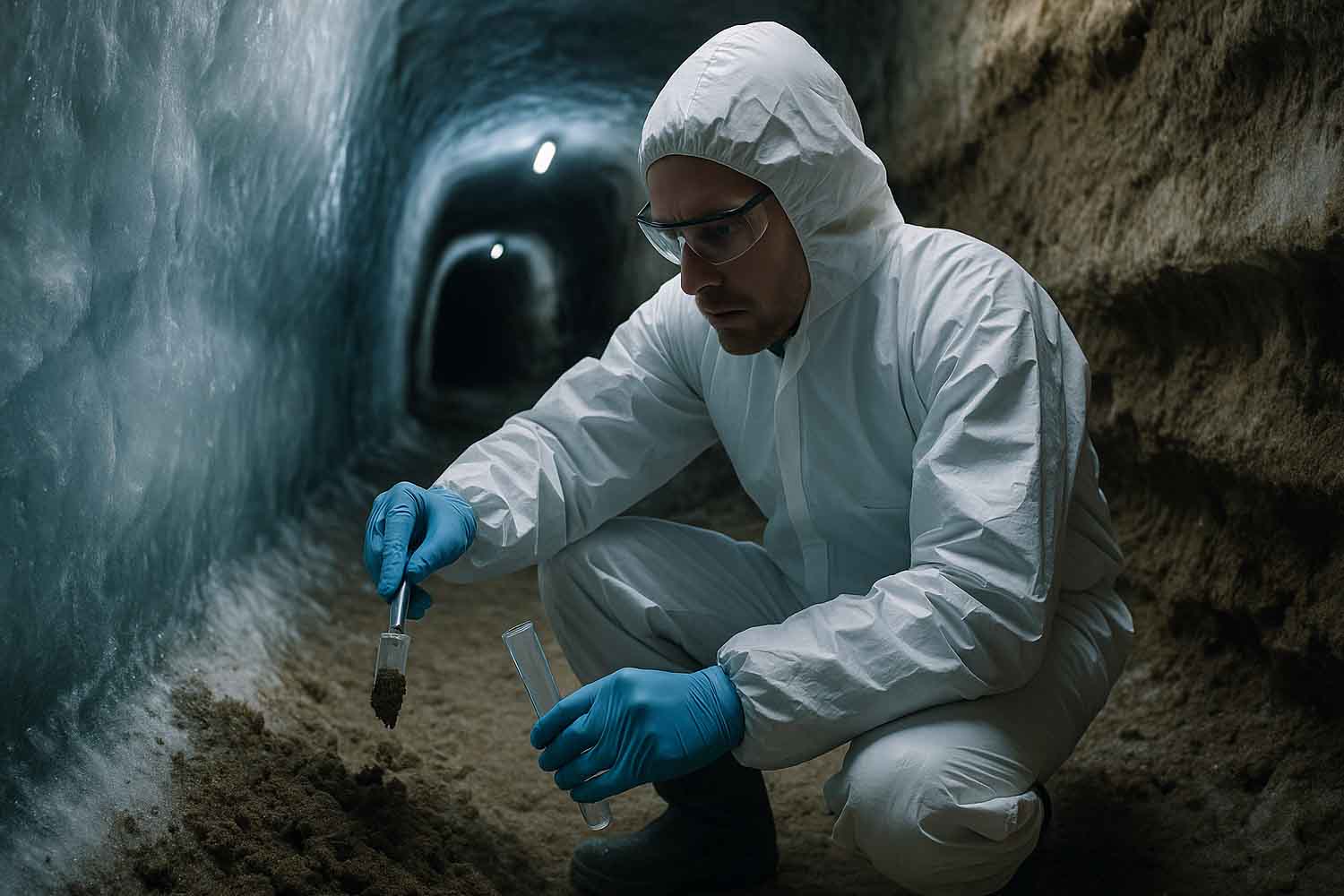
Under the ice of Alaska, 15 meters deep, lies a world that has remained intact for tens of thousands of years. In that frozen subsoil, called permafrost, a team of scientists has identified ancient microbes that are still alive, even if they have been inactive for tens of millennia. Once brought back to the laboratory, these microorganisms “awakened” and began releasing carbon dioxide (CO₂), raising concerns about the possible acceleration of global warming.
The discovery came from researchers at the University of Colorado at Boulder, who worked inside the Permafrost Tunnel Research Facility, near Fairbanks, Alaska. The structure, over 100 meters long, allows us to study the deep layers of frozen soil and preserves sediments dating back to the late Pleistocene, an era ranging from 11,700 to 129,000 years ago.
According to what the research team reported, the first thing you notice upon entering the tunnel is a pungent odor, described as similar to that of a damp cellar that has been closed for too long. The scientists explained that that smell would be linked to the presence of decaying organic material, a sign that microbial life is still present in the ice.
The microbes activated after months in the laboratory: they released CO₂
During the experiment, the researchers collected very ancient permafrost samples, in some cases around 40,000 years old. In the lab, those samples were immersed in water containing deuterium, a heavier form of hydrogen. The objective was to simulate the summer thaw conditions which now increasingly reach the deep layers of the Arctic soil.
The samples were kept at temperatures between 4 and 12°C, corresponding to what might occur in permafrost in future summers. The researchers monitored the biological activity over time, looking for any signs of active metabolism.
In the first months, a slow awakening of the microbes was observed, with an extremely low growth rate: they reproduced at a rate of just one new cell per 100,000 per day. But after six months, the situation changed. Some colonies became more active and began to break down organic matter in the soil and produce carbon dioxide as a by-product of metabolism.
The results of the study were published in the scientific journal JGR Biogeosciences, and represent a new step in understanding the effects of global warming on the Arctic areas.
Melting permafrost could release huge amounts of carbon and dormant microbes
Sebastian Kopf, professor of geological sciences and co-author of the research, explained the consequences of this discovery. According to what was stated, today the permafrost is melting at an increasingly rapid rate, and this trend could trigger a mechanism that is difficult to stop.
Scientists believe that as the ice melts, microbes still present in the soil may reactivate and begin to decompose organic matter that has been preserved for thousands of years. This decomposition releases gases such as CO₂ and methane, two of the most potent greenhouse gases known.
Kopf highlighted that this is one of the great unknowns of climate change. It is not yet clear how much carbon is actually stored in permafrost, nor how quickly it will be released into the atmosphere if microbes continue to activate as temperatures rise. The eventuality most feared by scientists is that a vicious circle will be generated: global warming melts the ice, the ice releases greenhouse gases, and these gases further increase warming.
For now, it is certain that permafrost is not just ice: it is a gigantic archive of organic matter and suspended microbial life, which with rising temperatures could transform into a new source of emissions.
You might also be interested in:
