
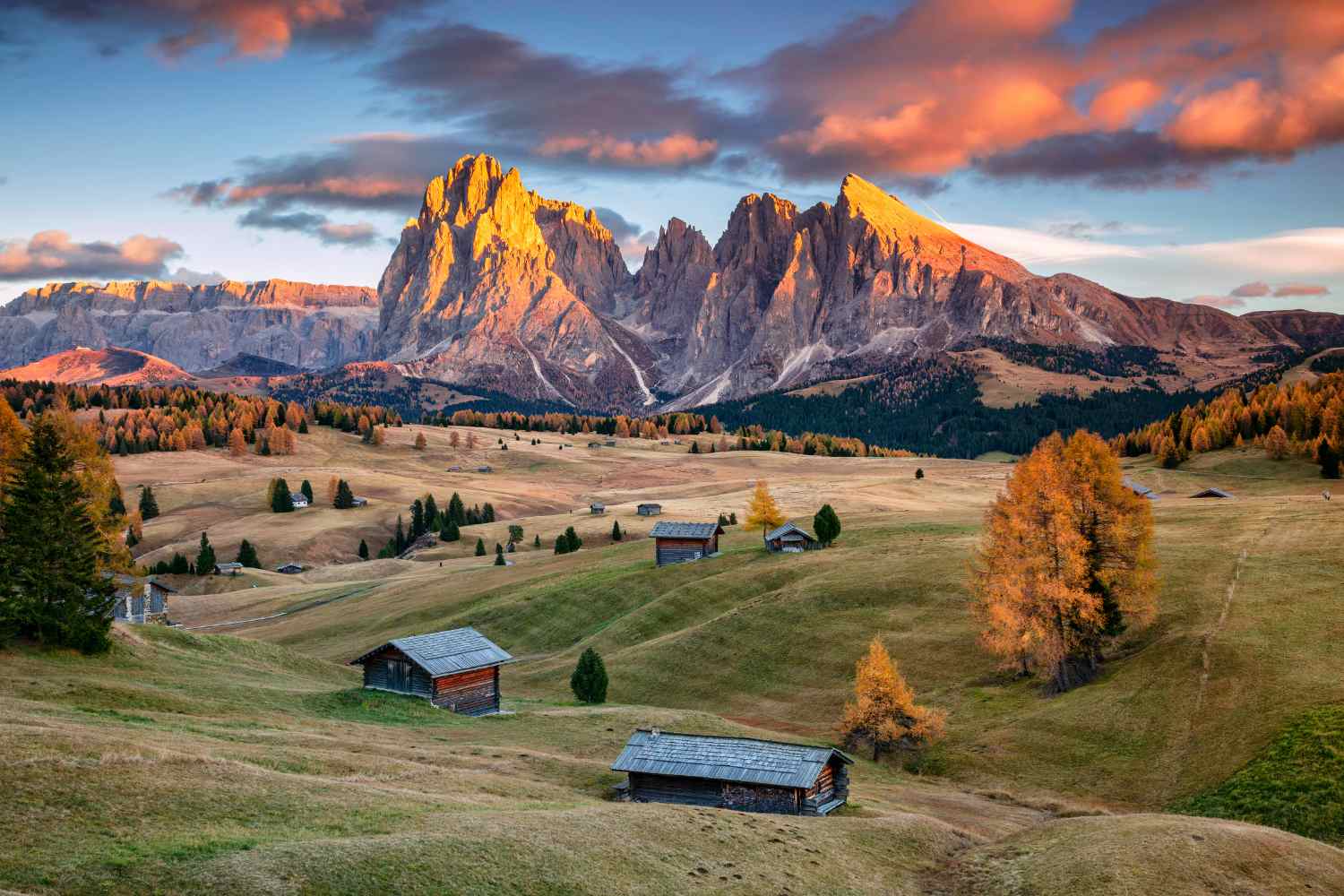
In Val Gardena, in the heart of the South Tyrolean Dolomites, among the larches that change color and the jagged profiles of the peaks, every autumn a natural phenomenon is repeated that attracts enthusiasts and the curious: the so-called Burning Dolomites. Between September and November, when the days get shorter and the air becomes clearer, the mountain walls are tinged with red and orange, as if they were catching fire. It is not an artificial effect or an advertising invention, but a combination of light, geology and season that transforms the Dolomites into a theater of reflections and changing shadows.
Burning Dolomites: where this phenomenon comes from
The phenomenon arises from the encounter between the light of the sunset and the composition of the mountains themselves. The Dolomites owe their color to dolomite, a mineral that reacts in a particular way to the low rays of the sun. When the light arrives almost edge-on, the mineral reflects the warmest wavelengths and the entire wall takes on shades ranging from red to copper. In autumn, then, the atmosphere is more stable, the air more transparent, and the sun sets more rapidly: the combination of these factors amplifies the effect. The vegetation does its part, with the larches turning yellow-gold and intensifying the contrast between forest and rock.
When you can attend the Burning Dolomites
The best time to witness the phenomenon is the window from mid-September to early November. In these weeks the afternoon light is more sparse, the sunsets arrive early and the lower temperatures favor the clarity of the air. In Val Gardena the excursions dedicated to Burning Dolomites they leave in the early afternoon and arrive on panoramic terraces just before the sun touches the peak line. Local guides organize outings that mix walking, naturalistic explanations and a moment’s pause in the refuges to wait for the right light. However, the effect does not always manifest itself in the same way: a mist or a sudden change in humidity is enough to attenuate the color. The experience depends on the weather and the patience of the observer.
Where to admire the Burning Dolomites from
Among the most popular points is the panoramic terrace of Sëurasas, above Santa Cristina, which offers an open view of the Sella group and the Sassolungo. The excursion to Alpe Juac is more challenging, requiring a few hours of climbing but rewarding with a broader and less crowded perspective. The rule is always the same: look for a space facing west or north-west, away from obstacles, and arrive early. The “lighting” of the walls does not last long, often just a few minutes. Those who arrive late find only the fading light before them.
Guided excursions
The Val Gardena Tourist Associations have transformed the Burning Dolomites into a structured autumn event, organizing guided excursions to closely observe the sunsets that color the Dolomites red. Mountain enthusiasts can participate until early November, choosing between two main routes: the one on Tuesday, from Stevia to Alpe Juac, more challenging and about five hours long, and the one on Thursday, towards the panoramic terrace of Sëurasas, of medium difficulty and with a difference in altitude of around 400 metres. The outings are managed by local guides from Val Gardena Active and include accompaniment, light equipment and an aperitif in the hut.
A reality, not a stage effect
The Burning Dolomites it is not a spectacular event in the tourist sense of the term. There are no artificial lights or special effects. It is a natural manifestation linked to the very material of the mountains, to their ability to react to light in a unique way. The tourist institutions of Alto Adige have chosen to enhance it, but without distorting its meaning. It is an invitation to look, not to consume. In an era in which everything must be photographed, the phenomenon retains something authentic: it only happens for a few minutes, not always, and not the same for everyone.
Attend the Burning Dolomites it means accepting a small margin of uncertainty. You walk, you wait, you observe. Sometimes the clouds cover the sun, other times the air is too thick. But when conditions align, the Dolomites really light up. It’s not a miracle, it’s the earth responding to the light. The peaks become coloured, the woods darken, the silence becomes deeper. And for a few minutes the mountain seems to breathe another life.
