
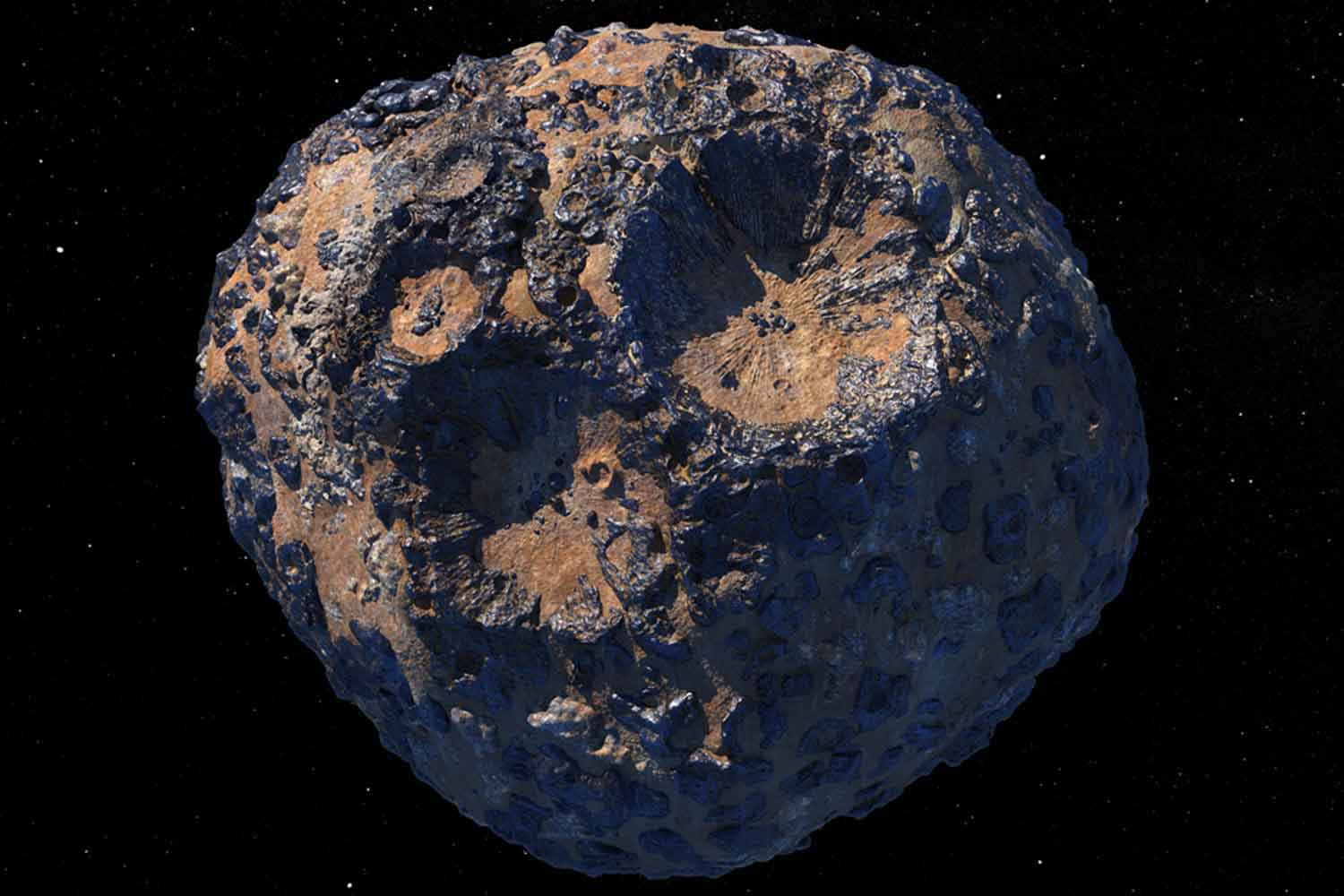
NASA has turned its spotlight on the asteroid 16 Psychea space giant that orbits in the band between Mars and Jupiter. With his beyond 200 kilometers in diameterthis celestial body has captured the attention of scientists not only for its unique metallic compositionbut also for the hypotheses linked to its potential value.
Unlike most asteroids, which are composed mostly of ice or rock, Psyche appears to contain between 30% and 60% metalsincluding iron, nickel and — according to some estimates — significant quantities of gold. Astronomers believe it may be the core of a primitive planetleft exposed after a catastrophic collision billions of years ago.
The NASA mission and the “700 quintillion dollars” myth of Psyche gold
The mission Psyche Mission of NASA has no economic purposes: the objective is exclusively scientific. The probe, which launched in October 2023, will reach the asteroid to analyze it magnetic field, gravity and surface compositionwith the aim of reconstructing the origins of rocky planets and better understanding the history of ours solar system.
Yet, sensationalist estimates and calculations have multiplied around Psyche. Some articles have spoken of a hypothetical value equal to 700 quintillion dollarscalculated by adding the commercial value of iron, nickel, gold and other metals if they were available on the land market. A figure so high that it surpasses any imaginable economy.
Experts clarify, however, that these numbers are highly speculative: we don’t know for sure how much of the asteroid is made up of gold, much less whether it would be possible to extract it. Furthermore, a similar input of precious metals would do prices collapse and it would eliminate any economic estimate.
Space mining: a still distant prospect
Dreaming of extracting metals from asteroids remains, for now, science fiction. The enormous distancesi prohibitive costs and the absence of suitable technologies make it impossible to imagine Psyche as an exploitable mine. Added to this are the legal uncertainties: There is still no clear international framework on who could claim ownership of space resources.
However, the discovery of Psyche fuels a debate that will become increasingly relevant: space as a new frontier of natural resources. Studying it means not only measuring the value of metals, but also collecting fundamental data to understand how the planets were formed and how the Earth developed its internal structure.
A natural laboratory to learn about the past of the planets
Beyond the charm linked to gold, Psyche represents a window on time. Analyzing its surface and composition means observing a primordial fragment that could reveal how the nuclei of planets appeared before collisions and evolution transformed them. In other words, a unique opportunity to study “live” i bricks originating from the solar system.
The Psyche mission, therefore, will not bring gold to Earth or make everyone millionaires, but it will offer invaluable knowledge: a scientific treasure that is much more concrete and long-lasting than any economic evaluation.
